THE CLASSIC COLLECTION✦An outlaw’s diary: the CommuneCLASSIC FREE BOOKS
An outlaw’s diary: the Commune
Cécile Tormay
THE CLASSIC COLLECTION · 1920
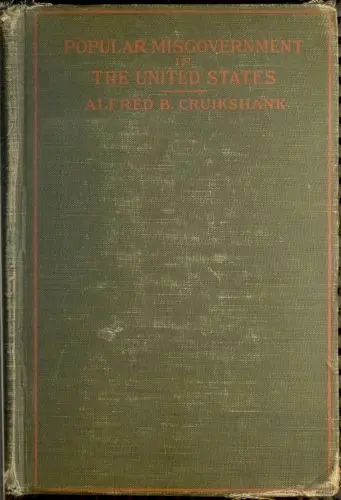
"Popular Misgovernment in the United States" by Alfred Byron Cruikshank is a political critique written in the early 20th century. The work discusses the perceived failures of popular governance in the United States, particularly focusing on the concept of universal suffrage and its implications for political corruption and inefficiency. Cruikshank argues that the unrestricted right to vote has led to the dominance of less qualified individuals in political office, leading to a governance that he views as ineffective and often corrupt. The opening of the book establishes a sense of urgency regarding the state of the American political system, highlighting the perceived threats of radical ideologies like Bolshevism, which he sees as a consequence of the failures of an unqualified electorate. Cruikshank emphasizes that the founding principles of governance should prioritize property ownership and societal contribution as qualifications for voters. He asserts that past political decisions, particularly the adoption of unqualified suffrage, have deteriorated American democracy, leading to governance characterized by inefficiency, corruption, and a disconnect from the virtues of the American foundations.
Introduction adapted from the source catalogue; source summaries may be automatically generated.
Free to read · English · 155,007 words · No account needed
MAKE TIME FOR A GOOD BOOK
On by default. Untick to stop anonymous reading totals. Each page counts after 10 seconds in view. How this works.
Anonymous counting is on unless you have switched it off.
The real difficulty in the case lies then not in ascertaining the source of American political ills, nor in prescribing the remedy; the difficulty lies in obtaining leadership or even advocacy of a movement which to most men appears to promise little in the way of personal advancement and much in the way of hostile criticism. As to the masses in private life, most are indifferent and the remainder voiceless. All the organs of public opinion are muzzled, controlled or terrified into silence by the politicians; and but few in public life whether newspaper men, clergymen, judges, politicians, teachers or public servants or officials; but few of those merely dependent upon or connected with politics or government, whether bankers, lawyers, physicians in hospitals, officers of public utilities or the like, have heretofore dared more than whisper to their closest friends their real hatred of the political despotism under which we are living today in the United States. Now, however, the present menace of the political madness known as Bolshevism affords a new and compelling motive to every true American to arouse himself, and there is a hope that in the presence of a new peril, good citizens may be moved to realize the inherent weakness and danger of our present political system, and to undertake the establishment of a suffrage based upon such qualifications as will insure the creation and continuance of a government in this country so strong, determined, intelligent and devoted to the interests of civilization that under it our whole political life may be purified and made efficient; one which may be relied upon not merely to crush Bolshevism in the United States but to extirpate it from this country forever.
The proposal to establish a property qualification for voters throughout the United States may seem novel and even startling to many Americans, but there is no other way out of the political mess in which we find ourselves. As will be shown in detail in subsequent pages the corrupt rule of the low professional politicians of this country is made secure by the vote of the thriftless and controllable class; until that vote is expurgated there can be no purification of the body politic; without purification there can be no efficiency; and unless the administration of our public affairs is purified and made efficient we cannot either answer the charges of the enemies of our institutions or repel their attacks. We cannot depend upon the electorate as at present made up; it has already shown its capacity to breed and encourage bad government; the thriftless classes are all ready to accept Bolshevism or any other economical and political absurdity; they are no more able to understand the scheme of civilization and the value and importance of accumulations of earnings and creation of property in furtherance of that scheme than they are able to understand a musical symphony or a problem in the higher mathematics. And after all there is nothing sacred about the doctrine of unlimited suffrage; it is only a political experiment like another; and the well known record of its complete and dismal failure is summarized in these pages where it is shown that it has not been an instrument of progress nor a means of freedom, but that its tendency has been and is towards reaction and despotism; that it is anti-social and hostile to civilization. The proposal to make property accumulations the basis of government, though it is sanctioned by ancient practise, is not reactionary; it is progressive, as every return to old and sound principles is progressive. Nor will it create or tend to create a narrow or exclusive electorate; it will on the contrary have a broadening effect and will tend to furnish a truly popular government, one resting directly on the consent and the votes of most of the population, and utilizing qualities of virtue and manhood now denied their proper effect in politics. It will represent directly or indirectly every element of value in the nation; everything on which a democratic government depends for its best support; namely, the industry, thrift, wealth, intelligence, character and honest independence of its people. The change will appear in the overthrow of the rule of brute force and the curbing of the present despotism of numbers. Do what we will, the passions and prejudices of the unthinking and uninstructed will always affect political action; but if our democracy is to survive their power must be checked and modified by associating with the sway of numbers the powers of intelligence, of character, and of industry which working together constitute efficiency.
Your reading position is saved on this browser. Take it to another device with a library code. Reading pages adapt to text, rather than matching a printed edition.
BEHIND THE BOOK
This eBook is for the use of anyone anywhere in the United States and most other parts of the world at no cost and with almost no restrictions whatsoever. You may copy it, give it away or re-use it under the terms of the Project Gutenberg License included with this eBook or online at www.gutenberg.org. If you are not located in the United States, you will have to check the laws of the country where you are located before using this eBook. Read the source licence.
The original source file, including credits and licence, is retained by this library. Request an original-format copy at no charge. Please include the book title and Project Gutenberg identifier #57862.
KEEP YOUR CURIOSITY GOING
Cécile Tormay

Moritz Busch
John L. Ransom
Frances Wright
Cécile Tormay

Mabel Potter Daggett