THE CLASSIC COLLECTION✦An outlaw’s diary: the CommuneCLASSIC FREE BOOKS
An outlaw’s diary: the Commune
Cécile Tormay
THE CLASSIC COLLECTION · 1920
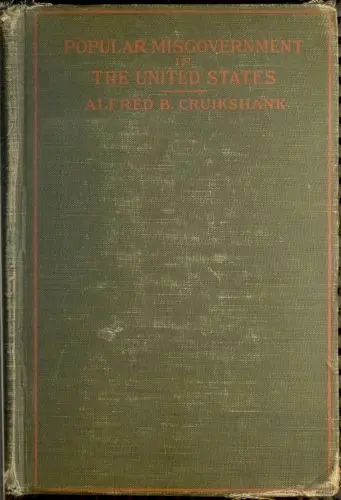
"Popular Misgovernment in the United States" by Alfred Byron Cruikshank is a political critique written in the early 20th century. The work discusses the perceived failures of popular governance in the United States, particularly focusing on the concept of universal suffrage and its implications for political corruption and inefficiency. Cruikshank argues that the unrestricted right to vote has led to the dominance of less qualified individuals in political office, leading to a governance that he views as ineffective and often corrupt. The opening of the book establishes a sense of urgency regarding the state of the American political system, highlighting the perceived threats of radical ideologies like Bolshevism, which he sees as a consequence of the failures of an unqualified electorate. Cruikshank emphasizes that the founding principles of governance should prioritize property ownership and societal contribution as qualifications for voters. He asserts that past political decisions, particularly the adoption of unqualified suffrage, have deteriorated American democracy, leading to governance characterized by inefficiency, corruption, and a disconnect from the virtues of the American foundations.
Introduction adapted from the source catalogue; source summaries may be automatically generated.
Free to read · English · 155,007 words · No account needed
MAKE TIME FOR A GOOD BOOK
On by default. Untick to stop anonymous reading totals. Each page counts after 10 seconds in view. How this works.
Anonymous counting is on unless you have switched it off.
Alabama. In 1819 the State of Alabama began to establish state banks, all of which became insolvent in 1842. To the debt of about $3,500,000 incident to this business, represented by bonds held by innocent holders in London and New York, was added obligations amounting to $21,000,000 incurred in the negro suffrage reconstruction period, elsewhere described. In 1876 the State scaled down the whole debt to $12,574,379, a repudiation, including interest, of about $15,000,000 State debt.
Arkansas. In 1837 and 1838 Arkansas issued about $3,000,000 of bonds in aid of two state banks. Part of this debt was subsequently repudiated. During the reconstruction period about $8,000,000 of state bonds were issued under legislative authority for railroad and levee construction and all were repudiated in 1880, thus reducing the state debt from $17,000,000 principal and interest to about $5,000,000.
Florida. In 1833 the Territory of Florida issued $3,000,000 bonds to the Union Bank, and in 1831 and 1835 $900,000 more to other banks. These obligations were definitely repudiated when Florida entered the Union in 1845. Under an Act passed in 1855, the state issued $4,000,000 bonds in aid of railroad construction; and these also have been repudiated, on the claim that the legislature lacked authority to authorize them.
Georgia. From 1868 to 1871 the State of Georgia issued about $8,000,000 of bonds in aid of railroad construction. In the years 1875, 1876 and 1877 all these bonds were repudiated by state legislation.
Louisiana. The debt of Louisiana at the outbreak of the Civil War was about $10,000,000. The Civil War debt was ignored. Reconstruction legislation brought up the state debt to about $50,000,000. This was scaled down by legislative enactment to $12,000,000 and the rest repudiated.
Mississippi. In June 1838 the State of Mississippi issued $5,000,000 of state bonds in payment of five thousand shares of stock in the Union Bank of Mississippi. Four years later these bonds, then held by innocent third parties, were repudiated by the state, although the highest court in Mississippi had declared that they were legally issued. A similar issue of $2,000,000 of state bonds issued to the Planters Bank was repudiated in 1852. The State of Mississippi has never redeemed its honor or paid the bonds.
North Carolina. In 1879 North Carolina passed a funding bill by which in settlement of a long controversy with its bond-holders it repudiated about $15,000,000 of State indebtedness. Bonds issued before the Civil War were redeemed at fifty cents on the dollar; bonds issued after the war to secure pre-war debts at twenty-five cents; and reconstruction bonds at fifteen cents on the dollar.
South Carolina. South Carolina was in debt about $3,800,000 at the time the Civil War began in 1861. The war debt was repudiated. The reconstruction debt amounted to nobody knows how much, say $20,000,000 and upwards. Nearly all of the state debt was practically repudiated in 1879 and prior thereto.
Your reading position is saved on this browser. Take it to another device with a library code. Reading pages adapt to text, rather than matching a printed edition.
BEHIND THE BOOK
This eBook is for the use of anyone anywhere in the United States and most other parts of the world at no cost and with almost no restrictions whatsoever. You may copy it, give it away or re-use it under the terms of the Project Gutenberg License included with this eBook or online at www.gutenberg.org. If you are not located in the United States, you will have to check the laws of the country where you are located before using this eBook. Read the source licence.
The original source file, including credits and licence, is retained by this library. Request an original-format copy at no charge. Please include the book title and Project Gutenberg identifier #57862.
KEEP YOUR CURIOSITY GOING
Cécile Tormay

Moritz Busch
John L. Ransom
Frances Wright
Cécile Tormay

Mabel Potter Daggett