THE CLASSIC COLLECTION✦An outlaw’s diary: the CommuneCLASSIC FREE BOOKS
An outlaw’s diary: the Commune
Cécile Tormay
THE CLASSIC COLLECTION · 1899
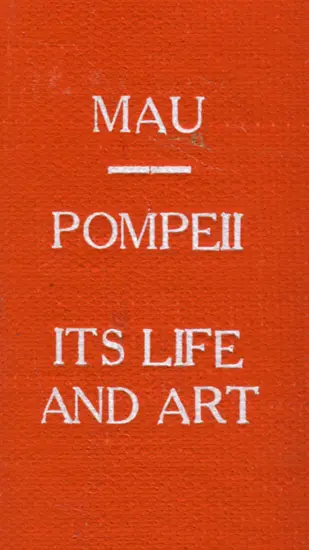
"Pompeii, Its Life and Art" by August Mau is a detailed historical account written in the late 19th century. The book explores the ancient city of Pompeii, focusing on its history, culture, architecture, and art, particularly in the context of its tragic destruction by the eruption of Mount Vesuvius in 79 A.D. The author showcases his extensive research and personal engagement with the archaeological site, offering insights into the rebuilding efforts of its citizens, the lives they led, and the remnants of their civilization. The opening of the work presents a comprehensive introduction to Pompeii's geographical context and historical significance. Mau vividly describes the city's strategic location near Vesuvius and its surrounding fertile landscape, which contributed to its prosperity. He sets the stage for a discussion of Pompeii's urban development prior to the devastating eruption, highlighting essential details about its inhabitants, their cultures, and the eventual transformations they underwent leading up to 79 A.D. Through a careful examination of evidence from the excavation of the city, the opening frames an essential understanding of Pompeii's vibrant life before its destruction, preparing readers for a deeper exploration of the archaeological findings that follow.
Introduction adapted from the source catalogue; source summaries may be automatically generated.
Free to read · English · 177,872 words · No account needed
MAKE TIME FOR A GOOD BOOK
On by default. Untick to stop anonymous reading totals. Each page counts after 10 seconds in view. How this works.
Anonymous counting is on unless you have switched it off.
Of the paintings in general: the paintings discovered prior to 1868 are described, with references to the literature, by W. HELBIG, Wandgemaelde der vom Vesuv verschuetteten Staedte Campaniens (Nebst einer Abhandlung ueber die antiken Wandmalereien in Technischer Beziehung, von Otto Donner, Leipzig, 1868); those discovered after the publication of Helbig's work and before 1880, by A. SOGLIANO, Le pitture murali Campane scoverte negli anni 1867-1879 (supplemento all' opera dell' Helbig, Naples, 1879. Published also in the volume, Pompei e la regione sotterrata dal Vesuvio, for which see p. 513); those that have come to light since 1879 are described by MAU in his reports (see note to Chap. IV) and in the Notizie degli scavi; cf. also HELBIG, Untersuchungen ueber die campanische Wandmalerei (Leipzig, 1873). Besides the reproductions of paintings by ZAHN and NICCOLINI mentioned above (p. 544), the more important examples are published in the Real Museo Borbonico (see Index at the end of vol. 16, pp. 37-58); ROUX, Herculanum et Pompei, vols. 1-5 (Paris, 1840); ROCHETTE, Choix de peintures de Pompei, la plupart de sujet historique (lithographiees en couleur par M. Roux, et publiees ... par M. Raoul-Rochette; 7 livraisons in fol., Paris, 1844-1853, incomplete); PRESUHN, Pompeji, Die neuesten Ausgrabungen von 1874 bis 1881 (Edit. 2, Leipzig, 1882; 80 chromolithograph plates); and in other works the titles of which are easily accessible in Furchheim's Bibliografia. The colored plates presented by A. NICCOLINI, Arte Pompeiana Monumenti scelti (a selection of 55 plates from the larger work, Naples, 1888), give a false idea of the paintings reproduced.
No evidence of development in composition or technique [p. 471]: cf. WICKHOFF, Roman Art, pp. 139 ff.
Hercules and Antaeus [p. 472]: Bull. dell' Inst., 1876, p. 101; SOGLIANO, Le pitture murali Campane, no. 495.
Mosaic pictures on the floor [p. 472]: as in the house of the Faun; see references on p. 533. For the Pompeian mosaics in general, see Gli ornati delle pareti ed i pavimenti delle stanze dell' antica Pompei, 3 vols. Naples, 1796-1808, vols. 1 and 2; Museo Borb., Index at the end of vol. 16, pp. 35-37; ROUX, Herculanum et Pompei, vol. 5 (latter part, 32 plates).
Group of Admetus and Alcestis in architectural framework [p. 473]: SOGLIANO, op. cit., no. 506.
Seafights [p. 474]: HELBIG, Wandgemaelde, nos. 1576-1580 (those of the Macellum are shown in a colored plate by MAZOIS, Les ruines de Pompei, vol. 3, pl. 46); Roem. Mitth., vol. 11 (1896), p. 56, nos. 113-116, and SOGLIANO, Mon. dei Lincei, vol. 8 (1898), p. 310, fig. 33; cf. also SOGLIANO op. cit., nos. 669-670.
Xenia [p. 474]: Vitr. VI. VII (X) 4; HELBIG, Wandegemaelde, nos.
1661-1718. For fig. 266 cf. Museo Borb., vol. 6, pl. 38; HELBIG, no.
1690.
Landscapes [p. 475]: ROUX, Herculanum et Pompei, vol. 3 (end; 30
plates); HELBIG, Wandgemaelde, pp. 385-394; SOGLIANO, op. cit., pp.
141-144.
Your reading position is saved on this browser. Take it to another device with a library code. Reading pages adapt to text, rather than matching a printed edition.
BEHIND THE BOOK
This eBook is for the use of anyone anywhere in the United States and most other parts of the world at no cost and with almost no restrictions whatsoever. You may copy it, give it away or re-use it under the terms of the Project Gutenberg License included with this eBook or online at www.gutenberg.org. If you are not located in the United States, you will have to check the laws of the country where you are located before using this eBook. Read the source licence.
The original source file, including credits and licence, is retained by this library. Request an original-format copy at no charge. Please include the book title and Project Gutenberg identifier #42715.
KEEP YOUR CURIOSITY GOING
Cécile Tormay

Moritz Busch
John L. Ransom
Frances Wright
Cécile Tormay

Mabel Potter Daggett