THE CLASSIC COLLECTION✦An outlaw’s diary: the CommuneCLASSIC FREE BOOKS
An outlaw’s diary: the Commune
Cécile Tormay
THE CLASSIC COLLECTION · 1899
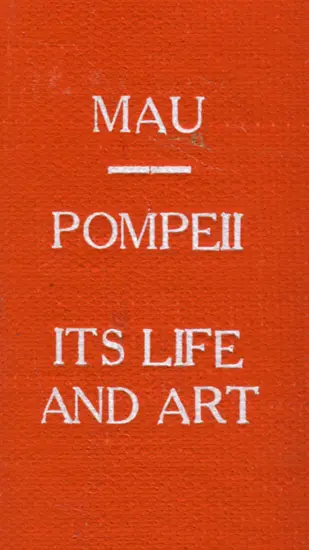
"Pompeii, Its Life and Art" by August Mau is a detailed historical account written in the late 19th century. The book explores the ancient city of Pompeii, focusing on its history, culture, architecture, and art, particularly in the context of its tragic destruction by the eruption of Mount Vesuvius in 79 A.D. The author showcases his extensive research and personal engagement with the archaeological site, offering insights into the rebuilding efforts of its citizens, the lives they led, and the remnants of their civilization. The opening of the work presents a comprehensive introduction to Pompeii's geographical context and historical significance. Mau vividly describes the city's strategic location near Vesuvius and its surrounding fertile landscape, which contributed to its prosperity. He sets the stage for a discussion of Pompeii's urban development prior to the devastating eruption, highlighting essential details about its inhabitants, their cultures, and the eventual transformations they underwent leading up to 79 A.D. Through a careful examination of evidence from the excavation of the city, the opening frames an essential understanding of Pompeii's vibrant life before its destruction, preparing readers for a deeper exploration of the archaeological findings that follow.
Introduction adapted from the source catalogue; source summaries may be automatically generated.
Free to read · English · 177,872 words · No account needed
MAKE TIME FOR A GOOD BOOK
On by default. Untick to stop anonymous reading totals. Each page counts after 10 seconds in view. How this works.
Anonymous counting is on unless you have switched it off.
Technique of Pompeian painting: DONNER, Die erhaltenen antiken Wandmalereien in technischer Beziehung, printed as an introduction to Helbig's Wandgemaelde (see Chap. LV.), pp. I--CXXVII; MAU, Geschichte der decorativen Wandmalerei in Pompeji (Berlin, 1882; with atlas of 20 plates).
Specimen illustrations: Many entire walls as well as single paintings are reproduced in color in the extensive works by ZAHN, Die schoensten Ornamente und merkwuerdigsten Gemaelde aus Pompeji, Herkulanum und Stabiae, nebst einigen Grundrissen und Ansichten (Mit deutschem und franzoesischem Text. Drei Abtheilungen in 30 Heften, 302 Tafeln. Berlin, 1827-1859); and NICCOLINI, Le case ed i monumenti di Pompei designati e descritti (Naples, 1854-1901). Both works are rarely found complete, and the plates of the second in particular leave much to be desired in respect to drawing as well as coloring; it has therefore been thought best not to encumber these notes with detailed references to them. A number of walls are shown also by ROUX, Herculanum et Pompei (8 vols., Paris, 1840), vol. 1 (108 plates), and by D'AMELIO, Dipinti Murali di Pompei, Naples, 1888. Professor Mau has in preparation a new work on wall decoration which will be illustrated by colored plates similar to those in the atlas to his Wandmalerei. The sources of the illustrations in this and the following chapter are given in our List of Illustrations, p. xxv.
Preparation of the wall [p. 456]: Vitr. VII. III; cf. also
MIDDLETON, The Remains of Ancient Rome (2 vols. London, 1892), vol. 1,
pp. 91-103.
Decoration of the house of Lucretius [p. 457]: see references on p.
528.
The four styles of decoration [p. 457]: suggestive critical comments by WICKHOFF, Roman Art (English trans. by Mrs. S. Arthur Strong, London, 1900), pp. 117 ff.; but see the review of the German original by Mau, Roem. Mitth., vol. 10 (1895), pp. 227-235.
Decoration of the second style in Rome [p. 462]--house of Germanicus on the Palatine: MAU, Due pareti d'una stanza sul Palatino, Ann. dell' Inst., vol. 52 (1880), pp. 136-149, and Mon. dell' Inst., vol. 11, pl. 22-23; MAU, Geschichte der dec. Wandmalerei, pp. 196-205 and pl. 9. House in the Farnesina garden: Not. d. Scavi, 1879, pp. 15, 40, 68, 114, 141, 179-180, 267, 314, 333, 1880, pp. 32, 127-128, 138-140, and pl. 4 (plan); MAU, Parete dipinta della casa antica scoperta nel giardino della Farnesina, Ann. dell' Inst., vol. 54 (1882), pp. 301-308; HUeLSEN, Fregio dipinta nella casa antica scoperta nel giardino della Farnesina, ibid., pp. 309-314; MAU, Pitture della casa antica scoperta nella villa Farnesina, Ann. dell' Inst., vol. 56 (1884), pp. 307-322, vol. 57 (1885), pp. 302-318; Mon. dell' Inst., vol. 11, pl. 44-48, vol. 12, pl. 5, 5 a, 7, 7 a, 8, 17-34; Supplemento (1891), pl. 32-36; especially LESSING and MAU, Wand- und Deckenschmuck eines roemischen Hauses aus der Zeit des Augustus (Berlin, 1891; with 16 plates from the same blocks as those in the Mon. dell' Inst.); HELBIG, Fuehrer durch die Sammlungen klassischer Altertuemer in Rom, vol. 2, pp. 226-223, nos. 1107-1108, 1119-1122, 1124, 1129-1136, 1141-1144, 1146-1148, 1151.
Your reading position is saved on this browser. Take it to another device with a library code. Reading pages adapt to text, rather than matching a printed edition.
BEHIND THE BOOK
This eBook is for the use of anyone anywhere in the United States and most other parts of the world at no cost and with almost no restrictions whatsoever. You may copy it, give it away or re-use it under the terms of the Project Gutenberg License included with this eBook or online at www.gutenberg.org. If you are not located in the United States, you will have to check the laws of the country where you are located before using this eBook. Read the source licence.
The original source file, including credits and licence, is retained by this library. Request an original-format copy at no charge. Please include the book title and Project Gutenberg identifier #42715.
KEEP YOUR CURIOSITY GOING
Cécile Tormay

Moritz Busch
John L. Ransom
Frances Wright
Cécile Tormay

Mabel Potter Daggett