
Switch off
Oliver Optic
THE CLASSIC COLLECTION · 1898
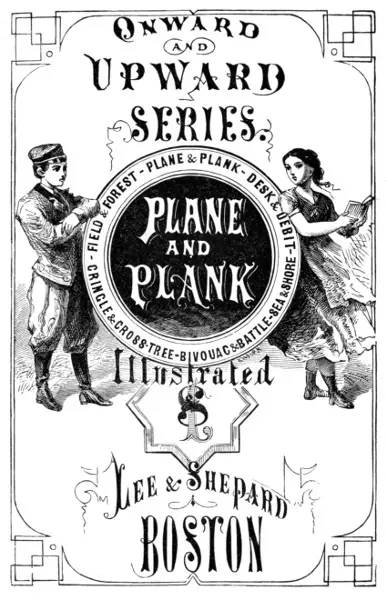
"Plane and Plank; or, The Mishaps of a Mechanic" by Oliver Optic is a novel written in the late 19th century. The story revolves around Phil Farringford, a young mechanic navigating the challenges of his trade and the society around him while exploring themes such as personal growth, morality, and the impact of intemperance. Set against the backdrop of the Missouri River and St. Louis, the book delves into Phil's aspirations to master carpentry while facing obstacles that reflect broader social issues. The opening of the narrative introduces Phil Farringford as he travels on a steamboat along the Missouri River, filled with curiosity and determination to learn a trade. Engaging in conversation with Mr. Gracewood, Phil expresses his desire to become a mechanic, showing both excitement and trepidation about his future. Upon arriving in St. Louis, he encounters Mr. Leonidas Lynchpinne, who initially appears friendly but ultimately tricks him into losing his money during a gambling incident. This initial mishap sets the stage for Phil’s journey as he navigates the complexities of life as a mechanic, setting a tone for the challenges and moral lessons that will unfold throughout the story.
Introduction adapted from the source catalogue; source summaries may be automatically generated.
Free to read · English · 55,862 words · No account needed
MAKE TIME FOR A GOOD BOOK
On by default. Untick to stop anonymous reading totals. Each page counts after 10 seconds in view. How this works.
Anonymous counting is on unless you have switched it off.
The demonstration was not a feint, either. I felt an utter contempt for Lynch, and, now that I realized his rascality, for Morgan Blair. I had fought the savage Indians in the forest, which had developed my courage, if nothing more. I glanced around the room, and saw at the grate an iron poker, with which I thought I might neutralize the odds against me, in case the interview resulted in anything more dangerous to life and health than mere words. The letter, in its postscript, as though it had been an afterthought, requested me to bring Mr. Gracewood's note. Blair had asked me to give it up to him. I was inclined to think that the parties before me wanted this note, though I could not imagine what earthly use it could be to them.
"You need not call me by that name any longer," added Lynch, biting his lip, and evidently vexed to find that I was not intimidated by my situation.
"As you gave me the name of Leonidas Lynchpinne, I shall consult my own inclination, rather than yours, in the use of it."
"You will change your tune before you are an hour older, Phil."
"If I do I shall take the pitch from you."
"You are here at my summons, my lad."
"I see now that I am; brought here by a lie and a swindle, which seem
be your stock in trade."
"Don't be impudent, Phil."
"If you speak to me like a gentleman, I will answer you in the same way. You need not put on airs."
"I have business with you, Phil."
"I have no business with you; and I respectfully decline having anything whatever to do with you."
"Your declination is not accepted. I want to tell you that I never forget a friend or forgive an enemy."
"I have fought Indians before, and though I don't like the business, I
can do it again."
"Do you call that talking like a gentleman, Phil?"
"No gentleman ever utters an Indian sentiment."
"You are in my power, Phil, and you had better come down from that high
horse."
"I'm not in your power, and never shall be till I become a thief, a blackleg, and a swindler," I replied, calmly, as I glanced at Morgan Blair, who, I thought, was completely in his power.
"What!" exclaimed Lynch, springing to his feet, his face red with anger.
I fell back two or three steps, and quietly took up the poker, which rested against the bracket at the side of the grate.
"What are you going to do with that?" demanded he.
"That will depend upon circumstances."
"Drop that poker!"
Your reading position is saved on this browser. Take it to another device with a library code. Reading pages adapt to text, rather than matching a printed edition.
BEHIND THE BOOK
This eBook is for the use of anyone anywhere in the United States and most other parts of the world at no cost and with almost no restrictions whatsoever. You may copy it, give it away or re-use it under the terms of the Project Gutenberg License included with this eBook or online at www.gutenberg.org. If you are not located in the United States, you will have to check the laws of the country where you are located before using this eBook. Read the source licence.
The original source file, including credits and licence, is retained by this library. Request an original-format copy at no charge. Please include the book title and Project Gutenberg identifier #44950.
KEEP YOUR CURIOSITY GOING
Coulson Kernahan

Maurice Baring
Frances Wright
Cécile Tormay

Frederic Jesup Stimson

W. H. P. (William Henry Pope) Jarvis
