
Switch off
Oliver Optic
THE CLASSIC COLLECTION · 1898
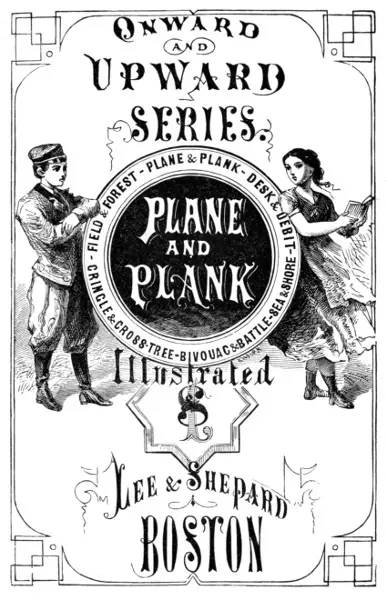
"Plane and Plank; or, The Mishaps of a Mechanic" by Oliver Optic is a novel written in the late 19th century. The story revolves around Phil Farringford, a young mechanic navigating the challenges of his trade and the society around him while exploring themes such as personal growth, morality, and the impact of intemperance. Set against the backdrop of the Missouri River and St. Louis, the book delves into Phil's aspirations to master carpentry while facing obstacles that reflect broader social issues. The opening of the narrative introduces Phil Farringford as he travels on a steamboat along the Missouri River, filled with curiosity and determination to learn a trade. Engaging in conversation with Mr. Gracewood, Phil expresses his desire to become a mechanic, showing both excitement and trepidation about his future. Upon arriving in St. Louis, he encounters Mr. Leonidas Lynchpinne, who initially appears friendly but ultimately tricks him into losing his money during a gambling incident. This initial mishap sets the stage for Phil’s journey as he navigates the complexities of life as a mechanic, setting a tone for the challenges and moral lessons that will unfold throughout the story.
Introduction adapted from the source catalogue; source summaries may be automatically generated.
Free to read · English · 55,862 words · No account needed
MAKE TIME FOR A GOOD BOOK
On by default. Untick to stop anonymous reading totals. Each page counts after 10 seconds in view. How this works.
Anonymous counting is on unless you have switched it off.
I repeat that I was startled when I saw the gentleman in the room with the open door. He was the very image of Matt Rockwood, who had taken me from the cold waters of the upper Missouri, and brought me up in his log cabin. Of course I could not believe it was old Matt, for I had seen him fall before the rifle-shot of the Indian, and had wept bitterly over his grave when his remains were committed to the earth.
The gentleman before me was dressed better than old Matt ever clothed himself; but his face was as brown from exposure, and his brow as deeply indented with wrinkles. If I had not known that my foster-father was dead, I should have been willing to declare, at the first glance, that this gentleman was he.
"What do you want, young man?" said he, as I paused rather longer that politeness would tolerate before his door.
His voice was that of Matt Rockwood; and, as I do not care to prolong a sensation, I at once jumped to the conclusion that the person before me was the brother of my foster-father, though Morgan Blair had assured me that he also was in his grave.
"If you please, sir, I would like to speak to you," I replied to his
question.
"Come in," he added, laying aside his newspaper. "What is your business
with me?"
I entered the room, which was a parlor, and from it a bedroom opened on one side. The apartments were very handsomely furnished, and as the gentleman before me was very well dressed, I concluded that fortune had dealt more kindly with him than with Matt.
"Are you Mr. Rockwood?" I asked, gazing earnestly at him.
"I am."
"Mr. Mark Rockwood?"
"Yes."
"You had a brother, sir?"
"I had."
"And a sister?"
"No; or rather I had two, but both of them died in their childhood," he replied, evidently astonished at my line of questions.
He had no sister, and Morgan Blair's story, as I had suspected after I found him in the company of Lynch, was all a fiction.
"Have you heard from your brother within a few years?" I inquired.
"Not for twenty years. But who are you, young man?" he demanded, evidently supposing that I had known his brother.
At this moment the waiter of whom I had inquired for Mr. Rockwood appeared before the door and looked in.
"What do you want, John?" asked the old gentleman.
"Nothing, sir; the young man with you inquired for your room, and I came to see if he found you," replied the servant, retiring.
Your reading position is saved on this browser. Take it to another device with a library code. Reading pages adapt to text, rather than matching a printed edition.
BEHIND THE BOOK
This eBook is for the use of anyone anywhere in the United States and most other parts of the world at no cost and with almost no restrictions whatsoever. You may copy it, give it away or re-use it under the terms of the Project Gutenberg License included with this eBook or online at www.gutenberg.org. If you are not located in the United States, you will have to check the laws of the country where you are located before using this eBook. Read the source licence.
The original source file, including credits and licence, is retained by this library. Request an original-format copy at no charge. Please include the book title and Project Gutenberg identifier #44950.
KEEP YOUR CURIOSITY GOING
Coulson Kernahan

Maurice Baring
Frances Wright
Cécile Tormay

Frederic Jesup Stimson

W. H. P. (William Henry Pope) Jarvis
