
Switch off
Oliver Optic
THE CLASSIC COLLECTION · 1898
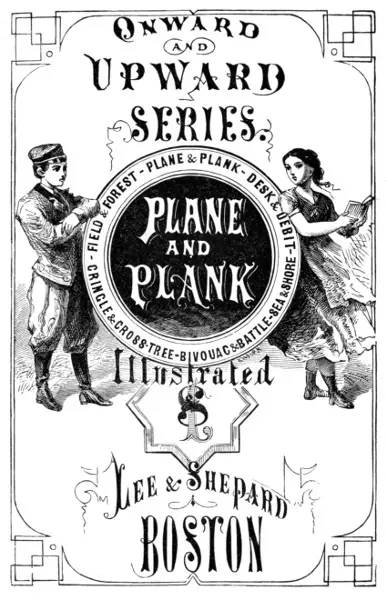
"Plane and Plank; or, The Mishaps of a Mechanic" by Oliver Optic is a novel written in the late 19th century. The story revolves around Phil Farringford, a young mechanic navigating the challenges of his trade and the society around him while exploring themes such as personal growth, morality, and the impact of intemperance. Set against the backdrop of the Missouri River and St. Louis, the book delves into Phil's aspirations to master carpentry while facing obstacles that reflect broader social issues. The opening of the narrative introduces Phil Farringford as he travels on a steamboat along the Missouri River, filled with curiosity and determination to learn a trade. Engaging in conversation with Mr. Gracewood, Phil expresses his desire to become a mechanic, showing both excitement and trepidation about his future. Upon arriving in St. Louis, he encounters Mr. Leonidas Lynchpinne, who initially appears friendly but ultimately tricks him into losing his money during a gambling incident. This initial mishap sets the stage for Phil’s journey as he navigates the complexities of life as a mechanic, setting a tone for the challenges and moral lessons that will unfold throughout the story.
Introduction adapted from the source catalogue; source summaries may be automatically generated.
Free to read · English · 55,862 words · No account needed
MAKE TIME FOR A GOOD BOOK
On by default. Untick to stop anonymous reading totals. Each page counts after 10 seconds in view. How this works.
Anonymous counting is on unless you have switched it off.
I felt that I could afford to lose sixty-five dollars better than ever before; but I did not like the idea of being swindled. It was especially repugnant to be overreached by such scoundrels as Lynch and Blair, though the latter appeared to be only the tool of the former.
"I did not like to give the man the money, but your father thought that, as he was a policeman, it was all right," Mrs. Greenough explained. "Your father was very much worried when he heard you were arrested."
"I have not been arrested," I replied.
"Your father wishes to see you," added the landlady.
"I will go up with you, if you please," said Mr. Rockwood.
We went up to my father's room, where I introduced my new friend to him. It required some time, of course, to explain who and what the planter was, and how I had made his acquaintance.
"Then you have not been arrested," said my father.
"No; but I was kept a prisoner by these scoundrels."
"We must attend to them," added Mr. Rockwood, consulting his watch.
"Dear me! there is the door-bell again!" exclaimed Mrs. Greenough. "Who can it be at this time of night!"
"It is only half past nine," added the planter, as I took a light to answer the bell. "I think Mrs. Greenough had better go to the door, for I don't believe these scoundrels will be satisfied with sixty-five dollars."
At this suggestion Mrs. Greenough answered the summons, and soon returned with another note--from me! I opened it, and read that I had been arrested in connection with the claim of Morgan Blair, and that when the police sergeant heard there was a note, which represented the property claimed, in my possession, he thought it was better to have it deposited with the chief of police for safe keeping.
"These fellows evidently think you have not yet returned to your home,
Phil," said Mr. Rockwood.
"I don't blame them much for thinking so, for I expected to stay on those roofs all night; and I think I should if you had not been so wise as to put a hotel in the block," I replied.
"The man asked if Phil was at home before he gave me the note," said the landlady, "and I evaded the question."
"What shall we do?" asked my father, raising himself in the bed.
"Phil and I will pay a visit to these rascals," answered the planter.
"Have you an envelope?"
"Yes," I replied, producing one, with some paper.
He folded up a sheet of paper, put it in the envelope, and requested the landlady to direct it to the chief of police.
Your reading position is saved on this browser. Take it to another device with a library code. Reading pages adapt to text, rather than matching a printed edition.
BEHIND THE BOOK
This eBook is for the use of anyone anywhere in the United States and most other parts of the world at no cost and with almost no restrictions whatsoever. You may copy it, give it away or re-use it under the terms of the Project Gutenberg License included with this eBook or online at www.gutenberg.org. If you are not located in the United States, you will have to check the laws of the country where you are located before using this eBook. Read the source licence.
The original source file, including credits and licence, is retained by this library. Request an original-format copy at no charge. Please include the book title and Project Gutenberg identifier #44950.
KEEP YOUR CURIOSITY GOING
Coulson Kernahan

Maurice Baring
Frances Wright
Cécile Tormay

Frederic Jesup Stimson

W. H. P. (William Henry Pope) Jarvis
