
Switch off
Oliver Optic
THE CLASSIC COLLECTION · 1898
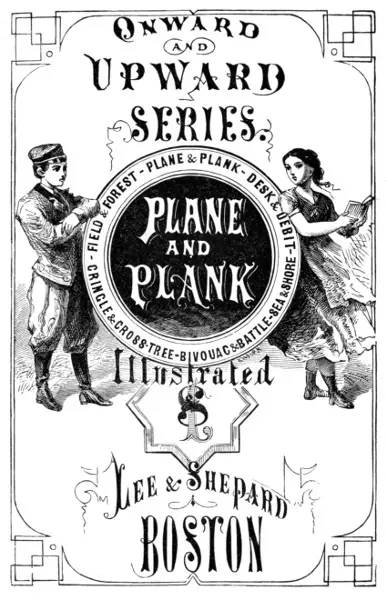
"Plane and Plank; or, The Mishaps of a Mechanic" by Oliver Optic is a novel written in the late 19th century. The story revolves around Phil Farringford, a young mechanic navigating the challenges of his trade and the society around him while exploring themes such as personal growth, morality, and the impact of intemperance. Set against the backdrop of the Missouri River and St. Louis, the book delves into Phil's aspirations to master carpentry while facing obstacles that reflect broader social issues. The opening of the narrative introduces Phil Farringford as he travels on a steamboat along the Missouri River, filled with curiosity and determination to learn a trade. Engaging in conversation with Mr. Gracewood, Phil expresses his desire to become a mechanic, showing both excitement and trepidation about his future. Upon arriving in St. Louis, he encounters Mr. Leonidas Lynchpinne, who initially appears friendly but ultimately tricks him into losing his money during a gambling incident. This initial mishap sets the stage for Phil’s journey as he navigates the complexities of life as a mechanic, setting a tone for the challenges and moral lessons that will unfold throughout the story.
Introduction adapted from the source catalogue; source summaries may be automatically generated.
Free to read · English · 55,862 words · No account needed
MAKE TIME FOR A GOOD BOOK
On by default. Untick to stop anonymous reading totals. Each page counts after 10 seconds in view. How this works.
Anonymous counting is on unless you have switched it off.
"You don't mean to say that Farringford here, whom everybody in St. Louis knows, is your father--do you?" continued Mr. Gray, apparently amazed at the absurdity of the proposition, while his friend and the sergeant laughed heartily.
"That is precisely what I mean to say," I replied, in the most
determined tone.
Farringford shook his head, and was apparently sorry that I had turned out to be such an abominable liar.
"What is your name?" inquired the sergeant.
"Philip Farringford."
I had taken especial pains not to give my full name to my father when he questioned me, and he doubtless supposed that I had invented the name for the occasion. He looked at me, and shook his head. Very likely, by this time, he was willing to believe I had deceived him, and that I had lost no money, for if I could lie about one thing I could about another.
"Do you justify this young man in calling you his father, Farringford?"
said Mr. Gray.
"I am sorry to say I cannot. Gentlemen, I have endeavored to act in good faith," replied my father. "I have always found that the truth would serve me better than falsehood."
"Did you call him your son?"
"I did, but used the expression as a kind of harmless fib to carry my purpose with this Lynch, who had robbed the boy of nearly a hundred dollars."
"It is false!" exclaimed Lynch.
"Keep cool, if you please, sir," interposed the sergeant. "We have heard your story, and now we will hear the other side."
"Philip may have deceived me, but I believed that he had been robbed, and I did the best I could to get his money back, after he had pointed out to me the man who took it from him. Certainly he is not my son. I never saw him till yesterday; and I am sorry he has thought it necessary to repeat my fib, or falsehood, if you please," continued Farringford.
"Nevertheless, I hope I shall be able to prove in due time that he is
my father," I added.
"But, my lad, everybody knows that Farringford has no children," said
Mr. Gray.
"Never mind that now. I want to know whether any robbery has been committed," interposed the sergeant, impatiently.
"Let the boy tell his own story," replied Mr. Gray.
"Here is Lynch's purse," I began, handing it to the sergeant.
"Then you did take these things from him?"
"I did; but he told me to put my hand in his pocket and take out the
pocket-book and the purse."
"Very probable!" sneered Lynch.
"It's all true," said Farringford.
"Well, go on, young man."
Your reading position is saved on this browser. Take it to another device with a library code. Reading pages adapt to text, rather than matching a printed edition.
BEHIND THE BOOK
This eBook is for the use of anyone anywhere in the United States and most other parts of the world at no cost and with almost no restrictions whatsoever. You may copy it, give it away or re-use it under the terms of the Project Gutenberg License included with this eBook or online at www.gutenberg.org. If you are not located in the United States, you will have to check the laws of the country where you are located before using this eBook. Read the source licence.
The original source file, including credits and licence, is retained by this library. Request an original-format copy at no charge. Please include the book title and Project Gutenberg identifier #44950.
KEEP YOUR CURIOSITY GOING
Coulson Kernahan

Maurice Baring
Frances Wright
Cécile Tormay

Frederic Jesup Stimson

W. H. P. (William Henry Pope) Jarvis
