
Switch off
Oliver Optic
THE CLASSIC COLLECTION · 1898
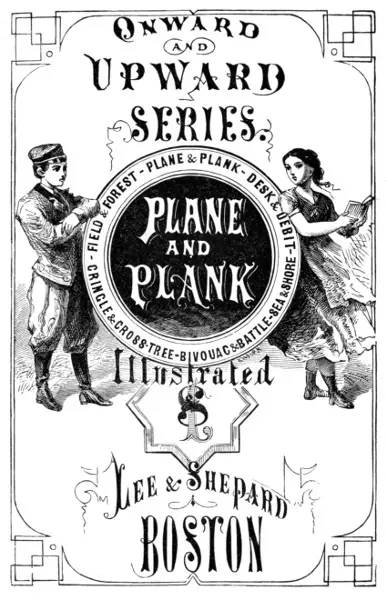
"Plane and Plank; or, The Mishaps of a Mechanic" by Oliver Optic is a novel written in the late 19th century. The story revolves around Phil Farringford, a young mechanic navigating the challenges of his trade and the society around him while exploring themes such as personal growth, morality, and the impact of intemperance. Set against the backdrop of the Missouri River and St. Louis, the book delves into Phil's aspirations to master carpentry while facing obstacles that reflect broader social issues. The opening of the narrative introduces Phil Farringford as he travels on a steamboat along the Missouri River, filled with curiosity and determination to learn a trade. Engaging in conversation with Mr. Gracewood, Phil expresses his desire to become a mechanic, showing both excitement and trepidation about his future. Upon arriving in St. Louis, he encounters Mr. Leonidas Lynchpinne, who initially appears friendly but ultimately tricks him into losing his money during a gambling incident. This initial mishap sets the stage for Phil’s journey as he navigates the complexities of life as a mechanic, setting a tone for the challenges and moral lessons that will unfold throughout the story.
Introduction adapted from the source catalogue; source summaries may be automatically generated.
Free to read · English · 55,862 words · No account needed
MAKE TIME FOR A GOOD BOOK
On by default. Untick to stop anonymous reading totals. Each page counts after 10 seconds in view. How this works.
Anonymous counting is on unless you have switched it off.
"But this is the place where we shall sleep. A friend of mine lets out some rooms here to lodgers. We can sleep here for fifty cents each, and it would cost a dollar at the hotel."
"All right; you engage a room for both of us."
"But come up. If you should want to go to bed before I am ready to come in, you won't be able to find your room, if you don't go and look at it now."
I thought we were wasting more time in debating the matter than it would take for me to look at the chamber, and I followed him up the stairs. We entered the building, which was of considerable dimensions. I groped my way, after my friend, through long entries, which were not lighted, until, after turning two corners, he halted and knocked.
"Who's there?" called a voice from within.
"Lynch," replied my guide. "Lynch is the short of Lynchpinne," he added
to me.
"Come in!"
I heard the springing of a bolt on the door before it was opened.
"Go in, Phil," said my companion, placing himself behind me, and gently forcing me into the apartment.
The room was not more than twelve feet square.
The only furniture it contained was a chair and a small toilet-table. The former was placed in one corner, and the latter directly in front of it.
"Is there to be a prayer-meeting this evening?" asked Mr. Lynchpinne of the man who sat behind the table.
"Of course."
"At what time?"
"Half past seven. What have you there?" continued the man behind the
table.
"A dove who has the yellow."
"Right; we will begin the meeting now then," added the man, producing a little silver box, open on one side, so that I could see it contained a pack of cards.
This was the first intimation I had that anything was wrong. The sight of the cards roused my suspicions, as well they might. I had heard the snap of the bolt as the man locked the door when we entered. I looked about me, and discovered that there were no windows in the room, though there was another door besides that by which we had entered.
"Put that up," said Mr. Lynchpinne. "You know that I never gamble."
"I thought you wanted to open the meeting."
"I don't know what you mean," added my companion, who certainly looked
very innocent.
"O, you don't!"
"Of course I don't. My young friend and I must stay in town over night, and we want a room. Have you any left, Redwood?"
"Not a room."
"Can't you find one?" persisted my friend.
Your reading position is saved on this browser. Take it to another device with a library code. Reading pages adapt to text, rather than matching a printed edition.
BEHIND THE BOOK
This eBook is for the use of anyone anywhere in the United States and most other parts of the world at no cost and with almost no restrictions whatsoever. You may copy it, give it away or re-use it under the terms of the Project Gutenberg License included with this eBook or online at www.gutenberg.org. If you are not located in the United States, you will have to check the laws of the country where you are located before using this eBook. Read the source licence.
The original source file, including credits and licence, is retained by this library. Request an original-format copy at no charge. Please include the book title and Project Gutenberg identifier #44950.
KEEP YOUR CURIOSITY GOING
Coulson Kernahan

Maurice Baring
Frances Wright
Cécile Tormay

Frederic Jesup Stimson

W. H. P. (William Henry Pope) Jarvis
