Practical Boat-Sailing: A Concise and Simple Treatise
Douglas Frazar
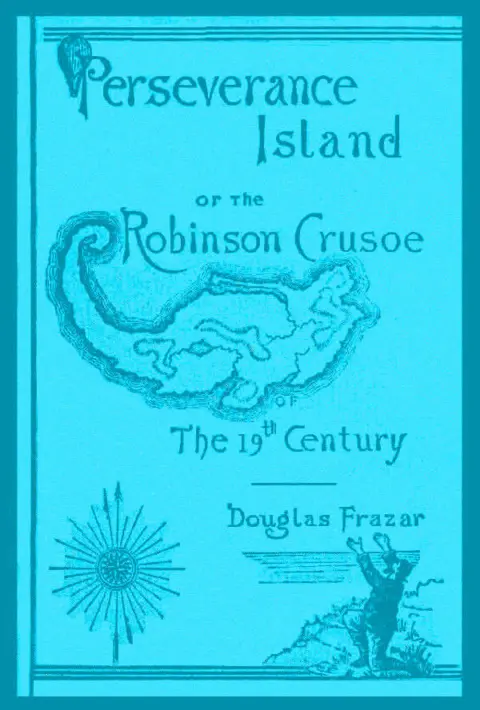
THE CLASSIC COLLECTION · 1885
"Perseverance Island; Or, The Robinson Crusoe of the Nineteenth Century" by Douglas Frazar is a novel written in the late 19th century. This adventure story follows a character who, after a series of maritime disasters, finds himself shipwrecked on a deserted island in the South Pacific. Drawing on his ingenuity and skills, he attempts to survive and thrive in this unfamiliar environment, focusing on themes of resilience, resourcefulness, and the indomitable human spirit. The opening of the narrative introduces the protagonist and provides the backstory of his life as a sailor, detailing his aspirations for adventure that culminate in joining the ill-fated expedition aboard the schooner "Good Luck." After navigating treacherous seas and facing storms, the crew suffers devastating losses, leading to the shipwreck. The protagonist survives the chaos of the storm, finds himself washed ashore on an unknown island, and begins to contemplate his situation, setting the stage for his struggle for survival. Filled with emotional depth and survival challenges, the beginning wastes no time immersing the reader into the hardships faced by the protagonist, highlighting both his vulnerabilities and strengths.
Introduction adapted from the source catalogue; source summaries may be automatically generated.
Free to read · English · 103,200 words · No account needed
MAKE TIME FOR A GOOD BOOK
On by default. Untick to stop anonymous reading totals. Each page counts after 10 seconds in view. How this works.
Anonymous counting is on unless you have switched it off.
Oh, what a lovely spot I found myself sitting in. I named the beautiful stream Rapid River, and drew out my birch-bark chart and sketched and located it. I felt that this would be my home; and could anything be more beautiful. As I sat upon a large stone near the river this is what I saw round about me. To the westward, I knew that just around the bend, but concealed from my eyes as I sat, was the long, beautiful beach of Stillwater Cove, with its inland glades that I had just passed over; to the northward and eastward, a gradually ascending grade of land, covered with lovely groves of trees in full foliage; on both sides of the river a beautiful valley of some quarter of a mile in extent, covered with a natural turf and fringed at its circumference with these beautiful groves; farther to the right a mountain that seemed of considerable magnitude. Birds passed me in their flight from one portion of the grove to the other, and I distinguished the wild pigeon and wood-dove and several others that were familiar to my eye. I observed that they came to one of the upper falls to drink, and after enjoying to the full the beautiful scenery round about me, I followed them there and tried to get a shot with my bow. I found that I could get quite near to them, say within twelve or fourteen yards, but I fired many times before I was successful enough to kill one, and even then I should not have been able to have succeeded if it were not for the innumerable number that came to drink and replace those whom I frightened away by my repeated bad marksmanship. Each shot, however, improved me, and I had also a determination to become skilled, and therefore studied and discovered the error of each shot, and improved upon it by the next. Looking down upon the terminus of Stillwater Cove from this upper fall was superb; there it lay, a pure basin of white sand, with this mountain stream dashing into it. Having feasted my eyes, I got out my flint and steel and built me a nice fire in a short time without any difficulty, and soon had my pigeon roasting at the end of a long stick over the blaze. He eat so very nicely that I took to my bow again, and after a few shots killed another, which I devoured in the same way. I found that the air and exercise and my wanderings here and there had made me very hungry, and I added to the roast pigeons several of the boiled eggs and a long draught of pure water from the running river at my feet. Having feasted abundantly, I arose, and leaving my heavy powder canister of water behind me, I crossed Rapid River just below the lower falls, and found myself on the further side of Stillwater Cove. I turned to the left and walked towards the Breakwater, and soon found myself heading for the place where the boat had first struck on the reef, and opposite to my late residence. Upon arrival there I could look across to my little hut, but I kept on till I came to the end of the Breakwater and to Point Deliverance. As I walked along the Breakwater I noticed on the inner side large masses of mussels nearly a foot in length, larger than anything of the kind I had ever seen before, the shells of which would make capital dishes. I stored the fact in my memory for use hereafter. I stood at last upon Point Deliverance and looked out to sea, but no sign of any friendly vessel met my eyes. I turned to the westward and saw a large bay, formed by my island, at least three miles across and three or four deep, bounded on the northwestern side by a slight promontory, which I concluded not to name, from the distance at which I now stood, and on account of the uncertainty of what lay behind it, now not to be seen from my present position; and as I was determined to pass round the whole island I knew that I should come to it in due season. The bay before me, into which Stillwater Cove poured its waters, I named Perseverance Bay, and marked the same upon my birch-bark chart. Having gazed about me and seen nothing to examine further, I retraced my steps to Rapid River, and again sat down at the upper fall, refreshing myself with a good long pull at the pure water. I started up the gorge and penetrated for about a mile into the interior of the island, and found that the river became smoother and more level as I advanced, and that the groves of trees in places receded, leaving meadows of grass, and long vistas often, on each bank. I made on this trip of a mile or so several discoveries, the most important of which was that there were plenty of goats upon the island, for I started several herds, one numbering as large as ten or twelve, from the long grass of the bottom land. This convinced me that years must have passed since they had been put upon the island, as they were evidently very numerous. I saw also a great many terrapin, or land tortoises, and saw in them a luxury for the future. I felt convinced that sea turtle would not often come to my island on account of its southerly position and climate, and I looked upon the one I had captured as an exceptional case; still, further in the summer they might be more plenty, their presence would prove my theory correct about the mildness of the climate, and I hoped it might prove true on every account.
Your reading position is saved on this browser. Take it to another device with a library code. Reading pages adapt to text, rather than matching a printed edition.
BEHIND THE BOOK
This eBook is for the use of anyone anywhere in the United States and most other parts of the world at no cost and with almost no restrictions whatsoever. You may copy it, give it away or re-use it under the terms of the Project Gutenberg License included with this eBook or online at www.gutenberg.org. If you are not located in the United States, you will have to check the laws of the country where you are located before using this eBook. Read the source licence.
The original source file, including credits and licence, is retained by this library. Request an original-format copy at no charge. Please include the book title and Project Gutenberg identifier #46128.
KEEP YOUR CURIOSITY GOING
Wilfrid Scawen Blunt
Wilfrid Scawen Blunt

E. W. (Edgar Watson) Howe
Coulson Kernahan

Maurice Baring
Frances Wright