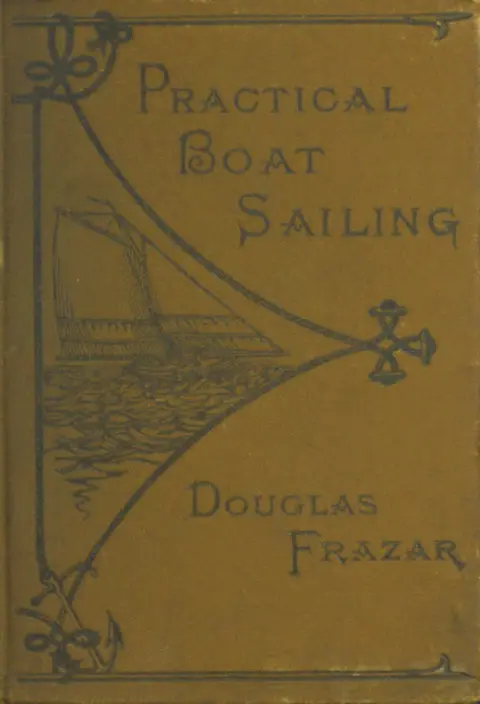
Practical Boat-Sailing: A Concise and Simple Treatise
Douglas Frazar

THE CLASSIC COLLECTION · 1885
"Perseverance Island; Or, The Robinson Crusoe of the Nineteenth Century" by Douglas Frazar is a novel written in the late 19th century. This adventure story follows a character who, after a series of maritime disasters, finds himself shipwrecked on a deserted island in the South Pacific. Drawing on his ingenuity and skills, he attempts to survive and thrive in this unfamiliar environment, focusing on themes of resilience, resourcefulness, and the indomitable human spirit. The opening of the narrative introduces the protagonist and provides the backstory of his life as a sailor, detailing his aspirations for adventure that culminate in joining the ill-fated expedition aboard the schooner "Good Luck." After navigating treacherous seas and facing storms, the crew suffers devastating losses, leading to the shipwreck. The protagonist survives the chaos of the storm, finds himself washed ashore on an unknown island, and begins to contemplate his situation, setting the stage for his struggle for survival. Filled with emotional depth and survival challenges, the beginning wastes no time immersing the reader into the hardships faced by the protagonist, highlighting both his vulnerabilities and strengths.
Introduction adapted from the source catalogue; source summaries may be automatically generated.
Free to read · English · 103,200 words · No account needed
MAKE TIME FOR A GOOD BOOK
On by default. Untick to stop anonymous reading totals. Each page counts after 10 seconds in view. How this works.
Anonymous counting is on unless you have switched it off.
My thoughts turned wholly now upon means of defending my vast treasures in case of invasion, and devising ways of escape from the island. As to the former, I overhauled all my artillery at the different points, increased my stock of gunpowder, and had each cannon well supplied with ammunition. I also perfected my battery at Stillwater Cove, and kept the armament on the walls of the Hermitage in excellent order. Not content with this, I went to work in the foundry and turned out several cylinders, similar to the one I had exploded the sunken wreck with, which I fitted with flint and steel, ready to be filled with powder; in short, a species of torpedo, which I had fully determined to take into the submarine boat and explode beneath the bottom of any hostile vessel that should dare to attack me, so much had the acquisition of vast riches changed my disposition. I felt that any vessel approaching and anchoring would be at my mercy; for in the night-time I could approach her, wherever she might be anchored, unknown to anyone, and, attaching one of my infernal machines, send her to the bottom with all on board. I do not say that I should have done this, but I was prepared for all emergencies, and determined to defend my treasure to the last. For means of escape I turned my attention to ballooning,--a subject which I had thought much about, but heretofore had done nothing in that direction. For several years I had been quietly gathering in all the dried pods of milkweed, floss, or silk that I could find,--and large spaces of the island were covered with it,--determined at some time to weave me some kind of cloth or silk from its fibre. I now commenced seriously upon this work, and took hold of it in earnest. It would take too long to relate how many changes I had to make in my loom, which I built of cast-iron, to be moved by water-power, before I could get it to work at all; but I had the theory all correct, and it was only practice that I needed to make cloth. The machine for spinning the floss into threads took me the longest time, but I finally accomplished it. After a while, and with many failures, I commenced to turn out from my loom a sort of cloth, about a yard wide, which was very strong, flexible, and light, but of an uneven surface, on account of the irregularity in the size of my threads, and fuzzy, like coarse flannel; but for strength and practical use I found the material all that could be desired; and, having tested it, I set carding and spinning wheels to work daily to procure thread for my loom. After making some hundred yards of this cloth, I stopped all the operations to experiment in another direction. In my boyhood I had seen balloon-ascensions made by filling the bag with a gas, created by pouring sulphuric acid upon iron or steel filings in this manner: Several old hogsheads were brought upon the field where the ascension was to take place, and into each of them was poured a quantity of iron filings, scraps, etc., and upon this was poured sulphuric acid; the casks were then headed up, and through a small orifice the gas engendered was led by a pipe from each to the balloon, which was thus inflated. If I could make this gas and successfully inflate a small balloon, it would then be time enough for me to advance with my clothmaking for a large one. I easily ascertained from my book how to make sulphuric acid. And this is how I did it: I got together a quantity of sulphur or brimstone, and setting fire to it in a closed vessel, with just enough draught for it to burn, I led the fumes into a closed vessel of water through a short funnel, where, combining with the water, I had at once sulphuric acid. To test this I tackled my friends the dog-sharks, in Stillwater Cove, and obtained several bladders, very thin and light, just suited for my purpose, which I blew up with atmospheric air, and allowed to dry perfectly in the sun. When they were in proper condition I placed in one of my porcelain jars a few handfuls of iron and steel filings, and poured upon it some of the sulphuric acid that I had made, and then lashed the neck of the bladder to the orifice of the jar. I watched my experiment with subdued excitement. I felt sure that I was right in theory; would the thing work in practice? I had yet to see. After leaving the bladder on for a considerable time, I drew a string around it perfectly tight so that no gas could escape and released it from the jar. With fear and trepidation I loosed my hold upon it, and in one moment it shot up into the sky like a rocket till it was nearly beyond my sight, when it disappeared in a northeasterly direction before a strong wind that was blowing. I was as pleased as a boy with his first toy-balloon, and, like a child, I let off several of these bladders as fast as filled with gas, perfectly fascinated to see them ascend and then disappear in the blue ether.
Your reading position is saved on this browser. Take it to another device with a library code. Reading pages adapt to text, rather than matching a printed edition.
BEHIND THE BOOK
This eBook is for the use of anyone anywhere in the United States and most other parts of the world at no cost and with almost no restrictions whatsoever. You may copy it, give it away or re-use it under the terms of the Project Gutenberg License included with this eBook or online at www.gutenberg.org. If you are not located in the United States, you will have to check the laws of the country where you are located before using this eBook. Read the source licence.
The original source file, including credits and licence, is retained by this library. Request an original-format copy at no charge. Please include the book title and Project Gutenberg identifier #46128.
KEEP YOUR CURIOSITY GOING
Wilfrid Scawen Blunt
Wilfrid Scawen Blunt

E. W. (Edgar Watson) Howe
Coulson Kernahan

Maurice Baring
Frances Wright