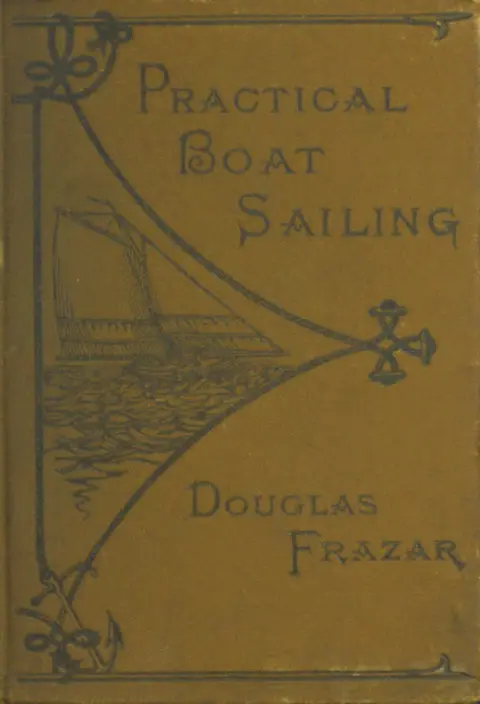
Practical Boat-Sailing: A Concise and Simple Treatise
Douglas Frazar

THE CLASSIC COLLECTION · 1885
"Perseverance Island; Or, The Robinson Crusoe of the Nineteenth Century" by Douglas Frazar is a novel written in the late 19th century. This adventure story follows a character who, after a series of maritime disasters, finds himself shipwrecked on a deserted island in the South Pacific. Drawing on his ingenuity and skills, he attempts to survive and thrive in this unfamiliar environment, focusing on themes of resilience, resourcefulness, and the indomitable human spirit. The opening of the narrative introduces the protagonist and provides the backstory of his life as a sailor, detailing his aspirations for adventure that culminate in joining the ill-fated expedition aboard the schooner "Good Luck." After navigating treacherous seas and facing storms, the crew suffers devastating losses, leading to the shipwreck. The protagonist survives the chaos of the storm, finds himself washed ashore on an unknown island, and begins to contemplate his situation, setting the stage for his struggle for survival. Filled with emotional depth and survival challenges, the beginning wastes no time immersing the reader into the hardships faced by the protagonist, highlighting both his vulnerabilities and strengths.
Introduction adapted from the source catalogue; source summaries may be automatically generated.
Free to read · English · 103,200 words · No account needed
MAKE TIME FOR A GOOD BOOK
On by default. Untick to stop anonymous reading totals. Each page counts after 10 seconds in view. How this works.
Anonymous counting is on unless you have switched it off.
We landed upon a nice sandy beach, and soon had a pot boiling, and some clams, of which there were vast quantities in the sand, cooking upon hot stones. We made a capital meal, and after a good smoke took our oars again and went on up the river. Shall I ever forget the ending of that pleasant day? As we were chatting and passing a bend, and opening a new reach, in one moment of time our ears were filled with awful shrieks and shouts, and we had become the centre of a perfect shower of missiles from the cliff underneath the base of which we had just passed.
Our first instinct was to drop our oars and grasp the firearms, and a dropping, irregular fire into the bushes at the foot of the bend and towards the higher cliff towering above us brought to a sudden cessation the shower of stones with which we had been assailed, and with wild cries of fear, pain, and awe these untutored savages fled into the dense forest behind them.
I was amazed at the ease with which we had repelled them, until I bethought me that probably our firearms were the first they had ever heard. I wondered why we had not fired more, and quicker, and turning my eyes from their disappearing bodies, I saw, with horror, the cause. Captain Davis lay in the stern sheets of the boat with a large stone across both legs, dropped evidently from the cliff, which was some twenty or thirty feet above us, upon them. He had fainted away, or else was dead from some other wound, for he did not offer to stir or remove the stone. I glanced towards my other two comrades, and found, upon examination, one with a serious fracture of the left arm, which, however, did not prevent his holding on to his revolver in a most determined manner, and the other with only a few slight bruises. I beckoned him to come aft and help lift the stone off the captain's legs, we did so, and threw water in his face to revive him. We dared not imagine how bad his injuries were, and left him lying as we found him, after throwing overboard the stone, which undoubtedly would have gone through the bottom of the boat and sunk us, if it had not encountered the legs of the captain in its descent. As for our other comrade, we bound up his arm as best we could. I felt dizzy and weak, but did not suspect any serious injury. All that I have written was performed quickly, as sailors always act in an emergency. Bill Thompson and I soon got the boat's head pointed down stream, and the way we pulled for the ship was a sight to behold; pausing once in awhile to lift a hand and explode a revolver to keep the savages from attacking us again; but they had evidently had enough of it, for we saw no signs of them, and after a long and arduous pull we came to the ship's side, and sad was the news that we had for our comrades. We slung the boat and hoisted her on board, and I ordered the anchor to be weighed at once, and we set sail from this treacherous bay. It was found upon examination that one of the captain's legs was broken, evidently a compound fracture, and the other much bruised and inflamed. He was carried with care and affection to his stateroom, and I took charge of the deck. The sailor's arm was found to be a simple fracture, and we soon had it in splints and himself in his berth. After the schooner was fairly under way and heading out of the bay, I went below to my stateroom, and found that I had received several severe blows, but none that had drawn blood, except in the back of my head, where I found the hair under my cap bloody and matted together. This it was that had made me dizzy, although my excitement had been so great that I could not fix where the pain was till all was over. I washed myself, and went on deck again, to remain there during the night and run the schooner out into the open sea. What thoughts passed through my brain as the little vessel gallantly slipped along by the land, towards the ocean!--what in the world were we to do should Captain Davis die, and where were we to recruit, for during the long watches of that night it was agreed that we had become too short handed to prosecute our enterprise, and that the best thing that we could do would be to make our way back to England and start afresh; but after a long consultation, it was acknowledged that we were in no condition to face Cape Horn, and that we must get somewhere to recruit before we dare attempt the passage home. The captain, who had his senses perfectly, although suffering bodily pain, said "that we must make one of the easterly of the Society Islands before attempting to go home, and there recruit ourselves, overhaul the vessel, and by that time he should know what he was to expect of his own health, but feared that his injuries were beyond mortal aid." Towards morning the open sea appeared ahead, and at about eight bells, we issued from the mouth of Magellan Straits, and I laid the course of the schooner northwest, so as to hit Easter Island, or some of the islands further to the westward should the wind haul. At two bells in the forenoon we were bowling along on our course with everything set, and a fine working breeze from north-northeast, and a smooth sea. Of course we talked over the disastrous trip of the day before, and, as in all such cases, wondered why we did not do so and so, and why we were not more careful, etc., but to what good. The deed was done: our comrade with his broken arm, and our captain with his broken leg, were mute reminders of our folly and carelessness. My greatest fear at this time was that we should lose the captain, and that his duties would devolve upon me. He seemed throughout this day slightly better, but upon examination we found that we could not set his leg as we had the sailor's arm, and that, although he complained of little pain, his leg had a puffed and swollen appearance, and I feared the worst. I was somewhat in favor of changing the course and making a port on the South American coast; but the captain would not hear of it. He said "you can at least get to the Society Islands and land your cargo in some port under some flag where it will be safely kept till you return to England for a new crew. I shall not get well any sooner, if at all, on the South American coast than I shall in the Society Islands. We are bound by honor to push the adventure to its legitimate end, or as near it as possible." This and many other convincing things were uttered by him. "If my leg should have been amputated it should have been done before this; and it will be too late to do anything at Santiago as well as at Easter Island. You can still do a great deal towards making the adventure a success; perhaps you can even get volunteers enough in the islands to fill up your ranks, so as not to have to go back to England till you have your headquarters established and a cargo ready to ship back." And thus this sick and dying man cheered us on.
Your reading position is saved on this browser. Take it to another device with a library code. Reading pages adapt to text, rather than matching a printed edition.
BEHIND THE BOOK
This eBook is for the use of anyone anywhere in the United States and most other parts of the world at no cost and with almost no restrictions whatsoever. You may copy it, give it away or re-use it under the terms of the Project Gutenberg License included with this eBook or online at www.gutenberg.org. If you are not located in the United States, you will have to check the laws of the country where you are located before using this eBook. Read the source licence.
The original source file, including credits and licence, is retained by this library. Request an original-format copy at no charge. Please include the book title and Project Gutenberg identifier #46128.
KEEP YOUR CURIOSITY GOING
Wilfrid Scawen Blunt
Wilfrid Scawen Blunt

E. W. (Edgar Watson) Howe
Coulson Kernahan

Maurice Baring
Frances Wright