THE CLASSIC COLLECTION✦An outlaw’s diary: the CommuneCLASSIC FREE BOOKS
An outlaw’s diary: the Commune
Cécile Tormay
THE CLASSIC COLLECTION · 1885
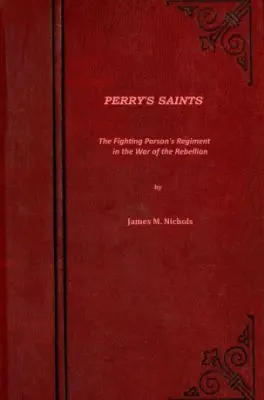
"Perry's Saints; Or, The Fighting Parson's Regiment in the War of the Rebellion" by James M. Nichols is a historical account written in the late 19th century. The book recounts the experiences of the 48th New York State Volunteers, known as "Perry's Saints," during the American Civil War, particularly focusing on their formation and service under Colonel James H. Perry. It aims to present an authentic portrayal of army life and the individual and collective experiences of soldiers fighting for the Union. The opening of this narrative sets the stage for the Civil War, highlighting the tension and causes behind the conflict, particularly the issue of slavery. It introduces Colonel James H. Perry, a former preacher turned soldier, showcasing his transformation from a man of peace to a commanding officer who inspires his regiment. The early chapters detail the regiment's formation, the eagerness of the soldiers, and their initial enthusiasm for service as they prepare to face the unknown challenges of war. Through snippets of personal reflections and the experiences of the soldiers, the story captures not only the historical context of the conflicts but also the emotional landscape of those who fought.
Introduction adapted from the source catalogue; source summaries may be automatically generated.
Free to read · English · 46,880 words · No account needed
MAKE TIME FOR A GOOD BOOK
On by default. Untick to stop anonymous reading totals. Each page counts after 10 seconds in view. How this works.
Anonymous counting is on unless you have switched it off.
About this time I was made familiar with a feature of army life to which I have made only slight reference. As a member of a general court-martial, day after day and week after week was occupied in the examination of charges of the gravest character, involving the liberty and life of scores of officers and men. It was the highest tribunal by which those composing the rank and file of the command could be adjudged. Questions of the gravest moment, and of supremest interest to those concerned, were discussed and determined. It was a responsibility shared only by the highest judges in the land, and life and death often hung upon our decisions. A photograph of army life is incomplete without this feature, and while the duty is the gravest and the most solemn which an officer is called upon to perform, it is as necessary to the well-being and efficiency of an army as the ordinary courts of justice to the preservation of the state.
January 30, the Enfans Perdus, an independent battalion, was consolidated into the 47th and 48th New York regiments. The number received by us was about one hundred and fifty. On the 31st, the veterans left for New York, under the charge of several officers. February 4, those left behind received orders to prepare six days' cooked rations, and be in readiness to march, and on the 5th, with the left wing of the 115th New York, they embarked on board the steamer Delaware. On the 6th they left Hilton Head, in company with a number of transports, under the convoy of a gunboat, and proceeded to Florida; the force numbering in all from six to seven thousand men, and comprising artillery, cavalry, and infantry. The artillery and cavalry were under the immediate command of Colonel Henry, and the infantry under Colonels Barton, Hawley, and Scammon, with General Seymour in command of the whole expedition. Its object was to aid the Union people of the state in withdrawing it from Confederate control. General Gilmore accompanied the troops as far as Jacksonville, where they disembarked, and, after seeing that all necessary arrangements were made which could promote the success of the enterprise, returned to Hilton Head, leaving with General Seymour instructions not to attempt an advance beyond Baldwin without further orders, nor unless well assured of success. His intention was to hold and fortify several important points, including Jacksonville, as centres of Federal authority, and reopen those sections to trade. But General Seymour, apparently satisfied that he could not be successfully opposed by any Confederate forces within the state, conceived the idea of destroying the railroad, and cutting off communication with Georgia. As soon as notified of this intended movement, General Gilmore sent a despatch to stop it, but was too late to prevent the massacre which followed. On the 20th a general advance was ordered, and the troops proceeded towards Lake City, about five thousand in all; Colonel Henry with the cavalry in advance, followed by three columns of infantry; Colonel Hawley, with his brigade, on the left; Colonel Barton in the centre; and Colonel Scammon, with his regiment, on the right. In the rear was a brigade of colored troops, under Colonel Montgomery. Near Olustee they came upon a strong force of Confederates favorably posted in the woods, with a swamp in front, over which our troops must pass to reach them. Before they were well aware of the vicinity of the enemy, a murderous fire was opened on them, at a distance of little more than a hundred yards, and for more than two hours they could scarcely do more than stand up to be slaughtered, the nature of the ground and the strength of the enemy effectually preventing any advance. No severer test could be applied to men than they suffered at the battle of Olustee, and when, at evening, the troops were withdrawn, nearly one-fourth of their number were dead or wounded. The most of the latter were left on the field, under the care of Surgeon Defendorf of our regiment, who volunteered to remain with them; an act of bravery and self-sacrifice which cannot be too highly commended. The testimony of those engaged in this affair, as we gather it from journals and other sources, is that it was the most trying position in which they were placed during the war, and the heroism displayed by our men is accounted marvellous. The retreat to Jacksonville was such as might have been expected from broken, dispirited, and defeated troops, with a strong body of the enemy in their rear, flushed with victory, and determined upon their destruction. On the way back, the stores at Baldwin were burned, and when the broken columns were gathered at Jacksonville, it was found that twelve hundred men had been sacrificed, five pieces of artillery and a large number of small arms left in the hands of the Confederates, while the purpose of the government in ordering the expedition was completely frustrated. Our own regiment, whose conduct in the affair was beyond all praise, suffered terribly.
Your reading position is saved on this browser. Take it to another device with a library code. Reading pages adapt to text, rather than matching a printed edition.
BEHIND THE BOOK
This eBook is for the use of anyone anywhere in the United States and most other parts of the world at no cost and with almost no restrictions whatsoever. You may copy it, give it away or re-use it under the terms of the Project Gutenberg License included with this eBook or online at www.gutenberg.org. If you are not located in the United States, you will have to check the laws of the country where you are located before using this eBook. Read the source licence.
The original source file, including credits and licence, is retained by this library. Request an original-format copy at no charge. Please include the book title and Project Gutenberg identifier #58480.
KEEP YOUR CURIOSITY GOING
Cécile Tormay

Moritz Busch
John L. Ransom
Frances Wright
Cécile Tormay

Mabel Potter Daggett