THE CLASSIC COLLECTION✦An outlaw’s diary: the CommuneCLASSIC FREE BOOKS
An outlaw’s diary: the Commune
Cécile Tormay
THE CLASSIC COLLECTION · 1885
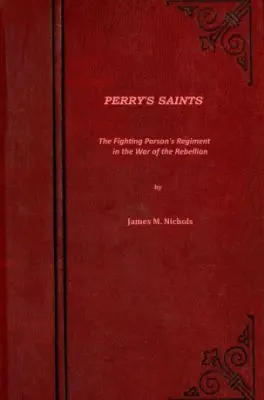
"Perry's Saints; Or, The Fighting Parson's Regiment in the War of the Rebellion" by James M. Nichols is a historical account written in the late 19th century. The book recounts the experiences of the 48th New York State Volunteers, known as "Perry's Saints," during the American Civil War, particularly focusing on their formation and service under Colonel James H. Perry. It aims to present an authentic portrayal of army life and the individual and collective experiences of soldiers fighting for the Union. The opening of this narrative sets the stage for the Civil War, highlighting the tension and causes behind the conflict, particularly the issue of slavery. It introduces Colonel James H. Perry, a former preacher turned soldier, showcasing his transformation from a man of peace to a commanding officer who inspires his regiment. The early chapters detail the regiment's formation, the eagerness of the soldiers, and their initial enthusiasm for service as they prepare to face the unknown challenges of war. Through snippets of personal reflections and the experiences of the soldiers, the story captures not only the historical context of the conflicts but also the emotional landscape of those who fought.
Introduction adapted from the source catalogue; source summaries may be automatically generated.
Free to read · English · 46,880 words · No account needed
MAKE TIME FOR A GOOD BOOK
On by default. Untick to stop anonymous reading totals. Each page counts after 10 seconds in view. How this works.
Anonymous counting is on unless you have switched it off.
The wreck of the sutler's schooner. Its consequences. The death of Colonel Perry. His character. Action of officers. Sent to New York. Lieutenant-Colonel Barton promoted. Detailed on recruiting service. General Mitchell commander of the department. Expedition to Bluffton. Blockade-runner Emma. Confederate ironclad. Back with the regiment. Its condition. Bluffton again visited. Ravages of war.
On the 16th and 17th of June, a fearful storm prevailed along the coast during which a schooner was discovered on her beam ends, on the bar off the west end of Cockspur Island. With much difficulty the crew was rescued, but the vessel became a total wreck, and the cargo, which consisted of sutler supplies, floated ashore on Tybee and Cockspur Islands. Cases of claret and champagne and barrels of beer and wine, were too strong an attraction to be resisted, and the result was that on the 17th the regiment was in a terrible state of demoralization. As soon as the facts were discovered by the colonel, the severest measures were applied. Guards were set along the shores to secure the cargo, and those who were intoxicated were confined in the guard-house and dungeon. The liquor was collected, and locked up in the magazine, and comparative order was restored. It is probable, however, that the excitement and vexation so overcame the colonel as to induce the attack of the following day. It was the first time that the brutalizing effects of the war had manifested themselves in our regiment, and he was grievously wounded. At about three o'clock of the afternoon of June 18, while the colonel was writing at his desk, his pen suddenly dropped from his hand, his head dropped, and scarcely with other sign, the silver cord was loosed and the golden bowl was broken. It was a sad day in the regiment. He was so strong--so far above the jealousies of ordinary army life--so just and true--that he was as a rock of defence to such as were in any way dependent upon him. Although holding a subordinate position, we felt that he had no superior in the department, in those qualities which constitute a leader and commander. How well I remember him, as firmly seated on his gray horse, the gift of his ministerial friends and others, he moved about the field at battalion drill, so familiar with the duties of his position as never to suggest a doubt, giving the word of command without effort, but with a power of tone such as I have never heard equalled. Here, as elsewhere, always dignified, always composed. A man to respect, to trust, to obey. It was his misfortune to be confined in a department which furnished so little scope for his abilities, and a still greater misfortune that he incurred the envy and jealousy of those over him. At the time of his death he had applied for leave of absence, and the promise of promotion led him to expect a transfer to some other corps. Had he lived, so large an estimate had we formed of his abilities that we should have expected his rapid advancement to a conspicuous position among the leading generals of the army. As a man he was admired and beloved, for, although reserved and reticent, he did not withhold his confidence, and esteem from such as he deemed worthy of it. Everything relating to those under him received his personal attention, and in cases of discipline, while sometimes severe, he was always just, and when he died the feeling was universal throughout the regiment that the loss we had suffered could never be made up to us. From the time of my first introduction to him, until that morning when I parted from him at Pulaski, never again to see him in life, I recall many instances of his kindness and thoughtful consideration; but they are too personal to be recorded here. Notwithstanding his reserve and his habitual seclusion, except when engaged in active duty, he knew his officers better than they thought, and cared for them better than they knew. As an evidence of this I recall with great distinctness the ride we had together, when we visited various points on Dawfuskie, when he found the rebels were making preparations to annoy or attack us. On our return as we slowly rode towards camp, the conversation turned upon the character and relative merits of the officers of the regiment. He was in a singularly communicative mood, and spoke with unusual freedom. There was no unkindness, no bitterness in what he said, but there was abundant evidence of keenness of observation, and a knowledge of the temper and disposition of those of whom he spoke, and had he lived, no good man would have had occasion to fear him, and no bad man to despise him. His parting words at our last interview in Pulaski, meant more than I knew then, but they were not needed to keep him in my mind, embalmed with loving thoughts and precious memories. We buried him outside the fort, but subsequently his body was removed to Cyprus Hill Cemetery, in Brooklyn; and a granite monument has now been erected above his remains,--by the efforts of James H. Perry Post, G.A.R., and the survivors of the regiment, assisted by the Hanson Place Methodist-Episcopal Church of Brooklyn, of which he had been the pastor. On this is inscribed, in fitting words, the story of his life, his services and sacrifice.
Your reading position is saved on this browser. Take it to another device with a library code. Reading pages adapt to text, rather than matching a printed edition.
BEHIND THE BOOK
This eBook is for the use of anyone anywhere in the United States and most other parts of the world at no cost and with almost no restrictions whatsoever. You may copy it, give it away or re-use it under the terms of the Project Gutenberg License included with this eBook or online at www.gutenberg.org. If you are not located in the United States, you will have to check the laws of the country where you are located before using this eBook. Read the source licence.
The original source file, including credits and licence, is retained by this library. Request an original-format copy at no charge. Please include the book title and Project Gutenberg identifier #58480.
KEEP YOUR CURIOSITY GOING
Cécile Tormay

Moritz Busch
John L. Ransom
Frances Wright
Cécile Tormay

Mabel Potter Daggett