THE CLASSIC COLLECTION✦An outlaw’s diary: the CommuneCLASSIC FREE BOOKS
An outlaw’s diary: the Commune
Cécile Tormay
THE CLASSIC COLLECTION · 1885
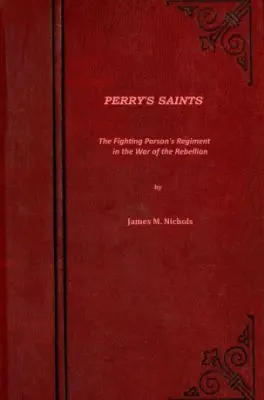
"Perry's Saints; Or, The Fighting Parson's Regiment in the War of the Rebellion" by James M. Nichols is a historical account written in the late 19th century. The book recounts the experiences of the 48th New York State Volunteers, known as "Perry's Saints," during the American Civil War, particularly focusing on their formation and service under Colonel James H. Perry. It aims to present an authentic portrayal of army life and the individual and collective experiences of soldiers fighting for the Union. The opening of this narrative sets the stage for the Civil War, highlighting the tension and causes behind the conflict, particularly the issue of slavery. It introduces Colonel James H. Perry, a former preacher turned soldier, showcasing his transformation from a man of peace to a commanding officer who inspires his regiment. The early chapters detail the regiment's formation, the eagerness of the soldiers, and their initial enthusiasm for service as they prepare to face the unknown challenges of war. Through snippets of personal reflections and the experiences of the soldiers, the story captures not only the historical context of the conflicts but also the emotional landscape of those who fought.
Introduction adapted from the source catalogue; source summaries may be automatically generated.
Free to read · English · 46,880 words · No account needed
MAKE TIME FOR A GOOD BOOK
On by default. Untick to stop anonymous reading totals. Each page counts after 10 seconds in view. How this works.
Anonymous counting is on unless you have switched it off.
Expedition to Coosawhatchie. Landing at Dawson's plantation. March to Coosawhatchie. Ambuscade. Firing on Confederate train. Confederate prisoners. Destruction of track. Retreat. Peril of Lieutenant Corwin. Lieutenant Blanding wounded. Pocataligo expedition a failure. Perilous voyage back to Pulaski. Confederate weapons. Yellow fever. Death of General Mitchell. His character. Review of Coosawhatchie.
October 21 we embarked on the steamer Planter, six companies of fifty men each, and proceeded to Hilton Head, where we joined the main body of troops belonging to the expedition, and, accompanied by a number of gunboats, started for the point of attack. The morning of the 22d found us opposite Mackey's Point on the Coosawhatchie River, in rear of the fleet, which numbered in all fifteen gunboats and transports. This was the point of disembarkation for the main body, but we proceeded farther up the river, accompanied by two gunboats. We had not gone far before our boat grounded on a point on the Dawson plantation near the house, and we landed in small boats. A few cavalry pickets delayed us a little, but we finally started up the road with Company H deployed as skirmishers under command of the writer. This road led directly to the village of Coosawhatchie, and ran nearly parallel to the railroad. The attempt to skirmish through the woods was soon abandoned, owing to the dense growth of plants and shrubs and trailing vines. The Spanish bayonet plant was the most formidable, its thick bristling points presenting such obstacles to our progress that we were soon compelled to confine ourselves to an advanced position on the road. Where other roads intersected, guards were stationed. A short march brought us to an open space, with the railroad in plain sight, only about two hundred yards distant from the turnpike. Without waiting for special orders, Company H was deployed along the railway embankment, at the same time that the whistle of an engine warned us that a train was approaching. Carefully posting the men along the track, but out of sight, a cautious observation discovered the train stopped a short distance below us. It was a period of anxious suspense, until we were assured that it was again in motion, when, the most careful instructions having been given as to when and how to fire, we awaited its approach. Several platform cars were loaded with troops, and as we poured in our fire upon them, at only a few feet distance, the effect was terrible. In an instant those crowded masses of humanity had disappeared. Some were killed and more were wounded, but a large number jumped from the train and concealed themselves in the swamp and woods. A few were taken prisoners, but the wounded were left to be cared for by their own people, who were known to be near by, as we had no means of caring for them. It was a cruel ambuscade, for as they came to the place where we were awaiting them, it was apparent that they had no intimation of our presence in the vicinity. We hoped to injure the engine and so wreck the train, and a number of the most reliable men were assigned to that special duty; but it passed on out of sight, and we gave our attention to the destruction of the railroad, under the direction of the engineers who had accompanied us for such purposes. Not much was accomplished before heavy firing warned us that we could not delay; and, collecting the prisoners and such arms as we had captured, we proceeded to join the regiment. This had arrived at the open space just in season to discharge the little cannon, which the colonel had borrowed from the navy, at the passing train, when it pushed on, hoping to destroy the bridge which crossed the river a little farther up the road; but the Confederates were found strongly entrenched, with heavy batteries guarding its approaches, and, after carefully feeling of the position and drawing the fire of the batteries, the colonel was obliged to give the order to return. Company H was again thrown out as skirmishers, and, discovering what was supposed to be a Confederate detachment, commenced firing. Fortunately, before any injury was done, it was ascertained that it was Lieutenant Corwin with his company, which had been left to guard a threatening point. Nothing further occurred until we reached the boat, when, as we were embarking, the little knot of cavalry which had been closely watching our movements for some time rode rapidly forward and gave us a volley, by which Lieutenant Blanding, of the 3d Rhode Island Artillery, who accompanied us, was severely wounded. A few shells from the little Parrot gun on our bow dispersed them, and we steamed down the river without further casualty. The main body of the expedition had the usual experience at Pocotaligo, where they hoped to be able to effectually destroy the railroad. The force was too small, and was repulsed with severe loss. We nevertheless expected to renew the attempt the next day; but this purpose was given up, and we were ordered back to the fort. The perils of our return passage were quite equal to any that we had encountered, for in the intense darkness the pilot lost his way, and for a long time we were buffeted about by wind and waves, not knowing what was to become of us. The next day we had leisure to examine the weapons we had captured. It was a curious collection, consisting of rifles, swords of venerable age, and a species of cleaver, much resembling those commonly used by butchers, showing to what extremities the Home Guards, at least, were already reduced. As I write I have a specimen of the last mentioned weapon on my table, personally taken from a rebel at Coosawhatchie.
Your reading position is saved on this browser. Take it to another device with a library code. Reading pages adapt to text, rather than matching a printed edition.
BEHIND THE BOOK
This eBook is for the use of anyone anywhere in the United States and most other parts of the world at no cost and with almost no restrictions whatsoever. You may copy it, give it away or re-use it under the terms of the Project Gutenberg License included with this eBook or online at www.gutenberg.org. If you are not located in the United States, you will have to check the laws of the country where you are located before using this eBook. Read the source licence.
The original source file, including credits and licence, is retained by this library. Request an original-format copy at no charge. Please include the book title and Project Gutenberg identifier #58480.
KEEP YOUR CURIOSITY GOING
Cécile Tormay

Moritz Busch
John L. Ransom
Frances Wright
Cécile Tormay

Mabel Potter Daggett