THE CLASSIC COLLECTION✦An outlaw’s diary: the CommuneCLASSIC FREE BOOKS
An outlaw’s diary: the Commune
Cécile Tormay
THE CLASSIC COLLECTION · 1885
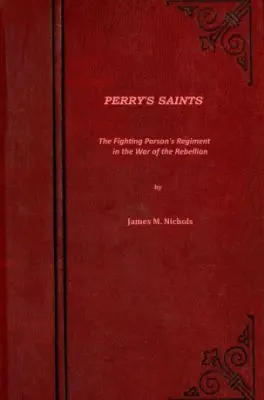
"Perry's Saints; Or, The Fighting Parson's Regiment in the War of the Rebellion" by James M. Nichols is a historical account written in the late 19th century. The book recounts the experiences of the 48th New York State Volunteers, known as "Perry's Saints," during the American Civil War, particularly focusing on their formation and service under Colonel James H. Perry. It aims to present an authentic portrayal of army life and the individual and collective experiences of soldiers fighting for the Union. The opening of this narrative sets the stage for the Civil War, highlighting the tension and causes behind the conflict, particularly the issue of slavery. It introduces Colonel James H. Perry, a former preacher turned soldier, showcasing his transformation from a man of peace to a commanding officer who inspires his regiment. The early chapters detail the regiment's formation, the eagerness of the soldiers, and their initial enthusiasm for service as they prepare to face the unknown challenges of war. Through snippets of personal reflections and the experiences of the soldiers, the story captures not only the historical context of the conflicts but also the emotional landscape of those who fought.
Introduction adapted from the source catalogue; source summaries may be automatically generated.
Free to read · English · 46,880 words · No account needed
MAKE TIME FOR A GOOD BOOK
On by default. Untick to stop anonymous reading totals. Each page counts after 10 seconds in view. How this works.
Anonymous counting is on unless you have switched it off.
On the next day, the 16th, occurred the battle of Strawberry Plains, where our loss was very severe. I copy from my journal: "During the forenoon moved to the left in rear of battery. Remained a little while, and then moved to the right through the woods. On the way, the firing became heavy in our front, and we soon got the order to double-quick. Through the woods, over dead bodies,--Federals and Confederates mingled together,--past lines of prisoners, into the open ground, knapsacks thrown off, full of enthusiasm, away we went, forming behind the Confederate works, by the right into line, as straight and true as ever on parade drill, amid the cheering of the troops about us. Men, cheerful, cool, and obedient, under a heavy fire, in which Lieutenant John M. Tantum, of Company D, a Christian man and good soldier, was killed, and Seward, Sears, and many others, wounded. We stuck to the works until the regiments on our right and left had fled, and only gave way when the Confederates were so near that we could almost feel their breath."
During the day we witnessed a marked illustration of the necessity for coolness, as well as bravery, especially on the part of officers. Our position was a trying one, for, although there was no enemy in sight, we were under a heavy enfilading fire, probably from sharpshooters stationed in the trees of the adjoining woods, and we had reason to expect an attack, either in front or flank, at any moment. Under the circumstances, it was necessary that the command should be well in hand, cool, alert, and ready for any emergency. While we were closely hugging the intrenchments, to avoid as far as possible the enemy's fire, every man grasping his musket, and waiting for the word of command, a staff officer, possessing more courage than discretion, came along, with pistol in one hand and sword in the other, and gave the order to commence firing. In an instant the men were on their feet, and the utmost confusion prevailed. The firing which followed indicated more perfectly the position of our regiment to the enemy, who were themselves so completely concealed in the woods at our left that no return fire could be effectual. Worse than all, our men could only fire directly to the front,--where as yet there was no sign of the enemy,--on account of the regiment which at that time connected with our left flank. As long as the firing continued, the advantage of preparations to repel attack was entirely lost, and it was only by threats of immediate personal injury that the officer was induced to take his ill-timed enthusiasm elsewhere, and order was restored. In our retreat, which occurred soon after, Captain Taylor was the only officer left to assist in the command of the regiment; and, as we hurried through the woods, a last look behind discovered several Confederate battle-flags close at hand, and already occupying the position we had just left. How heartily we congratulated each other on our escape, when so many of our friends and comrades had fallen; but only an hour afterwards, our picket-lines having been established, and placed in his charge, word was brought to me that he too had been grievously wounded. It was a sad blow, and left me in a very embarrassing position; for the enemy was pressing hard upon us. Soon, however, several officers, who, for various reasons, had been absent during the day, reported for duty; but no one who took his place. Always ready for whatever he was called upon to do, he was cheerful and intelligent in its performance. An excellent officer, and most agreeable companion. This was his third wound, and, although he recovered sufficiently to attend to ordinary business, he was obliged to leave the service. His constitution was much shattered, and gradually gave way, under the combined effects of his wounds and the malarial disorders contracted in the army. Never shall I forget the greeting of General Terry as we emerged from the woods. He had seen our good regiment through the whole affair, and his plaudit of "well done" was honest and hearty. There was no rest that night, but when, at the close of the following day, the 17th, after much wearisome marching, we sank down on the damp ground, wet, hungry, and exhausted, many a prayer of thanksgiving went up to Him who had spared us, where so many had fallen by our sides. On the 18th, there was fighting in our front, but we were not engaged.
Your reading position is saved on this browser. Take it to another device with a library code. Reading pages adapt to text, rather than matching a printed edition.
BEHIND THE BOOK
This eBook is for the use of anyone anywhere in the United States and most other parts of the world at no cost and with almost no restrictions whatsoever. You may copy it, give it away or re-use it under the terms of the Project Gutenberg License included with this eBook or online at www.gutenberg.org. If you are not located in the United States, you will have to check the laws of the country where you are located before using this eBook. Read the source licence.
The original source file, including credits and licence, is retained by this library. Request an original-format copy at no charge. Please include the book title and Project Gutenberg identifier #58480.
KEEP YOUR CURIOSITY GOING
Cécile Tormay

Moritz Busch
John L. Ransom
Frances Wright
Cécile Tormay

Mabel Potter Daggett