THE CLASSIC COLLECTION✦Hawthorne (English Men of Letters Series)CLASSIC FREE BOOKS
Hawthorne (English Men of Letters Series)
Henry James
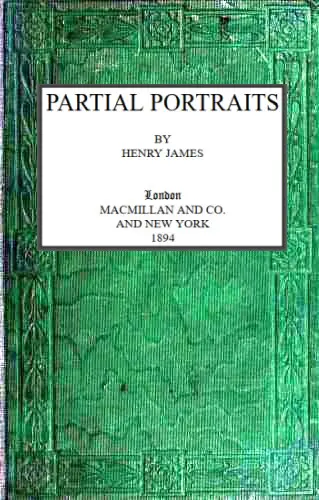
THE CLASSIC COLLECTION · 1888
"Partial Portraits" by Henry James is a collection of literary criticism published in 1888. This influential work gathers James's essays on major English, American, and European writers, exploring their unique artistic visions and techniques. The centerpiece is "The Art of Fiction," James's landmark argument for complete creative freedom in narrative writing. Through penetrating analyses of authors like George Eliot, Maupassant, and Turgenev, James champions each writer's distinctive perspective while establishing fiction's place among the fine arts. His elegant criticism reveals how different novelists view life through their own creative windows.
Introduction adapted from the source catalogue; source summaries may be automatically generated.
Free to read · English · 101,137 words · No account needed
MAKE TIME FOR A GOOD BOOK
On by default. Untick to stop anonymous reading totals. Each page counts after 10 seconds in view. How this works.
Anonymous counting is on unless you have switched it off.
I have left Mr. Stevenson’s best book to the last, as it is also the last he has given (at the present speaking) to the public--the tales comprising The Merry Men having already appeared; but I find that on the way I have anticipated some of the remarks that I had intended to make about it. That which is most to the point is that there are parts of it so fine as to suggest that the author’s talent has taken a fresh start, various as have been the impulses in which it had already indulged, and serious the hindrances among which it is condemned to exert itself. There would have been a kind of perverse humility in his keeping up the fiction that a production so literary as Kidnapped is addressed to immature minds, and, though it was originally given to the world, I believe, in a “boy’s paper,” the story embraces every occasion that it meets to satisfy the higher criticism. It has two weak spots, which need simply to be mentioned. The cruel and miserly uncle, in the first chapters, is rather in the tone of superseded tradition, and the tricks he plays upon his ingenuous nephew are a little like those of country conjurers. In these pages we feel that Mr. Stevenson is thinking too much of what a “boy’s paper” is expected to contain. Then the history stops without ending, as it were; but I think I may add that this accident speaks for itself. Mr. Stevenson has often to lay down his pen for reasons that have nothing to do with the failure of inspiration, and the last page of David Balfour’s adventures is an honourable plea for indulgence. The remaining five-sixths of the book deserve to stand by Henry Esmond as a fictive autobiography in archaic form. The author’s sense of the English idiom of the last century, and still more of the Scotch, has enabled him to give a gallant companion to Thackeray’s tour de force. The life, the humour, the colour of the central portions of Kidnapped have a singular pictorial virtue: these passages read like a series of inspired footnotes on some historic page. The charm of the most romantic episode in the world, though perhaps it would be hard to say why it is the most romantic, when it was associated with so much stupidity, is over the whole business, and the forlorn hope of the Stuarts is revived for us without evoking satiety. There could be no better instance of the author’s talent for seeing the familiar in the heroic, and reducing the extravagant to plausible detail, than the description of Alan Breck’s defence in the cabin of the ship and the really magnificent chapters of “The Flight in the Heather.” Mr. Stevenson has in a high degree (and doubtless for good reasons of his own) what may be called the imagination of physical states, and this has enabled him to arrive at a wonderfully exact translation of the miseries of his panting Lowland hero, dragged for days and nights over hill and dale, through bog and thicket, without meat or drink or rest, at the tail of an Homeric Highlander. The great superiority of the book resides to my mind, however, in the fact that it puts two characters on their feet with admirable rectitude. I have paid my tribute to Alan Breck, and I can only repeat that he is a masterpiece. It is interesting to observe that though the man is extravagant, the author’s touch exaggerates nothing: it is throughout of the most truthful, genial, ironical kind; full of penetration, but with none of the grossness of moralising satire. The figure is a genuine study, and nothing can be more charming than the way Mr. Stevenson both sees through it and admires it. Shall I say that he sees through David Balfour? This would be perhaps to under-estimate the density of that medium. Beautiful, at any rate, is the expression which this unfortunate though circumspect youth gives to those qualities which combine to excite our respect and our objurgation in the Scottish character. Such a scene as the episode of the quarrel of the two men on the mountain-side is a real stroke of genius, and has the very logic and rhythm of life; a quarrel which we feel to be inevitable, though it is about nothing, or almost nothing, and which springs from exasperated nerves and the simple shock of temperaments. The author’s vision of it has a profundity which goes deeper, I think, than Doctor Jekyll. I know of few better examples of the way genius has ever a surprise in its pocket--keeps an ace, as it were, up its sleeve. And in this case it endears itself to us by making us reflect that such a passage as the one I speak of is in fact a signal proof of what the novel can do at its best, and what nothing else can do so well. In the presence of this sort of success we perceive its immense value. It is capable of a rare transparency--it can illustrate human affairs in cases so delicate and complicated that any other vehicle would be clumsy. To those who love the art that Mr. Stevenson practises he will appear, in pointing this incidental moral, not only to have won a particular triumph, but to have given a delightful pledge.
Your reading position is saved on this browser. Take it to another device with a library code. Reading pages adapt to text, rather than matching a printed edition.
Henry James
Henry James
Henry James
Henry James
BEHIND THE BOOK
This eBook is for the use of anyone anywhere in the United States and most other parts of the world at no cost and with almost no restrictions whatsoever. You may copy it, give it away or re-use it under the terms of the Project Gutenberg License included with this eBook or online at www.gutenberg.org. If you are not located in the United States, you will have to check the laws of the country where you are located before using this eBook. Read the source licence.
The original source file, including credits and licence, is retained by this library. Request an original-format copy at no charge. Please include the book title and Project Gutenberg identifier #58471.
KEEP YOUR CURIOSITY GOING

David Patterson (Spirit) Hatch

David Patterson (Spirit) Hatch

David Patterson (Spirit) Hatch
Cécile Tormay

Moritz Busch
John L. Ransom