THE CLASSIC COLLECTION✦Hawthorne (English Men of Letters Series)CLASSIC FREE BOOKS
Hawthorne (English Men of Letters Series)
Henry James
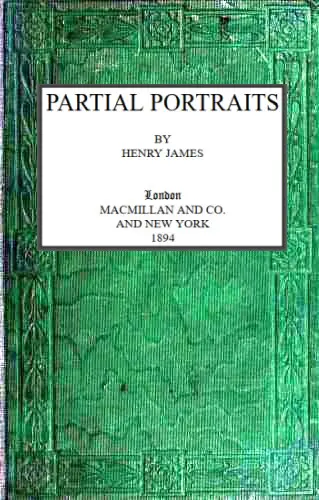
THE CLASSIC COLLECTION · 1888
"Partial Portraits" by Henry James is a collection of literary criticism published in 1888. This influential work gathers James's essays on major English, American, and European writers, exploring their unique artistic visions and techniques. The centerpiece is "The Art of Fiction," James's landmark argument for complete creative freedom in narrative writing. Through penetrating analyses of authors like George Eliot, Maupassant, and Turgenev, James champions each writer's distinctive perspective while establishing fiction's place among the fine arts. His elegant criticism reveals how different novelists view life through their own creative windows.
Introduction adapted from the source catalogue; source summaries may be automatically generated.
Free to read · English · 101,137 words · No account needed
MAKE TIME FOR A GOOD BOOK
On by default. Untick to stop anonymous reading totals. Each page counts after 10 seconds in view. How this works.
Anonymous counting is on unless you have switched it off.
But it would be hard to say (within the circle in which he revolved) what material he neglected. I have allowed myself to be detained so long by general considerations that I have almost forfeited the opportunity to give examples. I have spoken of The Warden not only because it made his reputation, but because, taken in conjunction with Barchester Towers, it is thought by many people to be his highest flight. Barchester Towers is admirable; it has an almost Thackerayan richness. Archdeacon Grantley grows more and more into life, and Mr. Harding is as charming as ever. Mrs. Proudie is ushered into a world in which she was to make so great an impression. Mrs. Proudie has become classical; of all Trollope’s characters she is the most often referred to. She is exceedingly true; but I do not think she is quite so good as her fame, and as several figures from the same hand that have not won so much honour. She is rather too violent, too vixenish, too sour. The truly awful female bully--the completely fatal episcopal spouse--would have, I think, a more insidious form, a greater amount of superficial padding. The Stanhope family, in Barchester Towers, are a real trouvaille, and the idea of transporting the Signora Vesey-Neroni into a cathedral-town was an inspiration. There could not be a better example of Trollope’s manner of attaching himself to character than the whole picture of Bertie Stanhope. Bertie is a delightful creation; and the scene in which, at the party given by Mrs. Proudie, he puts this majestic woman to rout is one of the most amusing in all the chronicles of Barset. It is perhaps permitted to wish, by the way, that this triumph had been effected by means intellectual rather than physical; though, indeed, if Bertie had not despoiled her of her drapery we should have lost the lady’s admirable “Unhand it, sir!” Mr. Arabin is charming, and the henpecked bishop has painful truth; but Mr. Slope, I think, is a little too arrant a scamp. He is rather too much the old game; he goes too coarsely to work, and his clamminess and cant are somewhat overdone. He is an interesting illustration, however, of the author’s dislike (at that period at least) of the bareness of evangelical piety. In one respect Barchester Towers is (to the best of our recollection) unique, being the only one of Trollope’s novels in which the interest does not centre more or less upon a simple maiden in her flower. The novel offers us nothing in the way of a girl; though we know that this attractive object was to lose nothing by waiting. Eleanor Bold is a charming and natural person, but Eleanor Bold is not in her flower. After this, however, Trollope settled down steadily to the English girl; he took possession of her, and turned her inside out. He never made her a subject of heartless satire, as cynical fabulists of other lands have been known to make the shining daughters of those climes; he bestowed upon her the most serious, the most patient, the most tender, the most copious consideration. He is evidently always more or less in love with her, and it is a wonder how under these circumstances he should make her so objective, plant her so well on her feet. But, as I have said, if he was a lover, he was a paternal lover; as competent as a father who has had fifty daughters. He has presented the British maiden under innumerable names, in every station and in every emergency in life, and with every combination of moral and physical qualities. She is always definite and natural. She plays her part most properly. She has always health in her cheek and gratitude in her eye. She has not a touch of the morbid, and is delightfully tender, modest and fresh. Trollope’s heroines have a strong family likeness, but it is a wonder how finely he discriminates between them. One feels, as one reads him, like a man with “sets” of female cousins. Such a person is inclined at first to lump each group together; but presently he finds that even in the groups there are subtle differences. Trollope’s girls, for that matter, would make delightful cousins. He has scarcely drawn, that we can remember, a disagreeable damsel. Lady Alexandrina de Courcy is disagreeable, and so is Amelia Roper, and so are various provincial (and indeed metropolitan) spinsters, who set their caps at young clergymen and government clerks. Griselda Grantley was a stick; and considering that she was intended to be attractive, Alice Vavasor does not commend herself particularly to our affections. But the young women I have mentioned had ceased to belong to the blooming season; they had entered the bristling, or else the limp, period. Not that Trollope’s more mature spinsters invariably fall into these extremes. Miss Thorne of Ullathorne, Miss Dunstable, Miss Mackenzie, Rachel Ray (if she may be called mature), Miss Baker and Miss Todd, in The Bertrams, Lady Julia Guest, who comforts poor John Eames: these and many other amiable figures rise up to contradict the idea. A gentleman who had sojourned in many lands was once asked by a lady (neither of these persons was English), in what country he had found the women most to his taste. “Well, in England,” he replied. “In England?” the lady repeated. “Oh yes,” said her interlocutor; “they are so affectionate!” The remark was fatuous, but it has the merit of describing Trollope’s heroines. They are so affectionate. Mary Thorne, Lucy Robarts, Adela Gauntlet, Lily Dale, Nora Rowley, Grace Crawley, have a kind of clinging tenderness, a passive sweetness, which is quite in the old English tradition. Trollope’s genius is not the genius of Shakespeare, but his heroines have something of the fragrance of Imogen and Desdemona. There are two little stories to which, I believe, his name has never been affixed, but which he is known to have written, that contain an extraordinarily touching representation of the passion of love in its most sensitive form. In Linda Tressel and Nina Balatka the vehicle is plodding prose, but the effect is none the less poignant. And in regard to this I may say that in a hundred places in Trollope the extremity of pathos is reached by the homeliest means. He often achieved a conspicuous intensity of the tragical. The long, slow process of the conjugal wreck of Louis Trevelyan and his wife (in He Knew He Was Right), with that rather lumbering movement which is often characteristic of Trollope, arrives at last at an impressive completeness of misery. It is the history of an accidental rupture between two stiff-necked and ungracious people--“the little rift within the lute”--which widens at last into a gulf of anguish. Touch is added to touch, one small, stupid, fatal aggravation to another; and as we gaze into the widening breach we wonder at the vulgar materials of which tragedy sometimes composes itself. I have always remembered the chapter called “Casalunga,” toward the close of He Knew He Was Right, as a powerful picture of the insanity of stiff-neckedness. Louis Trevelyan, separated from his wife, alone, haggard, suspicious, unshaven, undressed, living in a desolate villa on a hill-top near Siena and returning doggedly to his fancied wrong, which he has nursed until it becomes an hallucination, is a picture worthy of Balzac. Here and in several other places Trollope has dared to be thoroughly logical; he has not sacrificed to conventional optimism; he has not been afraid of a misery which should be too much like life. He has had the same courage in the history of the wretched Mr. Crawley and in that of the much-to-be-pitied Lady Mason. In this latter episode he found an admirable subject. A quiet, charming, tender-souled English gentlewoman who (as I remember the story of Orley Farm) forges a codicil to a will in order to benefit her son, a young prig who doesn’t appreciate immoral heroism, and who is suspected, accused, tried, and saved from conviction only by some turn of fortune that I forget; who is furthermore an object of high-bred, respectful, old-fashioned gallantry on the part of a neighbouring baronet, so that she sees herself dishonoured in his eyes as well as condemned in those of her boy: such a personage and such a situation would be sure to yield, under Trollope’s handling, the last drop of their reality.
Your reading position is saved on this browser. Take it to another device with a library code. Reading pages adapt to text, rather than matching a printed edition.
Henry James
Henry James
Henry James

Henry James
BEHIND THE BOOK
This eBook is for the use of anyone anywhere in the United States and most other parts of the world at no cost and with almost no restrictions whatsoever. You may copy it, give it away or re-use it under the terms of the Project Gutenberg License included with this eBook or online at www.gutenberg.org. If you are not located in the United States, you will have to check the laws of the country where you are located before using this eBook. Read the source licence.
The original source file, including credits and licence, is retained by this library. Request an original-format copy at no charge. Please include the book title and Project Gutenberg identifier #58471.
KEEP YOUR CURIOSITY GOING

David Patterson (Spirit) Hatch

David Patterson (Spirit) Hatch

David Patterson (Spirit) Hatch
Cécile Tormay

Moritz Busch
John L. Ransom