THE CLASSIC COLLECTION✦Hawthorne (English Men of Letters Series)CLASSIC FREE BOOKS
Hawthorne (English Men of Letters Series)
Henry James
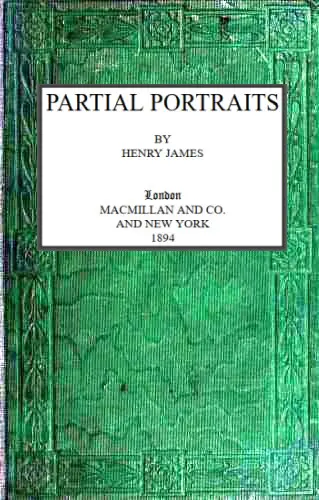
THE CLASSIC COLLECTION · 1888
"Partial Portraits" by Henry James is a collection of literary criticism published in 1888. This influential work gathers James's essays on major English, American, and European writers, exploring their unique artistic visions and techniques. The centerpiece is "The Art of Fiction," James's landmark argument for complete creative freedom in narrative writing. Through penetrating analyses of authors like George Eliot, Maupassant, and Turgenev, James champions each writer's distinctive perspective while establishing fiction's place among the fine arts. His elegant criticism reveals how different novelists view life through their own creative windows.
Introduction adapted from the source catalogue; source summaries may be automatically generated.
Free to read · English · 101,137 words · No account needed
MAKE TIME FOR A GOOD BOOK
On by default. Untick to stop anonymous reading totals. Each page counts after 10 seconds in view. How this works.
Anonymous counting is on unless you have switched it off.
I would speak in some detail of Barchester Towers if this did not seem to commit me to the prodigious task of appreciating each of Trollope’s works in succession. Such an attempt as that is so far from being possible that I must frankly confess to not having read everything that proceeded from his pen. There came a moment in his vigorous career (it was even a good many years ago) when I renounced the effort to “keep up” with him. It ceased to seem obligatory to have read his last story; it ceased soon to be very possible to know which was his last. Before that, I had been punctual, devoted; and the memories of the earlier period are delightful. It reached, if I remember correctly, to about the publication of He Knew He Was Right; after which, to my recollection (oddly enough, too, for that novel was good enough to encourage a continuance of past favours, as the shopkeepers say), the picture becomes dim and blurred. The author of Orley Farm and The Small House at Allington ceased to produce individual works; his activity became a huge “serial.” Here and there, in the vast fluidity, an organic particle detached itself. The Last Chronicle of Barset, for instance, is one of his most powerful things; it contains the sequel of the terrible history of Mr. Crawley, the starving curate--an episode full of that literally truthful pathos of which Trollope was so often a master, and which occasionally raised him quite to the level of his two immediate predecessors in the vivid treatment of English life--great artists whose pathetic effects were sometimes too visibly prepared. For the most part, however, he should be judged by the productions of the first half of his career; later the strong wine was rather too copiously watered. His practice, his acquired facility, were such that his hand went of itself, as it were, and the thing looked superficially like a fresh inspiration. But it was not fresh, it was rather stale; and though there was no appearance of effort, there was a fatal dryness of texture. It was too little of a new story and too much of an old one. Some of these ultimate compositions--Phineas Redux (Phineas Finn is much better), The Prime Minister, John Caldigate, The American Senator, The Duke’s Children--betray the dull, impersonal rumble of the mill-wheel. What stands Trollope always in good stead (in addition to the ripe habit of writing), is his various knowledge of the English world--to say nothing of his occasionally laying under contribution the American. His American portraits, by the way (they are several in number), are always friendly; they hit it off more happily than the attempt to depict American character from the European point of view is accustomed to do: though, indeed, as we ourselves have not yet learned to represent our types very finely--are not apparently even very sure what our types are--it is perhaps not to be wondered at that transatlantic talent should miss the mark. The weakness of transatlantic talent in this particular is apt to be want of knowledge; but Trollope’s knowledge has all the air of being excellent, though not intimate. Had he indeed striven to learn the way to the American heart? No less than twice, and possibly even oftener, has he rewarded the merit of a scion of the British aristocracy with the hand of an American girl. The American girl was destined sooner or later to make her entrance into British fiction, and Trollope’s treatment of this complicated being is full of good humour and of that fatherly indulgence, that almost motherly sympathy, which characterises his attitude throughout toward the youthful feminine. He has not mastered all the springs of her delicate organism nor sounded all the mysteries of her conversation. Indeed, as regards these latter phenomena, he has observed a few of which he has been the sole observer. “I got to be thinking if any one of them should ask me to marry him,” words attributed to Miss Boncassen, in The Duke’s Children, have much more the note of English American than of American English. But, on the whole, in these matters Trollope does very well. His fund of acquaintance with his own country--and indeed with the world at large--was apparently inexhaustible, and it gives his novels a spacious, geographical quality which we should not know where to look for elsewhere in the same degree, and which is the sign of an extraordinary difference between such an horizon as his and the limited world-outlook, as the Germans would say, of the brilliant writers who practise the art of realistic fiction on the other side of the Channel. Trollope was familiar with all sorts and conditions of men, with the business of life, with affairs, with the great world of sport, with every component part of the ancient fabric of English society. He had travelled more than once all over the globe, and for him, therefore, the background of the human drama was a very extensive scene. He had none of the pedantry of the cosmopolite; he remained a sturdy and sensible middle-class Englishman. But his work is full of implied reference to the whole arena of modern vagrancy. He was for many years concerned in the management of the Post-Office; and we can imagine no experience more fitted to impress a man with the diversity of human relations. It is possibly from this source that he derived his fondness for transcribing the letters of his love-lorn maidens and other embarrassed persons. No contemporary story-teller deals so much in letters; the modern English epistle (very happily imitated, for the most part), is his unfailing resource.
Your reading position is saved on this browser. Take it to another device with a library code. Reading pages adapt to text, rather than matching a printed edition.
Henry James
Henry James
Henry James

Henry James
BEHIND THE BOOK
This eBook is for the use of anyone anywhere in the United States and most other parts of the world at no cost and with almost no restrictions whatsoever. You may copy it, give it away or re-use it under the terms of the Project Gutenberg License included with this eBook or online at www.gutenberg.org. If you are not located in the United States, you will have to check the laws of the country where you are located before using this eBook. Read the source licence.
The original source file, including credits and licence, is retained by this library. Request an original-format copy at no charge. Please include the book title and Project Gutenberg identifier #58471.
KEEP YOUR CURIOSITY GOING

David Patterson (Spirit) Hatch

David Patterson (Spirit) Hatch

David Patterson (Spirit) Hatch
Cécile Tormay

Moritz Busch
John L. Ransom