THE CLASSIC COLLECTION✦Hawthorne (English Men of Letters Series)CLASSIC FREE BOOKS
Hawthorne (English Men of Letters Series)
Henry James
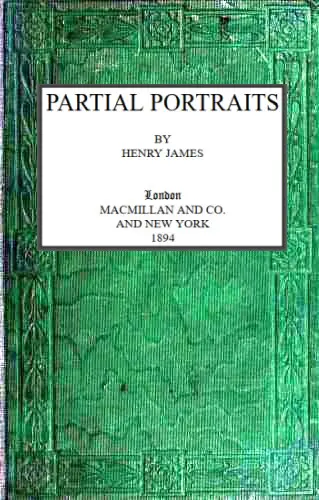
THE CLASSIC COLLECTION · 1888
"Partial Portraits" by Henry James is a collection of literary criticism published in 1888. This influential work gathers James's essays on major English, American, and European writers, exploring their unique artistic visions and techniques. The centerpiece is "The Art of Fiction," James's landmark argument for complete creative freedom in narrative writing. Through penetrating analyses of authors like George Eliot, Maupassant, and Turgenev, James champions each writer's distinctive perspective while establishing fiction's place among the fine arts. His elegant criticism reveals how different novelists view life through their own creative windows.
Introduction adapted from the source catalogue; source summaries may be automatically generated.
Free to read · English · 101,137 words · No account needed
MAKE TIME FOR A GOOD BOOK
On by default. Untick to stop anonymous reading totals. Each page counts after 10 seconds in view. How this works.
Anonymous counting is on unless you have switched it off.
Mr. Besant has some remarks on the question of “the story” which I shall not attempt to criticise, though they seem to me to contain a singular ambiguity, because I do not think I understand them. I cannot see what is meant by talking as if there were a part of a novel which is the story and part of it which for mystical reasons is not--unless indeed the distinction be made in a sense in which it is difficult to suppose that any one should attempt to convey anything. “The story,” if it represents anything, represents the subject, the idea, the donnée of the novel; and there is surely no “school”--Mr. Besant speaks of a school--which urges that a novel should be all treatment and no subject. There must assuredly be something to treat; every school is intimately conscious of that. This sense of the story being the idea, the starting-point, of the novel, is the only one that I see in which it can be spoken of as something different from its organic whole; and since in proportion as the work is successful the idea permeates and penetrates it, informs and animates it, so that every word and every punctuation-point contribute directly to the expression, in that proportion do we lose our sense of the story being a blade which may be drawn more or less out of its sheath. The story and the novel, the idea and the form, are the needle and thread, and I never heard of a guild of tailors who recommended the use of the thread without the needle, or the needle without the thread. Mr. Besant is not the only critic who may be observed to have spoken as if there were certain things in life which constitute stories, and certain others which do not. I find the same odd implication in an entertaining article in the Pall Mall Gazette, devoted, as it happens, to Mr. Besant’s lecture. “The story is the thing!” says this graceful writer, as if with a tone of opposition to some other idea. I should think it was, as every painter who, as the time for “sending in” his picture looms in the distance, finds himself still in quest of a subject--as every belated artist not fixed about his theme will heartily agree. There are some subjects which speak to us and others which do not, but he would be a clever man who should undertake to give a rule--an index expurgatorius--by which the story and the no-story should be known apart. It is impossible (to me at least) to imagine any such rule which shall not be altogether arbitrary. The writer in the Pall Mall opposes the delightful (as I suppose) novel of Margot la Balafrée to certain tales in which “Bostonian nymphs” appear to have “rejected English dukes for psychological reasons.” I am not acquainted with the romance just designated, and can scarcely forgive the Pall Mall critic for not mentioning the name of the author, but the title appears to refer to a lady who may have received a scar in some heroic adventure. I am inconsolable at not being acquainted with this episode, but am utterly at a loss to see why it is a story when the rejection (or acceptance) of a duke is not, and why a reason, psychological or other, is not a subject when a cicatrix is. They are all particles of the multitudinous life with which the novel deals, and surely no dogma which pretends to make it lawful to touch the one and unlawful to touch the other will stand for a moment on its feet. It is the special picture that must stand or fall, according as it seem to possess truth or to lack it. Mr. Besant does not, to my sense, light up the subject by intimating that a story must, under penalty of not being a story, consist of “adventures.” Why of adventures more than of green spectacles? He mentions a category of impossible things, and among them he places “fiction without adventure.” Why without adventure, more than without matrimony, or celibacy, or parturition, or cholera, or hydropathy, or Jansenism? This seems to me to bring the novel back to the hapless little rôle of being an artificial, ingenious thing--bring it down from its large, free character of an immense and exquisite correspondence with life. And what is adventure, when it comes to that, and by what sign is the listening pupil to recognise it? It is an adventure--an immense one--for me to write this little article; and for a Bostonian nymph to reject an English duke is an adventure only less stirring, I should say, than for an English duke to be rejected by a Bostonian nymph. I see dramas within dramas in that, and innumerable points of view. A psychological reason is, to my imagination, an object adorably pictorial; to catch the tint of its complexion--I feel as if that idea might inspire one to Titianesque efforts. There are few things more exciting to me, in short, than a psychological reason, and yet, I protest, the novel seems to me the most magnificent form of art. I have just been reading, at the same time, the delightful story of Treasure Island, by Mr. Robert Louis Stevenson and, in a manner less consecutive, the last tale from M. Edmond de Goncourt, which is entitled Chérie. One of these works treats of murders, mysteries, islands of dreadful renown, hairbreadth escapes, miraculous coincidences and buried doubloons. The other treats of a little French girl who lived in a fine house in Paris, and died of wounded sensibility because no one would marry her. I call Treasure Island delightful, because it appears to me to have succeeded wonderfully in what it attempts; and I venture to bestow no epithet upon Chérie, which strikes me as having failed deplorably in what it attempts--that is in tracing the development of the moral consciousness of a child. But one of these productions strikes me as exactly as much of a novel as the other, and as having a “story” quite as much. The moral consciousness of a child is as much a part of life as the islands of the Spanish Main, and the one sort of geography seems to me to have those “surprises” of which Mr. Besant speaks quite as much as the other. For myself (since it comes back in the last resort, as I say, to the preference of the individual), the picture of the child’s experience has the advantage that I can at successive steps (an immense luxury, near to the “sensual pleasure” of which Mr. Besant’s critic in the Pall Mall speaks) say Yes or No, as it may be, to what the artist puts before me. I have been a child in fact, but I have been on a quest for a buried treasure only in supposition, and it is a simple accident that with M. de Goncourt I should have for the most part to say No. With George Eliot, when she painted that country with a far other intelligence, I always said Yes.
Your reading position is saved on this browser. Take it to another device with a library code. Reading pages adapt to text, rather than matching a printed edition.
Henry James
Henry James
Henry James

Henry James
BEHIND THE BOOK
This eBook is for the use of anyone anywhere in the United States and most other parts of the world at no cost and with almost no restrictions whatsoever. You may copy it, give it away or re-use it under the terms of the Project Gutenberg License included with this eBook or online at www.gutenberg.org. If you are not located in the United States, you will have to check the laws of the country where you are located before using this eBook. Read the source licence.
The original source file, including credits and licence, is retained by this library. Request an original-format copy at no charge. Please include the book title and Project Gutenberg identifier #58471.
KEEP YOUR CURIOSITY GOING

David Patterson (Spirit) Hatch

David Patterson (Spirit) Hatch

David Patterson (Spirit) Hatch
Cécile Tormay

Moritz Busch
John L. Ransom