THE CLASSIC COLLECTION✦Hawthorne (English Men of Letters Series)CLASSIC FREE BOOKS
Hawthorne (English Men of Letters Series)
Henry James
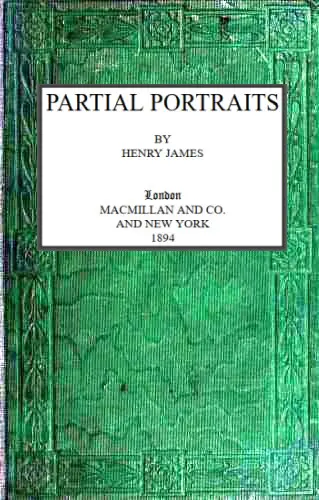
THE CLASSIC COLLECTION · 1888
"Partial Portraits" by Henry James is a collection of literary criticism published in 1888. This influential work gathers James's essays on major English, American, and European writers, exploring their unique artistic visions and techniques. The centerpiece is "The Art of Fiction," James's landmark argument for complete creative freedom in narrative writing. Through penetrating analyses of authors like George Eliot, Maupassant, and Turgenev, James champions each writer's distinctive perspective while establishing fiction's place among the fine arts. His elegant criticism reveals how different novelists view life through their own creative windows.
Introduction adapted from the source catalogue; source summaries may be automatically generated.
Free to read · English · 101,137 words · No account needed
MAKE TIME FOR A GOOD BOOK
On by default. Untick to stop anonymous reading totals. Each page counts after 10 seconds in view. How this works.
Anonymous counting is on unless you have switched it off.
I ought to add, however, that if Mr. Besant says at the beginning of his essay that the “laws of fiction may be laid down and taught with as much precision and exactness as the laws of harmony, perspective, and proportion,” he mitigates what might appear to be an extravagance by applying his remark to “general” laws, and by expressing most of these rules in a manner with which it would certainly be unaccommodating to disagree. That the novelist must write from his experience, that his “characters must be real and such as might be met with in actual life;” that “a young lady brought up in a quiet country village should avoid descriptions of garrison life,” and “a writer whose friends and personal experiences belong to the lower middle-class should carefully avoid introducing his characters into society;” that one should enter one’s notes in a common-place book; that one’s figures should be clear in outline; that making them clear by some trick of speech or of carriage is a bad method, and “describing them at length” is a worse one; that English Fiction should have a “conscious moral purpose;” that “it is almost impossible to estimate too highly the value of careful workmanship--that is, of style;” that “the most important point of all is the story,” that “the story is everything”: these are principles with most of which it is surely impossible not to sympathise. That remark about the lower middle-class writer and his knowing his place is perhaps rather chilling; but for the rest I should find it difficult to dissent from any one of these recommendations. At the same time, I should find it difficult positively to assent to them, with the exception, perhaps, of the injunction as to entering one’s notes in a common-place book. They scarcely seem to me to have the quality that Mr. Besant attributes to the rules of the novelist--the “precision and exactness” of “the laws of harmony, perspective, and proportion.” They are suggestive, they are even inspiring, but they are not exact, though they are doubtless as much so as the case admits of: which is a proof of that liberty of interpretation for which I just contended. For the value of these different injunctions--so beautiful and so vague--is wholly in the meaning one attaches to them. The characters, the situation, which strike one as real will be those that touch and interest one most, but the measure of reality is very difficult to fix. The reality of Don Quixote or of Mr. Micawber is a very delicate shade; it is a reality so coloured by the author’s vision that, vivid as it may be, one would hesitate to propose it as a model: one would expose one’s self to some very embarrassing questions on the part of a pupil. It goes without saying that you will not write a good novel unless you possess the sense of reality; but it will be difficult to give you a recipe for calling that sense into being. Humanity is immense, and reality has a myriad forms; the most one can affirm is that some of the flowers of fiction have the odour of it, and others have not; as for telling you in advance how your nosegay should be composed, that is another affair. It is equally excellent and inconclusive to say that one must write from experience; to our supposititious aspirant such a declaration might savour of mockery. What kind of experience is intended, and where does it begin and end? Experience is never limited, and it is never complete; it is an immense sensibility, a kind of huge spider-web of the finest silken threads suspended in the chamber of consciousness, and catching every airborne particle in its tissue. It is the very atmosphere of the mind; and when the mind is imaginative--much more when it happens to be that of a man of genius--it takes to itself the faintest hints of life, it converts the very pulses of the air into revelations. The young lady living in a village has only to be a damsel upon whom nothing is lost to make it quite unfair (as it seems to me) to declare to her that she shall have nothing to say about the military. Greater miracles have been seen than that, imagination assisting, she should speak the truth about some of these gentlemen. I remember an English novelist, a woman of genius, telling me that she was much commended for the impression she had managed to give in one of her tales of the nature and way of life of the French Protestant youth. She had been asked where she learned so much about this recondite being, she had been congratulated on her peculiar opportunities. These opportunities consisted in her having once, in Paris, as she ascended a staircase, passed an open door where, in the household of a pasteur, some of the young Protestants were seated at table round a finished meal. The glimpse made a picture; it lasted only a moment, but that moment was experience. She had got her direct personal impression, and she turned out her type. She knew what youth was, and what Protestantism; she also had the advantage of having seen what it was to be French, so that she converted these ideas into a concrete image and produced a reality. Above all, however, she was blessed with the faculty which when you give it an inch takes an ell, and which for the artist is a much greater source of strength than any accident of residence or of place in the social scale. The power to guess the unseen from the seen, to trace the implication of things, to judge the whole piece by the pattern, the condition of feeling life in general so completely that you are well on your way to knowing any particular corner of it--this cluster of gifts may almost be said to constitute experience, and they occur in country and in town, and in the most differing stages of education. If experience consists of impressions, it may be said that impressions are experience, just as (have we not seen it?) they are the very air we breathe. Therefore, if I should certainly say to a novice, “Write from experience and experience only,” I should feel that this was rather a tantalising monition if I were not careful immediately to add, “Try to be one of the people on whom nothing is lost!”
Your reading position is saved on this browser. Take it to another device with a library code. Reading pages adapt to text, rather than matching a printed edition.
Henry James
Henry James
Henry James

Henry James
BEHIND THE BOOK
This eBook is for the use of anyone anywhere in the United States and most other parts of the world at no cost and with almost no restrictions whatsoever. You may copy it, give it away or re-use it under the terms of the Project Gutenberg License included with this eBook or online at www.gutenberg.org. If you are not located in the United States, you will have to check the laws of the country where you are located before using this eBook. Read the source licence.
The original source file, including credits and licence, is retained by this library. Request an original-format copy at no charge. Please include the book title and Project Gutenberg identifier #58471.
KEEP YOUR CURIOSITY GOING

David Patterson (Spirit) Hatch

David Patterson (Spirit) Hatch

David Patterson (Spirit) Hatch
Cécile Tormay

Moritz Busch
John L. Ransom