THE CLASSIC COLLECTION✦Hawthorne (English Men of Letters Series)CLASSIC FREE BOOKS
Hawthorne (English Men of Letters Series)
Henry James
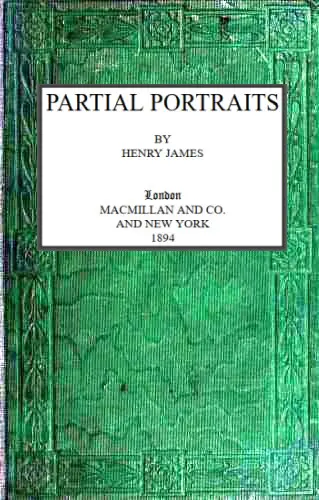
THE CLASSIC COLLECTION · 1888
"Partial Portraits" by Henry James is a collection of literary criticism published in 1888. This influential work gathers James's essays on major English, American, and European writers, exploring their unique artistic visions and techniques. The centerpiece is "The Art of Fiction," James's landmark argument for complete creative freedom in narrative writing. Through penetrating analyses of authors like George Eliot, Maupassant, and Turgenev, James champions each writer's distinctive perspective while establishing fiction's place among the fine arts. His elegant criticism reveals how different novelists view life through their own creative windows.
Introduction adapted from the source catalogue; source summaries may be automatically generated.
Free to read · English · 101,137 words · No account needed
MAKE TIME FOR A GOOD BOOK
On by default. Untick to stop anonymous reading totals. Each page counts after 10 seconds in view. How this works.
Anonymous counting is on unless you have switched it off.
His was not, I should say, predominantly, or even in a high degree, the artistic nature, though it was deeply, if I may make the distinction, the poetic. But during the last twelve years of his life he lived much with artists and men of letters, and he was eminently capable of kindling in the glow of discussion. He cared for questions of form, though not in the degree in which Flaubert and Edmond de Goncourt cared for them, and he had very lively sympathies. He had a great regard for Madame George Sand, the head and front of the old romantic tradition; but this was on general grounds, quite independent of her novels, which he never read, and which she never expected him, or apparently any one else, to read. He thought her character remarkably noble and sincere. He had, as I have said, a great affection for Gustave Flaubert, who returned it; and he was much interested in Flaubert’s extraordinary attempts at bravery of form and of matter, knowing perfectly well when they failed. During those months which it was Flaubert’s habit to spend in Paris, Turgénieff went almost regularly to see him on Sunday afternoon, and was so good as to introduce me to the author of Madame Bovary, in whom I saw many reasons for Turgénieff’s regard. It was on these Sundays, in Flaubert’s little salon, which, at the top of a house at the end of the Faubourg Saint-Honoré, looked rather bare and provisional, that, in the company of the other familiars of the spot, more than one of whom[6] have commemorated these occasions, Turgénieff’s beautiful faculty of talk showed at its best. He was easy, natural, abundant, more than I can describe, and everything that he said was touched with the exquisite quality of his imagination. What was discussed in that little smoke-clouded room was chiefly questions of taste, questions of art and form; and the speakers, for the most part, were in æsthetic matters, radicals of the deepest dye. It would have been late in the day to propose among them any discussion of the relation of art to morality, any question as to the degree in which a novel might or might not concern itself with the teaching of a lesson. They had settled these preliminaries long ago, and it would have been primitive and incongruous to recur to them. The conviction that held them together was the conviction that art and morality are two perfectly different things, and that the former has no more to do with the latter than it has with astronomy or embryology. The only duty of a novel was to be well written; that merit included every other of which it was capable. This state of mind was never more apparent than one afternoon when ces messieurs delivered themselves on the subject of an incident which had just befallen one of them. L’Assommoir of Emile Zola had been discontinued in the journal through which it was running as a serial, in consequence of repeated protests from the subscribers. The subscriber, as a type of human imbecility, received a wonderful dressing, and the Philistine in general was roughly handled. There were gulfs of difference between Turgénieff and Zola, but Turgénieff, who, as I say, understood everything, understood Zola too, and rendered perfect justice to the high solidity of much of his work. His attitude, at such times, was admirable, and I could imagine nothing more genial or more fitted to give an idea of light, easy, human intelligence. No one could desire more than he that art should be art; always, ever, incorruptibly, art. To him this proposition would have seemed as little in need of proof, or susceptible of refutation, as the axiom that law should always be law or medicine always medicine. As much as any one he was prepared to take note of the fact that the demand for abdications and concessions never comes from artists themselves, but always from purchasers, editors, subscribers. I am pretty sure that his word about all this would have been that he could not quite see what was meant by the talk about novels being moral or the reverse; that a novel could no more propose to itself to be moral than a painting or a symphony, and that it was arbitrary to lay down a distinction between the numerous forms of art. He was the last man to be blind to their unity. I suspect that he would have said, in short, that distinctions were demanded in the interest of the moralists, and that the demand was indelicate, owing to their want of jurisdiction. Yet at the same time that I make this suggestion as to his state of mind I remember how little he struck me as bound by mere neatness of formula, how little there was in him of the partisan or the pleader. What he thought of the relation of art to life his stories, after all, show better than anything else. The immense variety of life was ever present to his mind, and he would never have argued the question I have just hinted at in the interest of particular liberties--the liberties that were apparently the dearest to his French confrères. It was this air that he carried about with him of feeling all the variety of life, of knowing strange and far-off things, of having an horizon in which the Parisian horizon--so familiar, so wanting in mystery, so perpetually exploité--easily lost itself, that distinguished him from these companions. He was not all there, as the phrase is; he had something behind, in reserve. It was Russia, of course, in a large measure; and, especially before the spectacle of what is going on there to-day, that was a large quantity. But so far as he was on the spot, he was an element of pure sociability.
Your reading position is saved on this browser. Take it to another device with a library code. Reading pages adapt to text, rather than matching a printed edition.
Henry James
Henry James
Henry James

Henry James
BEHIND THE BOOK
This eBook is for the use of anyone anywhere in the United States and most other parts of the world at no cost and with almost no restrictions whatsoever. You may copy it, give it away or re-use it under the terms of the Project Gutenberg License included with this eBook or online at www.gutenberg.org. If you are not located in the United States, you will have to check the laws of the country where you are located before using this eBook. Read the source licence.
The original source file, including credits and licence, is retained by this library. Request an original-format copy at no charge. Please include the book title and Project Gutenberg identifier #58471.
KEEP YOUR CURIOSITY GOING

David Patterson (Spirit) Hatch

David Patterson (Spirit) Hatch

David Patterson (Spirit) Hatch
Cécile Tormay

Moritz Busch
John L. Ransom