THE CLASSIC COLLECTION✦Hawthorne (English Men of Letters Series)CLASSIC FREE BOOKS
Hawthorne (English Men of Letters Series)
Henry James
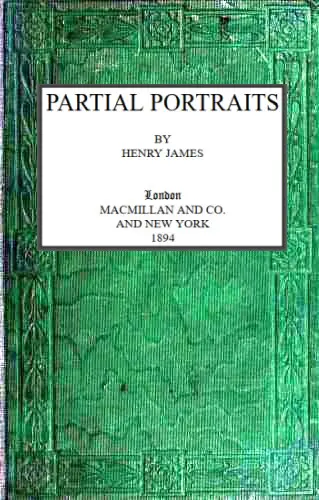
THE CLASSIC COLLECTION · 1888
"Partial Portraits" by Henry James is a collection of literary criticism published in 1888. This influential work gathers James's essays on major English, American, and European writers, exploring their unique artistic visions and techniques. The centerpiece is "The Art of Fiction," James's landmark argument for complete creative freedom in narrative writing. Through penetrating analyses of authors like George Eliot, Maupassant, and Turgenev, James champions each writer's distinctive perspective while establishing fiction's place among the fine arts. His elegant criticism reveals how different novelists view life through their own creative windows.
Introduction adapted from the source catalogue; source summaries may be automatically generated.
Free to read · English · 101,137 words · No account needed
MAKE TIME FOR A GOOD BOOK
On by default. Untick to stop anonymous reading totals. Each page counts after 10 seconds in view. How this works.
Anonymous counting is on unless you have switched it off.
Les Rois en Exil, however, has a greater perfection; it is simpler, more equal, and it contains much more of the beautiful. In Le Nabab there are various lacunæ and a certain want of logic; it is not a sustained narrative, but a series of almost diabolically clever pictures. But the other book has more largeness of line--a fine tragic movement which deepens and presses to the catastrophe. Daudet had observed that several dispossessed monarchs had taken up their residence in the French capital--some of them waiting and plotting for a restoration, and chafing under their disgrace; others indifferent, resigned, relieved, eager to console themselves with the pleasures of Paris. It occurred to him to suppose a drama in which these exalted personages should be the actors, and which, unlike either of his former productions, should have a pure and noble heroine. He was conscious of a dauntless little imagination, the idea of making kings and queens talk among themselves had no terror for him; he had faith in his good taste, in his exquisite powers of divination. The success is worthy of the spirit--the gallant artistic spirit--in which it was invoked. Les Rois en Exil is a finished picture. He has had, it is true, to simplify his subject a good deal to make it practicable; the court of the king and queen of Illyria, in the suburb of Saint-Mandé, is a little too much like a court in a fairy-tale. But the amiable depravity of Christian, in whom conviction, resolution, ambition, are hopelessly dead, and whose one desire is to enjoy Paris with the impunity of a young man about town; the proud, serious, concentrated nature of Frederica, who believes ardently in her royal function, and lives with her eyes fixed on the crown, which she regards as a symbol of duty; both of these conceptions do M. Daudet the utmost honour, and prove that he is capable of handling great situations--situations which have a depth of their own, and do not depend for their interest on amusing accidents. It takes perhaps some courage to say so, but the feelings, the passions, the view of life, of royal personages, differ essentially from those of common mortals; their education, their companions, their traditions, their exceptional position, take sufficient care of that. Alphonse Daudet has comprehended the difference; and I scarcely know, in the last few years, a straighter flight of imagination. The history of the queen of Illyria is a tragedy. Her husband sells his birthright for a few millions of francs, and rolls himself in the Parisian gutter; her child perishes from poverty of blood; she herself dries up in her despair. There is nothing finer in all Daudet than the pages, at the end of the book, which describe her visits to the great physician Bouchereau, when she takes her poor half-blind child by the hand, and (wishing an opinion unbiassed by the knowledge of her rank) goes to sit in his waiting-room like one of the vulgar multitude. Wonderful are the delicacy, the verity, the tenderness of these pages; we always point to them to justify our predilection. But we must stop pointing. We will not say more of Numa Roumestan than we have already said; for it is better to pass so happy a work by than to speak of it inadequately. We will only repeat that we delight in Numa Roumestan. Alphonse Daudet’s last book is a novelty at the time I write; L’Evangéliste has been before the public but a month or two. I will say but little of it, partly because my opportunity is already over, and partly because I have found that, for a fair judgment of one of Daudet’s works, the book should be read a second time, after a certain interval has elapsed. This interval has not brought round my second perusal of L’Evangéliste. My first suggests that with all the author’s present mastery of his resources the book has a grave defect. It is not that the story is painful; that is a defect only when the sources of this element are not, as I may say, abundant. It treats of a young girl (a Danish Protestant) who is turned to stone by a Medusa of Calvinism, the sombre and fanatical wife of a great Protestant banker. Madame Autheman persuades Eline Ebsen to wash her hands of the poor old mother with whom up to this moment she has lived in the closest affection, and go forth into strange countries to stir up the wicked to conversion. The excellent Madame Ebsen, bewildered, heart-broken, desperate, terrified at the imagined penalties of her denunciation of the rich and powerful bigot (so that she leaves her habitation and hides in a household of small mechanics to escape from them--one of the best episodes in the book), protests, struggles, goes down on her knees in vain; then, at last, stupefied and exhausted, desists, looks for the last time at her inexorable, impenetrable daughter, who has hard texts on her lips and no recognition in her eye, and who lets her pass away, without an embrace, for ever. The incident in itself is perfectly conceivable: many well-meaning persons have held human relationships cheap in the face of a religious call. But Daudet’s weakness has been simply a want of acquaintance with his subject. Proposing to himself to describe a particular phase of French Protestantism, he has “got up” certain of his facts with commendable zeal; but he has not felt nor understood the matter, has looked at it solely from the outside, sought to make it above all things grotesque and extravagant. Into these excesses it doubtless frequently falls; but there is a general human verity which regulates even the most stubborn wills, the most perverted lives; and of this saving principle the author, in quest of striking pictures, has rather lost his grasp. His pictures are striking, as a matter of course; but to us readers of Protestant race, familiar with the large, free, salubrious life which the children of that faith have carried with them over the globe, there is almost a kind of drollery in these fearsome pictures of the Protestant temperament. The fact is that M. Daudet has not (to my belief) any natural understanding of the religious passion; he has a quick perception of many things, but that province of the human mind cannot be fait de chic--experience, there, is the only explorer. Madame Autheman is not a real bigot; she is simply a dusky effigy, she is undemonstrated. Eline Ebsen is not a victim, inasmuch as she is but half alive, and victims are victims only in virtue of being thoroughly sentient. I do not easily perceive her spiritual joints. All the human part of the book, however, has the author’s habitual felicity; and the reader of these remarks knows what I hold that to be. It may seem to him, indeed, that in making the concession I made just above--in saying that Alphonse Daudet’s insight fails him when he begins to take the soul into account--I partly retract some of the admiration I have expressed for him. For that amounts, after all, to saying that he has no high imagination, and, as a consequence, no ideas. It is very true, I am afraid, that he has not a great number of ideas. There are certain things he does not conceive--certain forms that never appear to him. Imaginative writers of the first order always give us an impression that they have a kind of philosophy. We should be embarrassed to put our finger on Daudet’s philosophy. “And yet you have praised him so much,” we fancy we hear it urged; “you have praised him as if he were one of the very first.” All that is very true, and yet we take nothing back. Determinations of rank are a delicate matter, and it is sufficient priority for an author that one likes him immensely. Daudet is bright, vivid, tender; he has an intense artistic life. And then he is so free. For the spirit that moves slowly, going carefully from point to point, not sure whether this or that or the other will “do,” the sight of such freedom is delightful.
Your reading position is saved on this browser. Take it to another device with a library code. Reading pages adapt to text, rather than matching a printed edition.
Henry James
Henry James
Henry James

Henry James
BEHIND THE BOOK
This eBook is for the use of anyone anywhere in the United States and most other parts of the world at no cost and with almost no restrictions whatsoever. You may copy it, give it away or re-use it under the terms of the Project Gutenberg License included with this eBook or online at www.gutenberg.org. If you are not located in the United States, you will have to check the laws of the country where you are located before using this eBook. Read the source licence.
The original source file, including credits and licence, is retained by this library. Request an original-format copy at no charge. Please include the book title and Project Gutenberg identifier #58471.
KEEP YOUR CURIOSITY GOING

David Patterson (Spirit) Hatch

David Patterson (Spirit) Hatch

David Patterson (Spirit) Hatch
Cécile Tormay

Moritz Busch
John L. Ransom