
Why not? A book for every woman
Horatio Robinson Storer
THE CLASSIC COLLECTION · 1860
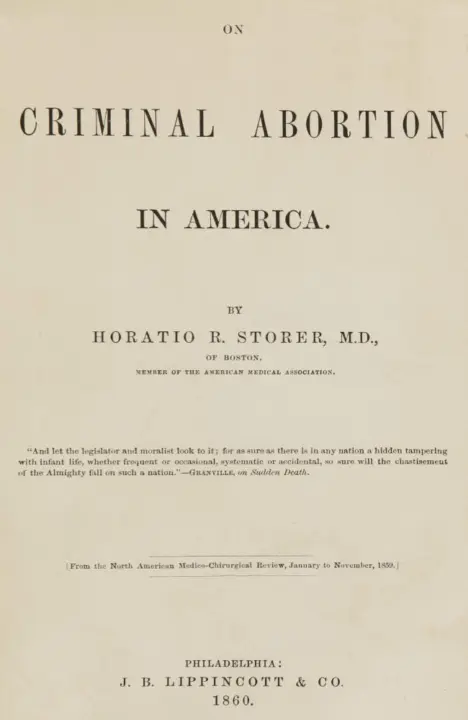
"On Criminal Abortion in America" by Horatio Robinson Storer is a medical treatise written in the mid-19th century. The work critically examines the legal and moral issues surrounding abortion, highlighting its perceived status as a crime against fetal life that has largely been overlooked by existing laws. Storer argues for the need for a more robust legal framework that reflects society's moral responsibilities toward both mothers and their unborn children. The opening of the text lays the groundwork for a detailed investigation into the complexities and frequency of criminal abortion, outlining the initial assumptions and subsequent arguments necessary for the discourse. Storer addresses the legal ambiguities surrounding abortion, emphasizing that common law and many state codes largely ignore fetal life, positioning the crime as one primarily against the mother. He goes on to assert the necessity of evaluating the frequency and consequences of this practice, suggesting that the medical community has a pivotal role in shaping public sentiment and legal standards regarding abortion. Storer prepares the reader for an exploration of both the legislative deficiencies and the ethical imperative for medical professionals and society as a whole to confront this "great opprobrium of the law."
Introduction adapted from the source catalogue; source summaries may be automatically generated.
Free to read · English · 45,185 words · No account needed
MAKE TIME FOR A GOOD BOOK
On by default. Untick to stop anonymous reading totals. Each page counts after 10 seconds in view. How this works.
Anonymous counting is on unless you have switched it off.
[124] Med. Times and Gazette, Jan., 1856, p. 611.
[125] “This operation must not on any account be undertaken without the sanction, and in the presence, of another practitioner.”—CLAY, Hand-book of Obstetric Surgery, p. 13.
[126] 1 GABBETT, Cr. Law, 523.
[127] Loc. cit.
[128] CHEVALIER and DEVERGIE, Ann. d’Hyg., 1856, p. 157.
[129] Med. Jurisp.; Griffith’s ed., p. 472, Hartshorne’s ed., p. 378.
[130] TARDIEU, loc. cit., 1856, p. 124.
[131] A Woman’s Thoughts about Women. By the author of “John Halifax, Gentleman.” 1858, p. 14.
[132] Loc. cit.
[133] Ibid.
[134] Mass. Laws of 1847, chap. 83.
[135] “By imprisonment in the State prison, house of correction, or common jail, not more than three years, or by fine not exceeding one thousand dollars.”
[136] Opera omnia. Ed. 1655, i., p. 643.
[137] JÖRG of Leipsic, who speaks of the human fœtus as “only a higher species of intestinal worm, not endowed with a human soul, nor entitled to human attributes.”
[138] SIMPSON, Obst. Works, i. pp. 352, 404.
[139] Boston Med. and Surg. Journal, January, 1857, p. 462.
[140] The immorality of craniotomy, where delivery can be effected by any other method, is gradually becoming acknowledged in Great Britain. A late discussion on this subject, at the Obstetric Society of London, is reported in the Medical Times and Gazette for February, 1859.
[141] CLAY, Obstetric Surgery, p. 68.
[142] SINCLAIR and JOHNSTON, Practical Midwifery, 1858. 130 cases of craniotomy in 13,748 labors.
[143] CLAY, Loc. cit., p. 69.
[144] The subject of justifiable craniotomy has of late been ably though controversially discussed by an anonymous writer (Dublin Review, April and October, 1858,) and Dr. Churchill (Dublin Quarterly Journal of Medical Science, August and November, of the same year). Care must be taken, lest in assenting to the decided and imperative necessity of the operation in certain cases, and by a natural professional sympathy, too great frequency is not allowed to this most horrible and appalling of all the operations to which as physicians we can ever be called.
[145] Review of CLAY’s Obstetric Surgery; Boston Med. and Surg. Journal, November, 1856, p. 283.
[146] Theory and Practice of Midwifery, p. 348.
[147] De jure vitæ et necis quod competit medico in partu. Heidelberg,
1826.
[148] “Where one only can by any possibility be preserved, the female herself may use her right of self-preservation and choose whether her own life or that of her child shall fall a sacrifice.” GUY, Principles of Forensic Medicine, p. 145.
[149] Guy’s Hospital Reports, 1856, p. 12.
[150] Dublin Quarterly Journ. of Med. Science, August, 1858, p. 10.
[151] RADFORD, British Record of Obst. Medicine, 1848, p. 84.
Your reading position is saved on this browser. Take it to another device with a library code. Reading pages adapt to text, rather than matching a printed edition.
Horatio Robinson Storer
BEHIND THE BOOK
This eBook is for the use of anyone anywhere in the United States and most other parts of the world at no cost and with almost no restrictions whatsoever. You may copy it, give it away or re-use it under the terms of the Project Gutenberg License included with this eBook or online at www.gutenberg.org. If you are not located in the United States, you will have to check the laws of the country where you are located before using this eBook. Read the source licence.
The original source file, including credits and licence, is retained by this library. Request an original-format copy at no charge. Please include the book title and Project Gutenberg identifier #65244.
KEEP YOUR CURIOSITY GOING

David Patterson (Spirit) Hatch
Cécile Tormay

Moritz Busch
Coulson Kernahan
John L. Ransom

Ralph Waldo Emerson