
Why not? A book for every woman
Horatio Robinson Storer
THE CLASSIC COLLECTION · 1860
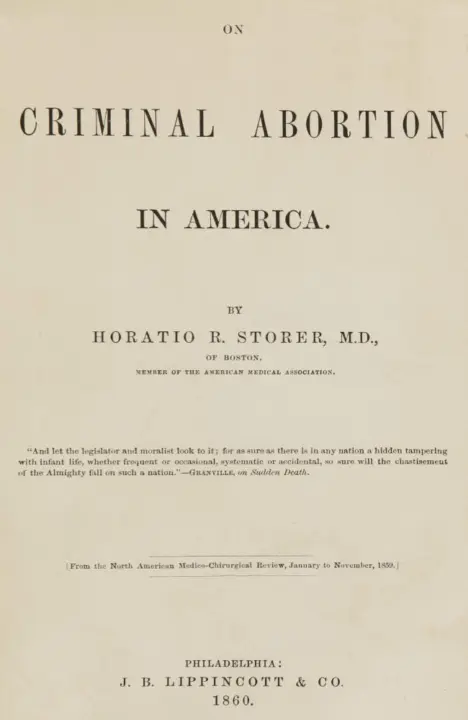
"On Criminal Abortion in America" by Horatio Robinson Storer is a medical treatise written in the mid-19th century. The work critically examines the legal and moral issues surrounding abortion, highlighting its perceived status as a crime against fetal life that has largely been overlooked by existing laws. Storer argues for the need for a more robust legal framework that reflects society's moral responsibilities toward both mothers and their unborn children. The opening of the text lays the groundwork for a detailed investigation into the complexities and frequency of criminal abortion, outlining the initial assumptions and subsequent arguments necessary for the discourse. Storer addresses the legal ambiguities surrounding abortion, emphasizing that common law and many state codes largely ignore fetal life, positioning the crime as one primarily against the mother. He goes on to assert the necessity of evaluating the frequency and consequences of this practice, suggesting that the medical community has a pivotal role in shaping public sentiment and legal standards regarding abortion. Storer prepares the reader for an exploration of both the legislative deficiencies and the ethical imperative for medical professionals and society as a whole to confront this "great opprobrium of the law."
Introduction adapted from the source catalogue; source summaries may be automatically generated.
Free to read · English · 45,185 words · No account needed
MAKE TIME FOR A GOOD BOOK
On by default. Untick to stop anonymous reading totals. Each page counts after 10 seconds in view. How this works.
Anonymous counting is on unless you have switched it off.
[152] The rules of the Catholic Church upon this point have been already referred to. Suffice it to say, further, that while they enjoin the Cæsarean and vaginal sections, in preference to craniotomy and in cases of extra-uterine fœtation, yet turning, the use of forceps, and the induction of premature labor, where such are indicated, are distinctly allowed by them. BARRY, Medico-Christian Embryology, pp. 41, 44, 45, 60.
[153] Guy’s Hosp. Reports, 1856, p. 4.
[154] For a full discussion of the respective merits of the several methods instanced above, see SIMPSON, loc. cit., i. p. 738.
I have lately contrived an instrument very similar to one not long since proposed by Spencer Wells for dilatation of the female urethra, which by a simple combination of the three principles involved, will probably prove of material service in the induction of premature labor. It may be called the uterine dilator, as it possesses many advantages over expansible tents for all cases of uterine disease where dilatation is necessary, either for diagnosis or treatment. A description of the instrument, and of its first application to obstetric practice, is published in the current number of the American Journal of the Medical Sciences.
[155] Bulletin de l’Académie, xvii. p. 364.
[156] British Record, etc., p. 82.
[157] I have elsewhere discussed this subject; American Journal of the Medical Sciences, January, 1859.
[158] Enchiridion Medicum, p. 510.
[159] Question d’Embryologie Médicale, etc.; Revue de l’Amérique et de
l’Ouest, 1846.
[160] JOAN. RIOLAN., Anthropographia, lib. vi. cap. vii. p. 589.
[161] CHURCHILL, Dublin Quarterly Journ. of Med. Science, August, 1858,
p. 22.
[162] A case in point has been reported by the writer; Amer. Journ. of the Med. Sciences, April, 1859.
[163] Reports to the Suffolk Dist. Med. Society of Massachusetts, 1857, and to the American Medical Association, 1859.
[164] “It would in my opinion,” says Ramsbotham, referring to the nature of fœtal existence, “be much better not to endeavor to explain the secrets of nature, so deeply hidden.”—(Obst. Medicine and Surgery, p. 309.) This belief seems still, in practice, very widely entertained.
[165] CLAY, Obstetric Retrospect, March, 1848, p. 44.
[166] Medical Communications of the Mass. Med. Soc., 1858, p. 77.
The writer having been a member of this committee, here enters, as he has already done by letter to the councillors of the Society, his earnest protest against the plainly erroneous opinion avowed in that report, which was presented and accepted during his absence from the State.
By the laws of Massachusetts, the offence is considered as mainly against the person of the mother. In case of her death, already sufficiently provided for at common law, convictions can be effected, with great difficulty, under the statute,—as has twice occurred the present year, in the cases of Jackson and Brown; but hardly otherwise.
Your reading position is saved on this browser. Take it to another device with a library code. Reading pages adapt to text, rather than matching a printed edition.
Horatio Robinson Storer
BEHIND THE BOOK
This eBook is for the use of anyone anywhere in the United States and most other parts of the world at no cost and with almost no restrictions whatsoever. You may copy it, give it away or re-use it under the terms of the Project Gutenberg License included with this eBook or online at www.gutenberg.org. If you are not located in the United States, you will have to check the laws of the country where you are located before using this eBook. Read the source licence.
The original source file, including credits and licence, is retained by this library. Request an original-format copy at no charge. Please include the book title and Project Gutenberg identifier #65244.
KEEP YOUR CURIOSITY GOING

David Patterson (Spirit) Hatch
Cécile Tormay

Moritz Busch
Coulson Kernahan
John L. Ransom

Ralph Waldo Emerson