
Why not? A book for every woman
Horatio Robinson Storer
THE CLASSIC COLLECTION · 1860
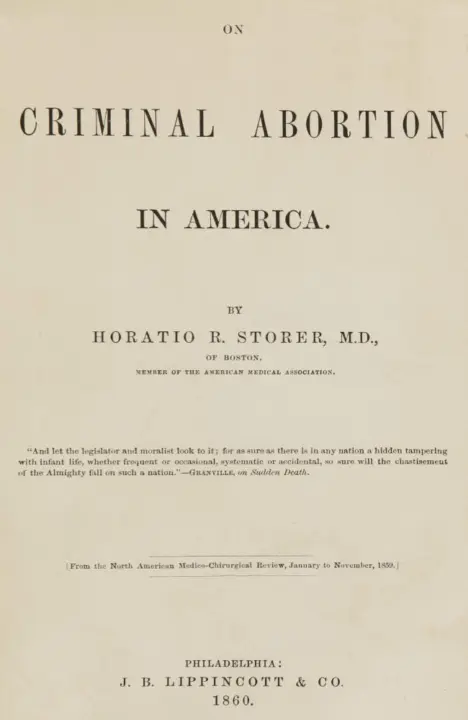
"On Criminal Abortion in America" by Horatio Robinson Storer is a medical treatise written in the mid-19th century. The work critically examines the legal and moral issues surrounding abortion, highlighting its perceived status as a crime against fetal life that has largely been overlooked by existing laws. Storer argues for the need for a more robust legal framework that reflects society's moral responsibilities toward both mothers and their unborn children. The opening of the text lays the groundwork for a detailed investigation into the complexities and frequency of criminal abortion, outlining the initial assumptions and subsequent arguments necessary for the discourse. Storer addresses the legal ambiguities surrounding abortion, emphasizing that common law and many state codes largely ignore fetal life, positioning the crime as one primarily against the mother. He goes on to assert the necessity of evaluating the frequency and consequences of this practice, suggesting that the medical community has a pivotal role in shaping public sentiment and legal standards regarding abortion. Storer prepares the reader for an exploration of both the legislative deficiencies and the ethical imperative for medical professionals and society as a whole to confront this "great opprobrium of the law."
Introduction adapted from the source catalogue; source summaries may be automatically generated.
Free to read · English · 45,185 words · No account needed
MAKE TIME FOR A GOOD BOOK
On by default. Untick to stop anonymous reading totals. Each page counts after 10 seconds in view. How this works.
Anonymous counting is on unless you have switched it off.
“In order to baptize the child, a syringe charged with natural water may be used. If this be not at hand, a person may use a sponge, or a linen or cotton rag, wetted with water, which is to be carried to the child by the fingers, a pair of forceps, or any other suitable contrivance, and then squeezed or pressed on the surface of the part presenting.” (Loc. cit., p. 45.)
“Any person, whether man, woman or child, may baptize an infant when in danger of death.” (Ibid., p. 76.)
If the facts now stated should be generally known and acted upon by the profession, hundreds of lives, infant and maternal, would annually be saved.
[104] MS. Letter, dated Nov. 14th, 1858.
[105] It is not of course intended to imply that Protestantism, as such, in any way encourages, or indeed permits, the practice of inducing abortion; its tenets are uncompromisingly hostile to all crime. So great, however, is the popular ignorance regarding this offence, that an abstract morality is here comparatively powerless; and there can be no doubt that the Romish ordinance, flanked on the one hand by the confessional, and by denouncement and excommunication on the other, has saved to the world thousands of infant lives.
[106] PASSOT, Des dangers de l’avortement provoqué dans un but criminel; Gazette Méd. de Lyon, 1853.
[107] Ann. d’Hygiène, 1856, p. 147.
[108] DUBOIS and DEVERGIE, ibid., tome xix. p. 425; tome xxxix. p. 157.
[109] Ibid.
[110] Review of MONTGOMERY’s Signs of Pregnancy; The North American Medico-Chirurgical Review, March, 1857, p. 249.
[111] Principles of Midwifery, p. 547.
[112] BAUDELOCQUE, tome i. p. 115; FODERE, ii. p. 17; MARC, Dict. de Méd., i. p. 228; MONTGOMERY, Signs of Pregnancy, p. 578; DEVERGIE, Méd. Légale, i. p. 244.
[113] RYAN, p. 267; TARDIEU, loc. cit.
[114] CLARKE, Trans. of Soc. for Impr. of Med.-Chir. Knowledge, iii. p. 290; BAUDELOCQUE, i. p. 123, note; LEROUX, Traité des Pertes, Obs. xiii. p. 25; MONTGOMERY, loc. cit., p. 618.
[115] GARDNER, of New York, note to TYLER SMITH’s Lectures on Obstetrics,
p. 203.
[116] Am. Journ. of the Med. Sciences, April, 1859. In the instance referred to, the cervix had been deeply and extensively lacerated, forceps having been used in four previous labors; while depressions existing between the old cicatrices and half filled and ragged with clots, were decidedly suggestive of punctured wounds. The true nature of the case was rendered evident by its past history, and corroborated by the fact that the patient was a Catholic; the latter being a point to which I am inclined to attach much importance, for reasons already given.
[117] Practical Treatise, p. 275.
[118] RYAN, Med. Jurisprudence, p. 282.
[119] ROSCOE, Law of Evidence, 242.
[120] ARCHBOLD, Crim. Pleading, 491; 1 HALE, 455.
[121] DAVIS, Crim. Justice, 482.
[122] DAVIS, Crim. Justice, 483.
[123] Reg. v. Haynes; Reg. v. Goodall; Rex v. Phillips.
Your reading position is saved on this browser. Take it to another device with a library code. Reading pages adapt to text, rather than matching a printed edition.
Horatio Robinson Storer
BEHIND THE BOOK
This eBook is for the use of anyone anywhere in the United States and most other parts of the world at no cost and with almost no restrictions whatsoever. You may copy it, give it away or re-use it under the terms of the Project Gutenberg License included with this eBook or online at www.gutenberg.org. If you are not located in the United States, you will have to check the laws of the country where you are located before using this eBook. Read the source licence.
The original source file, including credits and licence, is retained by this library. Request an original-format copy at no charge. Please include the book title and Project Gutenberg identifier #65244.
KEEP YOUR CURIOSITY GOING

David Patterson (Spirit) Hatch
Cécile Tormay

Moritz Busch
Coulson Kernahan
John L. Ransom

Ralph Waldo Emerson