
Why not? A book for every woman
Horatio Robinson Storer
THE CLASSIC COLLECTION · 1860
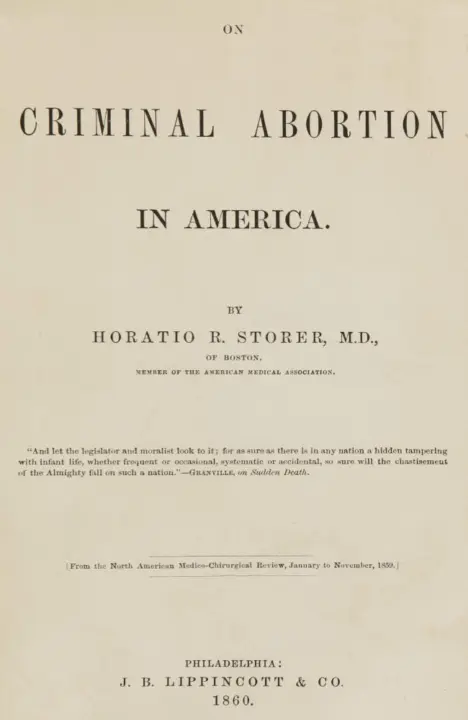
"On Criminal Abortion in America" by Horatio Robinson Storer is a medical treatise written in the mid-19th century. The work critically examines the legal and moral issues surrounding abortion, highlighting its perceived status as a crime against fetal life that has largely been overlooked by existing laws. Storer argues for the need for a more robust legal framework that reflects society's moral responsibilities toward both mothers and their unborn children. The opening of the text lays the groundwork for a detailed investigation into the complexities and frequency of criminal abortion, outlining the initial assumptions and subsequent arguments necessary for the discourse. Storer addresses the legal ambiguities surrounding abortion, emphasizing that common law and many state codes largely ignore fetal life, positioning the crime as one primarily against the mother. He goes on to assert the necessity of evaluating the frequency and consequences of this practice, suggesting that the medical community has a pivotal role in shaping public sentiment and legal standards regarding abortion. Storer prepares the reader for an exploration of both the legislative deficiencies and the ethical imperative for medical professionals and society as a whole to confront this "great opprobrium of the law."
Introduction adapted from the source catalogue; source summaries may be automatically generated.
Free to read · English · 45,185 words · No account needed
MAKE TIME FOR A GOOD BOOK
On by default. Untick to stop anonymous reading totals. Each page counts after 10 seconds in view. How this works.
Anonymous counting is on unless you have switched it off.
Though we cannot at once, and in exact figures, show the yearly amount of criminal abortion in this country, statistics on the subject being necessarily imperfect or wanting, we may yet arrive at an approximate result. This is done by an easy and reliable process of induction, the several factors of which, each of itself rendering probable the conclusion, tend, when combined, to make it almost absolutely certain.
We are to consider, in this connection, the evidence afforded by—
I.—The comparative increase of population.
II.—The published records of still-births.
III.—The number of arrests, or trials for abortion.
IV.—The published number of immediate maternal deaths.
V.—The pecuniary success of abortionists, and
abortion-producing nostrums.
VI.—The comparative size of families in present and past times.
VII.—The experience of physicians—direct from applications for abortion and actual cases, and indirect from their results.
Several of these points are as yet almost wholly uninvestigated. They are stated, therefore, with care, as bearing decidedly on the question at issue, and as tending to provoke still further research.
To go into an elaborate comparison of our national and state censuses with themselves, past and present, with each other, and with those of similar communities abroad, involving, as it would do, intricate calculations regarding the effect of emigration from state to state, and from nation to nation, the increase of urban population, and the frequent decrease of rural, is not our present intention, nor is it necessary. By considering this point in connection with that immediately succeeding it, with which it is intimately related, its bearing and importance will at once be seen.
Statistics in this country are as yet so imperfect, that we are necessitated to a process of deduction. If it can be shown that a state of things prevails elsewhere to a certain extent, explainable only on one supposition, and that the same state of things prevails in this country to a greater extent, all other causes, save the one referred to, being in great measure absent, little doubt can be entertained of the part this plays; but if it can, in addition, be proved that this cause must necessarily be stronger with us than elsewhere, then its existence becomes morally certain. Accordingly, if we find that in another country living births are steadily lessening in proportion alike to the population and to its increase, that natural or preventive causes are insufficient to account for this, while the proportion of still-births and of known abortions is constantly increasing, and these last bear an evident yet increasing ratio to the still-births; that in this country the decrease of living births, and the increase of still-births, are in much greater ratio to the population, and the proportion of premature births is also increasing; that these relations are constant and yearly more marked, we are justified in supposing that abortions are at least as frequent with us, and probably more so.
Your reading position is saved on this browser. Take it to another device with a library code. Reading pages adapt to text, rather than matching a printed edition.
Horatio Robinson Storer
BEHIND THE BOOK
This eBook is for the use of anyone anywhere in the United States and most other parts of the world at no cost and with almost no restrictions whatsoever. You may copy it, give it away or re-use it under the terms of the Project Gutenberg License included with this eBook or online at www.gutenberg.org. If you are not located in the United States, you will have to check the laws of the country where you are located before using this eBook. Read the source licence.
The original source file, including credits and licence, is retained by this library. Request an original-format copy at no charge. Please include the book title and Project Gutenberg identifier #65244.
KEEP YOUR CURIOSITY GOING

David Patterson (Spirit) Hatch
Cécile Tormay

Moritz Busch
Coulson Kernahan
John L. Ransom

Ralph Waldo Emerson