
Why not? A book for every woman
Horatio Robinson Storer
THE CLASSIC COLLECTION · 1860
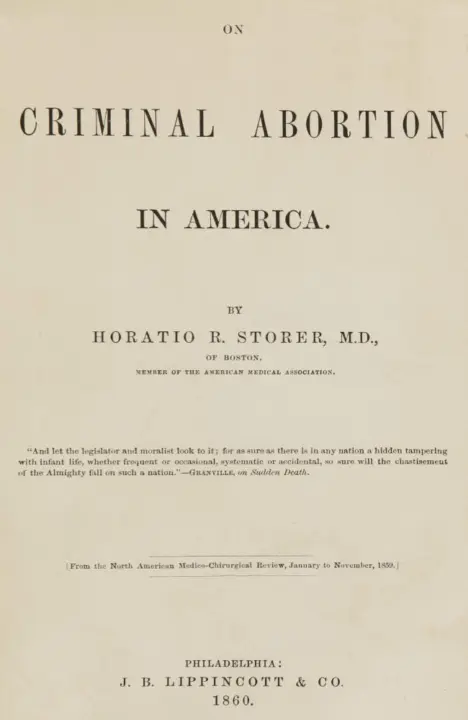
"On Criminal Abortion in America" by Horatio Robinson Storer is a medical treatise written in the mid-19th century. The work critically examines the legal and moral issues surrounding abortion, highlighting its perceived status as a crime against fetal life that has largely been overlooked by existing laws. Storer argues for the need for a more robust legal framework that reflects society's moral responsibilities toward both mothers and their unborn children. The opening of the text lays the groundwork for a detailed investigation into the complexities and frequency of criminal abortion, outlining the initial assumptions and subsequent arguments necessary for the discourse. Storer addresses the legal ambiguities surrounding abortion, emphasizing that common law and many state codes largely ignore fetal life, positioning the crime as one primarily against the mother. He goes on to assert the necessity of evaluating the frequency and consequences of this practice, suggesting that the medical community has a pivotal role in shaping public sentiment and legal standards regarding abortion. Storer prepares the reader for an exploration of both the legislative deficiencies and the ethical imperative for medical professionals and society as a whole to confront this "great opprobrium of the law."
Introduction adapted from the source catalogue; source summaries may be automatically generated.
Free to read · English · 45,185 words · No account needed
MAKE TIME FOR A GOOD BOOK
On by default. Untick to stop anonymous reading totals. Each page counts after 10 seconds in view. How this works.
Anonymous counting is on unless you have switched it off.
[94] Since our last article, the report of the Committee appointed in 1858 to investigate the Health Department of the City of New York has appeared, and we find that our statements regarding the frequency of the crime in the metropolis are fully corroborated. Not merely are additional official statistics on this point given (pp. 182, 183), but valuable testimony from Drs. Griscom (pp. 25, 30), McNulty (p. 55), Francis (p. 64), and Bulkley (p. 133). Dr. Reese’s paper on Infant Mortality, republished by the Committee (pp. 90-100), from the Transactions of the American Medical Association for 1857, also contains incidental reference to the frequency of abortion, and for its direct and earnest dealing with the subject deserves unqualified commendation.
In this connection we would call attention to the evidence of the extent of the crime in Boston, afforded since our own remarks upon that point were in type, by Dr. Walter Channing. (Boston Med. and Surg. Journal, March 17, 1859.)
[95] Annales d’Hygiène Publique, 1856, p. 122.
[96] Les Consummations, etc.
[97] Comptes Rendus Annuels, etc.
[98] MAYER, Des Rapports Conjugaux, considérés sous le triple point de vue de la population, de la santé et de la morale publique. Paris, 1857.
[99] CANGIAMILA, Embryologia Sacra, p. 15.
[100] In verification of this statement I am enabled to quote from the last authorized edition of the Canon Laws of the Church of Rome. “Omnes, qui abortûs seu fœtûs immaturi, tam animati quam inanimati, formati vel informis, ejectionem procuraverint, pœnas propositas et inflictas tam divino quam humano jure, ac tam per canonicas sanctiones et apostolicas constitutiones quam civilia jura adversus veros homicidas incurrere, hâc nostrâ perpetuo valiturâ constitutione statuimus et ordinamus.” REIFFENSTUELL, Jus Canonicum Universum, tome iii. Paris, 1854.
[101] Decreta Synodi plenariæ Episcoporum Hiberniæ, apud Thurles habitæ anno 1850. Art. de Baptismo, p. 20.
[102] Dublin Review, April, 1858, p. 100.
[103] DEVENTER, 1734, p. 366; STERNE, Tristram Shandy, p. 54; Med. Times and Gazette, Aug., 1858, p. 196. Though the fact of this decision has been doubted, it is nevertheless strictly true. Through the kindness of Bishop Fitzpatrick I have been favored with a copy of BARRY’s Medico-Christian Embryology, as presenting upon this point the authorized and generally received doctrine of the Catholic Church. I quote the following from the chapter “On Baptism in Impracticable and Difficult Labors:”
“In case of impacted head and at all times that one is obliged to apply the forceps, whether at one of the straits or in the pelvic excavation, it becomes necessary to baptize the child on the part which presents at the uterine orifice after the rupture of the bag containing the waters.
Your reading position is saved on this browser. Take it to another device with a library code. Reading pages adapt to text, rather than matching a printed edition.
Horatio Robinson Storer
BEHIND THE BOOK
This eBook is for the use of anyone anywhere in the United States and most other parts of the world at no cost and with almost no restrictions whatsoever. You may copy it, give it away or re-use it under the terms of the Project Gutenberg License included with this eBook or online at www.gutenberg.org. If you are not located in the United States, you will have to check the laws of the country where you are located before using this eBook. Read the source licence.
The original source file, including credits and licence, is retained by this library. Request an original-format copy at no charge. Please include the book title and Project Gutenberg identifier #65244.
KEEP YOUR CURIOSITY GOING

David Patterson (Spirit) Hatch
Cécile Tormay

Moritz Busch
Coulson Kernahan
John L. Ransom

Ralph Waldo Emerson