THE CLASSIC COLLECTION✦An outlaw’s diary: the CommuneCLASSIC FREE BOOKS
An outlaw’s diary: the Commune
Cécile Tormay
THE CLASSIC COLLECTION · 1893
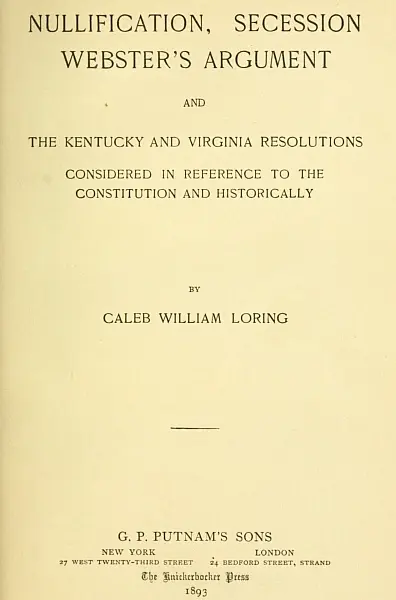
"Nullification, Secession, Webster's Argument, and the Kentucky and Virginia Resolutions" by Caleb William Loring is a historical account written in the late 19th century. The book examines the constitutional debates surrounding nullification and secession in the context of the United States' formation and the preservation of the Union. It specifically focuses on the arguments presented by Daniel Webster in response to southern claims of state sovereignty, particularly those advanced by Robert Hayne and John C. Calhoun, and explores the interpretation of the Constitution through a historical lens. The opening of this work introduces the author's motivation to address a perceived misrepresentation of Webster's stance on the nullification doctrine, which was often defended by southern contemporaries. Loring lays the groundwork by highlighting the debates of the early 19th century, notably the fierce exchanges between Webster and Hayne in the Senate regarding the legitimacy of state rights to secede from the Union. He argues that the Union was intended to be national and indissoluble, thereby challenging the notion that states had the authority to nullify federal laws or secede from the Union. This perspective sets the stage for a deeper exploration of constitutional interpretation and the historical context of these contentious issues.
Introduction adapted from the source catalogue; source summaries may be automatically generated.
Free to read · English · 41,599 words · No account needed
MAKE TIME FOR A GOOD BOOK
On by default. Untick to stop anonymous reading totals. Each page counts after 10 seconds in view. How this works.
Anonymous counting is on unless you have switched it off.
Madison, James, protective duties, 26;
as to compact, 29;
suggestions as to convention to form government, 51;
letter to Hamilton on adoption of Constitution, 72;
wrongly accused of support of nullification, 96;
author of Virginia resolutions of 1798 and explanation of 1799, 102;
a strict constructionist, 82;
signed re-charter of the United States Bank, 133;
see Virginia resolutions
Marshall, John, Chief-Justice, declaration concerning supremacy of
United States, 142;
that State courts had invariably yielded, 150
Martin, Luther, definition of extent of judicial power of United
States, 20;
objection to punishing treason, 43
Mason, George, insisted on National Government, 57; refused to sign Constitution, reasons, 69
Massachusetts, acceptance of Constitution and use of word compact, 75; submission to embargo, 30
Military academies in Southern States, 158
Missouri Compromise, 135, 136
Morley, John, on British opinion, 2, 3
Morris, Gouverneur, report of draft of Constitution, 64; on the importance of the Mississippi, 123
New England, discontent with embargo and submission, 130
New York, consideration of the acceptance of the Constitution, 72, 73; unanimous assertion of its convention that the adoption was for perpetuity, 77, 78
Nullification, claim that validity of laws of general government are at the caprice of each State, 25, 26; no suggestion of such right in conventions, 75; no claim of such right save in Kentucky resolutions until 1830, 133; so stated by Jackson, Marshall, and the nullifiers of South Carolina, 141, 142
Pennsylvania, resistance to excise law, 84, 85; resistance to United States in Gideon Olmstead case, 118-122; proposition to Virginia for amendment of Constitution as to questions between States and United States, 122, 123
Pinckney, Charles C., declaration in convention of South Carolina that the States never had sovereignty, 74; satisfaction with Constitution, 67
Pinckney, Charles, declaration as to nationality of the Constitution,
74
Quincy, Josiah, his declaration a threat of rebellion, not a claim of right of secession, 124, 125; non-concurrence of Massachusetts, 124, 130, 131; not made delegate to Hartford convention, 132
Randolph, Edmund, introduced national resolutions in convention, 51; did not sign Constitution, 69; supported it in Virginia convention, 71
Resolutions of State legislatures are mere opinions, 89; even when declaring laws of United States null and void, 148
Secession, general belief in right of, by Southern and English
writers, 1-4;
belief of some Northern writers, 5, 6;
impracticability of claim, 25;
declaration of perpetuity in preamble of Constitution, 33, 34;
historically no claim of such right until 1830, 142
Senate, equality of States in, merely a compromise of representation,
60, 61
Slavery abolished by power given in Constitution, 46, 158
South Carolina, declaration concerning tariff, warlike preparations, 138; original adoption of the Constitution, 73, 74; nationality asserted in convention, 74; only State asserting right of nullification in 1833, 146; resolutions of other Southern States opposing her opinions, 146-148; collection of duties after State ordinance, 145, 146, and note; submission to judgment overruling taxation of United States Bank, 150; first State to secede, 155; statue of Calhoun and monument at Spartanburg, 161, 162
Your reading position is saved on this browser. Take it to another device with a library code. Reading pages adapt to text, rather than matching a printed edition.
BEHIND THE BOOK
This eBook is for the use of anyone anywhere in the United States and most other parts of the world at no cost and with almost no restrictions whatsoever. You may copy it, give it away or re-use it under the terms of the Project Gutenberg License included with this eBook or online at www.gutenberg.org. If you are not located in the United States, you will have to check the laws of the country where you are located before using this eBook. Read the source licence.
The original source file, including credits and licence, is retained by this library. Request an original-format copy at no charge. Please include the book title and Project Gutenberg identifier #41673.
KEEP YOUR CURIOSITY GOING
Cécile Tormay

Moritz Busch
John L. Ransom
Frances Wright
Cécile Tormay

Mabel Potter Daggett