THE CLASSIC COLLECTION✦An outlaw’s diary: the CommuneCLASSIC FREE BOOKS
An outlaw’s diary: the Commune
Cécile Tormay
THE CLASSIC COLLECTION · 1893
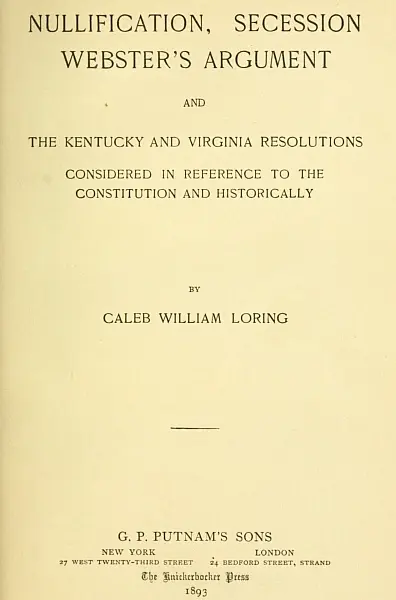
"Nullification, Secession, Webster's Argument, and the Kentucky and Virginia Resolutions" by Caleb William Loring is a historical account written in the late 19th century. The book examines the constitutional debates surrounding nullification and secession in the context of the United States' formation and the preservation of the Union. It specifically focuses on the arguments presented by Daniel Webster in response to southern claims of state sovereignty, particularly those advanced by Robert Hayne and John C. Calhoun, and explores the interpretation of the Constitution through a historical lens. The opening of this work introduces the author's motivation to address a perceived misrepresentation of Webster's stance on the nullification doctrine, which was often defended by southern contemporaries. Loring lays the groundwork by highlighting the debates of the early 19th century, notably the fierce exchanges between Webster and Hayne in the Senate regarding the legitimacy of state rights to secede from the Union. He argues that the Union was intended to be national and indissoluble, thereby challenging the notion that states had the authority to nullify federal laws or secede from the Union. This perspective sets the stage for a deeper exploration of constitutional interpretation and the historical context of these contentious issues.
Introduction adapted from the source catalogue; source summaries may be automatically generated.
Free to read · English · 41,599 words · No account needed
MAKE TIME FOR A GOOD BOOK
On by default. Untick to stop anonymous reading totals. Each page counts after 10 seconds in view. How this works.
Anonymous counting is on unless you have switched it off.
Calhoun, John C., United States a confederacy, not a nation, 24;
his youthful prominence in Congress, 34;
his early opinions of the Constitution, 134, 135;
change of opinion, 137, 138;
personal appearance, 138, 139;
his reasoning on right of nullification, 140;
his argument considered, 140, 141
Chase, Salmon P., decision on secession, 34, 35
Clay, Henry, tariff compromise, 23
Clinton, George, his opinion as stated by Mr. Lodge, 5; his written declaration that the United States Government is perpetual, 77, 78
Compact, may be for national, indissoluble government, 28, 29; a voluntary union of independent nations must be by compact, 28; Southern views of, 30
Confederacy of the Southern States, constitution and compact as to
slavery, 158
Confederacy of the United States, its failure, 31, 32;
dependent upon the States, 48
Constitution of United States, adoption by Continental Congress, States, and people, 32; perpetuity declared in preamble, 33, 34; supremacy, 35, 36, 49; oath of every State officer and judge to support, 36; supremacy in all sovereign powers, 37, 38; prohibitions to States, 38, 39, 47; power to coerce States in articles punishing treason, 41, 42, 43; can take all powers from States by amendments, 45, 46; made States suable, 44; powers given by Constitution to States, 46; naturalization, 47; takes from States powers of resistance, 47, 48; its excellence proved by few amendments, 159, 160; its adoption opposed on account of its nationality and of excessive powers given, 69-73; no claim of right of secession or nullification suggested in the conventions adopting the Constitution, 73
Convention that made the Constitution, its members and mode of voting, 51-53; proposition of the delegation of Virginia for a National Government debated and passed, 51-53; New Jersey plan amending confederacy, 54, 56; resolves for a National Government again taken up and passed, 56-62; representation in Senate, 58-60; a compromise of representation not a compromise of powers granted, 60, 61; resolutions calling the proposed government national referred to Committee to Report a Constitution, 61, 62; report of committee and articles again considered separately, 62-64; change in preamble by Committee of Style and Arrangement, 64; opinions of members, 65, 66; its nationality and great powers, 70-72
Cooper, Thomas, pronounced in 1833, in South Carolina, author of
nullification, 141, 142
Your reading position is saved on this browser. Take it to another device with a library code. Reading pages adapt to text, rather than matching a printed edition.
BEHIND THE BOOK
This eBook is for the use of anyone anywhere in the United States and most other parts of the world at no cost and with almost no restrictions whatsoever. You may copy it, give it away or re-use it under the terms of the Project Gutenberg License included with this eBook or online at www.gutenberg.org. If you are not located in the United States, you will have to check the laws of the country where you are located before using this eBook. Read the source licence.
The original source file, including credits and licence, is retained by this library. Request an original-format copy at no charge. Please include the book title and Project Gutenberg identifier #41673.
KEEP YOUR CURIOSITY GOING
Cécile Tormay

Moritz Busch
John L. Ransom
Frances Wright
Cécile Tormay

Mabel Potter Daggett