THE CLASSIC COLLECTION✦An outlaw’s diary: the CommuneCLASSIC FREE BOOKS
An outlaw’s diary: the Commune
Cécile Tormay
THE CLASSIC COLLECTION · 1893
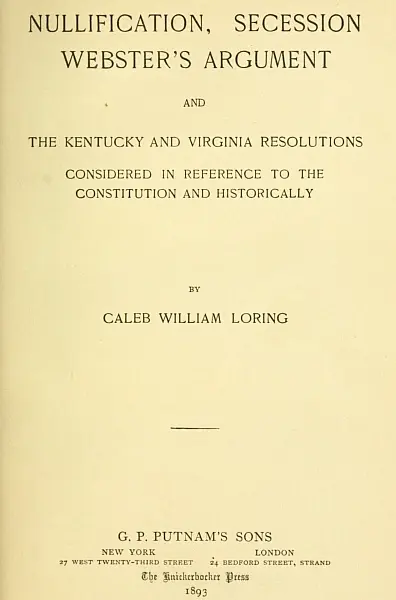
"Nullification, Secession, Webster's Argument, and the Kentucky and Virginia Resolutions" by Caleb William Loring is a historical account written in the late 19th century. The book examines the constitutional debates surrounding nullification and secession in the context of the United States' formation and the preservation of the Union. It specifically focuses on the arguments presented by Daniel Webster in response to southern claims of state sovereignty, particularly those advanced by Robert Hayne and John C. Calhoun, and explores the interpretation of the Constitution through a historical lens. The opening of this work introduces the author's motivation to address a perceived misrepresentation of Webster's stance on the nullification doctrine, which was often defended by southern contemporaries. Loring lays the groundwork by highlighting the debates of the early 19th century, notably the fierce exchanges between Webster and Hayne in the Senate regarding the legitimacy of state rights to secede from the Union. He argues that the Union was intended to be national and indissoluble, thereby challenging the notion that states had the authority to nullify federal laws or secede from the Union. This perspective sets the stage for a deeper exploration of constitutional interpretation and the historical context of these contentious issues.
Introduction adapted from the source catalogue; source summaries may be automatically generated.
Free to read · English · 41,599 words · No account needed
MAKE TIME FOR A GOOD BOOK
On by default. Untick to stop anonymous reading totals. Each page counts after 10 seconds in view. How this works.
Anonymous counting is on unless you have switched it off.
Southern States, satisfaction with Constitution at first, 67;
opposition to secession in 1833, 146;
resolves of legislatures, 146-148;
change of views, 154;
control of the government before the Civil War, 153;
laws of United States and decision of Supreme Court establishing
right to introduce slaves into territories, 154;
preparations for secession, 155;
confidence of success, 157
State governments, powers derived from Constitutions, 27;
subordinate and local, 39, 40;
limited under the Constitution of United States, 46;
original sovereignty questioned, 79-81;
admitted by Webster, 80;
denied in convention of South Carolina, 74;
resolutions of legislatures mere opinions, 148
Stephens, Alexander H., on secession, 1, 2
Story, Joseph, Judge of Supreme Court, doctrine of supremacy of United States, tenacity in his belief, 152, 153
Supreme Court of United States, its powers principally those of
restraint, 152;
see Judiciary of the United States
Taney, Roger B., Chief-Justice, maintained authority of United States,
151 and note
Tariffs, for revenue and protection, second act, first Congress, 26; no question of power then, 81, 82
Taylor, John, views concerning the government, 114, 115
Treason, crime according to the Constitution, 41;
right of government to punish, implies its citizens owe allegiance,
41;
a confederacy does not punish it, 41;
the old confederacy, 41;
consideration of the clauses of punishment of, 41, 42
United States Government, limited to powers granted by the
Constitution, 27;
was a nation or a confederacy made? 28, 29;
the compact was for a nation, 30;
perpetuity declared in preamble, 34;
its supremacy expressly declared and nature of powers granted, 35,
36;
great powers over States, 38, 44;
can be extended by amendment, 45, 46;
see Judiciary of the United States
Your reading position is saved on this browser. Take it to another device with a library code. Reading pages adapt to text, rather than matching a printed edition.
BEHIND THE BOOK
This eBook is for the use of anyone anywhere in the United States and most other parts of the world at no cost and with almost no restrictions whatsoever. You may copy it, give it away or re-use it under the terms of the Project Gutenberg License included with this eBook or online at www.gutenberg.org. If you are not located in the United States, you will have to check the laws of the country where you are located before using this eBook. Read the source licence.
The original source file, including credits and licence, is retained by this library. Request an original-format copy at no charge. Please include the book title and Project Gutenberg identifier #41673.
KEEP YOUR CURIOSITY GOING
Cécile Tormay

Moritz Busch
John L. Ransom
Frances Wright
Cécile Tormay

Mabel Potter Daggett