THE CLASSIC COLLECTION✦An outlaw’s diary: the CommuneCLASSIC FREE BOOKS
An outlaw’s diary: the Commune
Cécile Tormay
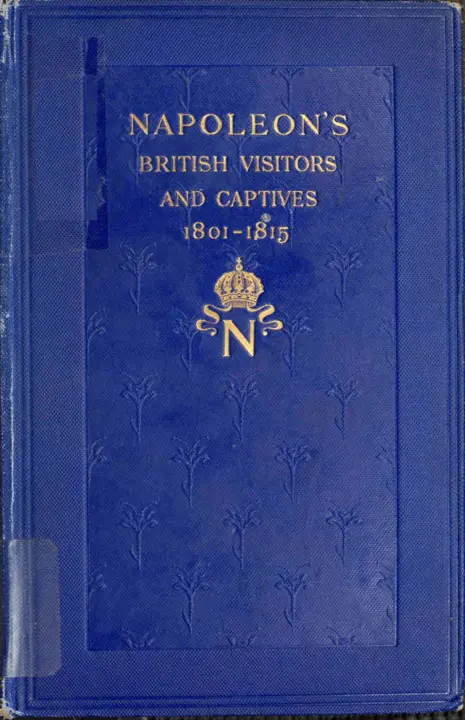
THE CLASSIC COLLECTION · 1904
"Napoleon's British Visitors and Captives, 1801-1815" by John Goldworth Alger is a historical account written in the early 20th century. The book explores the interactions and experiences of British visitors and captives in France during the tumultuous period of Napoleon's rise and reign. Alger delves into the social dynamics, political undertones, and personal stories that emerged as Englishmen navigated their relationships with French citizens amid shifting allegiances and changing circumstances. The opening of the work sets the stage for a comprehensive examination of the vast impact of the French Revolution, highlighting the notable dislocation of individuals across Europe, particularly among the French nobility and other political figures. Alger outlines how the Peace of Amiens in 1802 marked a significant uptick in British travel to France after a decade of hostilities, with numerous English visitors eager to witness the transformative atmosphere of post-revolutionary France. The introductory chapter establishes a backdrop of historical context, emphasizing the social and political exchanges that occurred not only between British visitors and French society but also amidst the hardships faced by those who found themselves unexpectedly detained under Napoleon's regime.
Introduction adapted from the source catalogue; source summaries may be automatically generated.
Free to read · English · 89,397 words · No account needed
MAKE TIME FOR A GOOD BOOK
On by default. Untick to stop anonymous reading totals. Each page counts after 10 seconds in view. How this works.
Anonymous counting is on unless you have switched it off.
[126] Reichardt, who met Bishop Grégoire and Kosciuski at her house, describes her as wearing a cap with long flaps covering her cheeks, and with a large bouquet falling down from her hair to her nose, so that with her constant nods and gesticulations there were only occasional glimpses of her eyes and mouth. He was bored, too, by the poetical recitations of Vigée, Madame Vigée-Lebrun’s brother. Poole, however, was pleased at meeting so many literati, and Meyer, canon of Hamburg, thought the hostess resembled Angelica Kaufmann.
[127] Jerningham Letters, 1896.
[128] F. 7, 6251, dossier 4980.
[129] T. 777 and 1640.
[130] Revue Internationale, 1887.
[131] A. F. iv. 1473.
[132] I can find no confirmation of this story. If there was a duel, it must have been with Thomas Pitt, Lord Camelford, but Christopher was probably confused with Thomas Potter, a member of Wilkes’s Hell-fire club, who, elected as an anti-Pittite, joined Pitt, and in 1756 was appointed Paymaster of the Forces. The two Potters may or may not have been kinsmen.
[133] Malmesbury, who did not take the overture seriously, says--‘He came to me avec des projets insensés.’
[134] A. F. iv. 1329.
[135] Probably Letourneur’s Edition.
[137] Hamburg was fined four millions by Napoleon for this act.
[138] Times, February 25, 1803.
[139] Kirwan in Fraser’s Magazine, 1860; Fitzpatrick, Secret
Service under Pitt.
[140] Année, Livre Noir, 1829.
[141] Dublin Review, April 1890.
[143] Fraser’s Magazine, 1860.
[144] W. T. Tone’s autobiography appeared in a French review, the
Carnet, in 1899.
[145] Atlantic Monthly, September 1890. His tomb at Père
Lachaise is no longer discoverable.
[146] Atlantic Monthly, February 1893.
[147] Helmine von Chézy, Unvergessenes.
[148] She pretended, however, to be Dorinda Rogers, an American.
[149] A. F. iv. 1496 and 1498.
[150] Lord Colchester, Letters. King speaks of the swarm of English bankrupts and sharpers at Calais and Boulogne.
[151] Oscar Browning, England and Napoleon in 1803.
[152] Brother to Madame de Genlis.
[153] Remaele, Bonaparte et les Bourbons.
[154] Thibaudeau, Mémoires.
[155] Remacle, p. 93.
[156] Some French ladies, who were disagreeably crowded by public curiosity in Kensington Gardens, complained heavily of our want of politesse. They should remember, however, that they were not quite undressed in the fashion, and that the English ladies always walk out with something upon their heads, however they treat the rest of their persons.--Times, April 19, 1803.
[157] Holcroft was told by a French lady, who sent for him to make this confidence and received him in her bath, that Fiévée was commissioned to bribe London newspapers (Travels from Hamburg to Paris). Holcroft believed that the mission was unsuccessful.
[158] Napoleon, Correspondance.
[159] See my Englishmen in the French Revolution and Paris in
1789–94.
[160] Révue des Deux Mondes, Sept. 1, 1902, p. 115.
[161] A police note charges him with having transmitted letters to and
from émigrés.
[162] A. F. iv. 1327.
[163] Remacle, Bonaparte et les Bourbons.
[164] Remacle.
Your reading position is saved on this browser. Take it to another device with a library code. Reading pages adapt to text, rather than matching a printed edition.
BEHIND THE BOOK
This eBook is for the use of anyone anywhere in the United States and most other parts of the world at no cost and with almost no restrictions whatsoever. You may copy it, give it away or re-use it under the terms of the Project Gutenberg License included with this eBook or online at www.gutenberg.org. If you are not located in the United States, you will have to check the laws of the country where you are located before using this eBook. Read the source licence.
The original source file, including credits and licence, is retained by this library. Request an original-format copy at no charge. Please include the book title and Project Gutenberg identifier #70408.
KEEP YOUR CURIOSITY GOING
Cécile Tormay

Moritz Busch
John L. Ransom
Frances Wright
Cécile Tormay

Mabel Potter Daggett