THE CLASSIC COLLECTION✦An outlaw’s diary: the CommuneCLASSIC FREE BOOKS
An outlaw’s diary: the Commune
Cécile Tormay
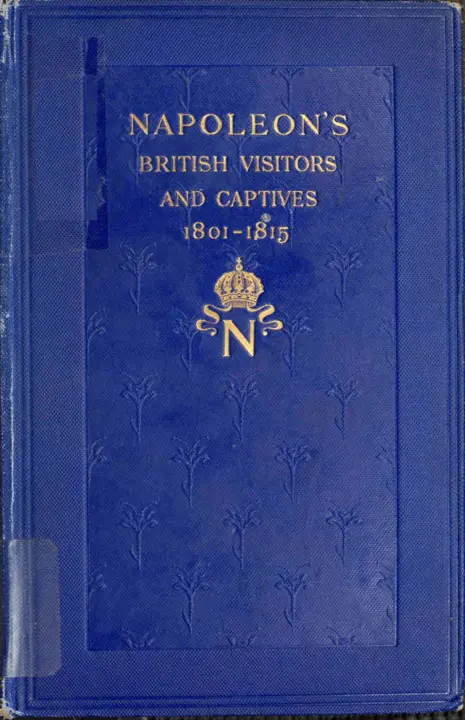
THE CLASSIC COLLECTION · 1904
"Napoleon's British Visitors and Captives, 1801-1815" by John Goldworth Alger is a historical account written in the early 20th century. The book explores the interactions and experiences of British visitors and captives in France during the tumultuous period of Napoleon's rise and reign. Alger delves into the social dynamics, political undertones, and personal stories that emerged as Englishmen navigated their relationships with French citizens amid shifting allegiances and changing circumstances. The opening of the work sets the stage for a comprehensive examination of the vast impact of the French Revolution, highlighting the notable dislocation of individuals across Europe, particularly among the French nobility and other political figures. Alger outlines how the Peace of Amiens in 1802 marked a significant uptick in British travel to France after a decade of hostilities, with numerous English visitors eager to witness the transformative atmosphere of post-revolutionary France. The introductory chapter establishes a backdrop of historical context, emphasizing the social and political exchanges that occurred not only between British visitors and French society but also amidst the hardships faced by those who found themselves unexpectedly detained under Napoleon's regime.
Introduction adapted from the source catalogue; source summaries may be automatically generated.
Free to read · English · 89,397 words · No account needed
MAKE TIME FOR A GOOD BOOK
On by default. Untick to stop anonymous reading totals. Each page counts after 10 seconds in view. How this works.
Anonymous counting is on unless you have switched it off.
No Thoroughfare--Occasional Visitors--Negotiations--Fox--M. P.’s--Ex-and Prospective M. P.’s--Peers and their Families--Baronets--Soldiers--Sailors--Functionaries--Lawyers --Doctors--Clergymen--Savants--Artists--Actors--Inventors-- Claimants and Men of Business--Writers on France--Other Authors--Residents--Ancestors--Fugitives--Emigrés.
The Peace of Amiens reopened France, and not merely France but central and southern Europe, to British travellers. Since the outbreak of hostilities in 1793 the ‘grand tour’ had been suspended. Maritime ascendency, indeed, had always ensured our communications with North Germany and Italy, but the risk of capture by privateers such as befell Richard (afterwards the Marquis) Wellesley, the Duke of Wellington’s elder brother, on his return from Lisbon in 1794, coupled with intermittent campaigns and conquests by France, had virtually put a stop to foreign travel. Young noblemen in charge of tutors or ‘bear-wards’ had ceased to traverse the Continent, and French schools had ceased to receive British students. The schools, moreover, had mostly been closed by the Revolution. An Arthur Wellesley, even if inclined, could not have studied horsemanship at Angers, nor could a Gilbert Elliot have been the comrade of a Mirabeau at Fontainebleau. So also as to girls. Pentemont Abbey in Paris, where daughters of such aristocratic families as Annesley, Hobart, De Ros and De Bathe had been educated between 1780 and 1789, was shut, preparatory to conversion into a barrack,[3] while the English Austin convent, where for 150 years Towneleys, Dormers, and Fermors had been pupils, sometimes when adults returning as nuns, though still in the possession of the community, had not yet been reopened as a school. London newspapers complacently calculated the money thus prevented from leaving the country.
It it true that a few of the Englishmen arrested as hostages for Toulon in the autumn of 1793, though released after the Terror, had been unable or unwilling to quit France. Christopher Potter, ex-M.P. for Colchester, in 1796 offered Lord Malmesbury, on behalf of Barras, to secure peace for a bribe of half a million. Captain Henry Swinburne, commissioner for exchanging prisoners, a collateral ancestor of the poet, likewise found in Paris about that date Mrs. Grace Dalrymple Elliott, ex-mistress of ‘Egalité’ Orleans, who remained till 1801, Admiral Rodney’s Portuguese wife and her two daughters, Richard Chenevix, grand-nephew of a Bishop of Waterford, Walter Smythe, brother of the famous Mrs. Fitzherbert, two sons of the Whitehall preacher Charles Este, and George Hamilton, a Jamaica planter whose wife, a daughter of Lord Leven, was afterwards, as we shall see, the companion of Sir Herbert Croft; but of course there had been scarcely any fresh arrivals. Indeed it was illegal for British subjects, unless with special permission, to cross over to France.[4] They were liable at home to punishment for the attempt, just as they were liable if they reached the French shore to being prevented from landing or to incarceration as spies. Lord Camelford, Pitt’s eccentric cousin, who threatened if Horne Tooke was refused admission as a clergyman to the seat for Old Sarum,[5] to nominate in his place his negro servant--a black man in lieu of a black coat--was arrested in February 1799 when on the point of crossing the Channel; but as his object was to examine the Mediterranean ports he was liberated, being, however, deprived of his naval post. We shall hear of him again. Boyd and Ker, bankers of whom too we shall hear again, made their way back to Paris in 1797 in the hope of recovering confiscated property, but were promptly packed off. A London newspaper of that year mentions that two men who had paid a Prussian captain eighty guineas for a passage from Dover to Calais were also unceremoniously expelled. Braham, however, and Miss Storace got to Paris and gave concerts in 1797. Thomas Hardy, the radical shoemaker, managed to send Thomas Paine a pair of shoes so good that Paine lent them as a model to a Parisian craftsman, but Hardy would not have found it easy to carry them over himself. Fishermen and smugglers, it is true, kept up intermittent communications, conveying newspapers or merchandise, but they seldom ran the risk of taking passengers. Even fishing-boats, moreover, which on both sides had been unmolested, were in January 1801 declared by the British Government liable to capture; but Bonaparte’s threat of recalling Otto, the commissioner of exchanges, from a country where the laws and usages of war were disregarded and violated,[6] coincidentally with the resignation of Pitt on account of George III.’s objection to Catholic emancipation, led to this order being rescinded. Indeed the explanations given on this point by the new Addington Administration paved the way for peace negotiations.
Your reading position is saved on this browser. Take it to another device with a library code. Reading pages adapt to text, rather than matching a printed edition.
BEHIND THE BOOK
This eBook is for the use of anyone anywhere in the United States and most other parts of the world at no cost and with almost no restrictions whatsoever. You may copy it, give it away or re-use it under the terms of the Project Gutenberg License included with this eBook or online at www.gutenberg.org. If you are not located in the United States, you will have to check the laws of the country where you are located before using this eBook. Read the source licence.
The original source file, including credits and licence, is retained by this library. Request an original-format copy at no charge. Please include the book title and Project Gutenberg identifier #70408.
KEEP YOUR CURIOSITY GOING
Cécile Tormay

Moritz Busch
John L. Ransom
Frances Wright
Cécile Tormay

Mabel Potter Daggett