THE CLASSIC COLLECTION✦An outlaw’s diary: the CommuneCLASSIC FREE BOOKS
An outlaw’s diary: the Commune
Cécile Tormay
THE CLASSIC COLLECTION · 1904
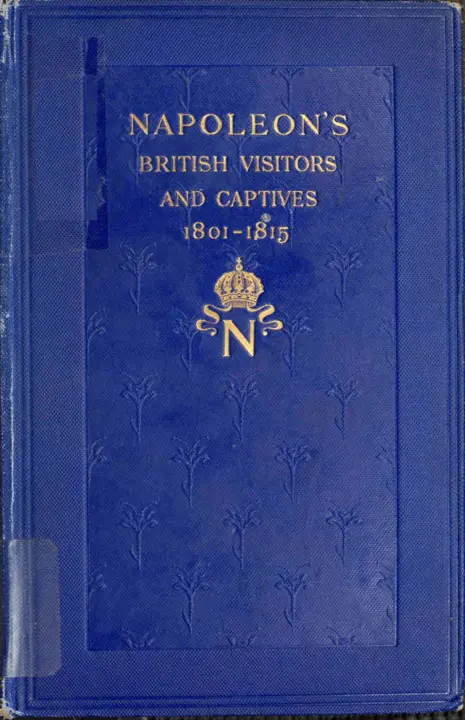
"Napoleon's British Visitors and Captives, 1801-1815" by John Goldworth Alger is a historical account written in the early 20th century. The book explores the interactions and experiences of British visitors and captives in France during the tumultuous period of Napoleon's rise and reign. Alger delves into the social dynamics, political undertones, and personal stories that emerged as Englishmen navigated their relationships with French citizens amid shifting allegiances and changing circumstances. The opening of the work sets the stage for a comprehensive examination of the vast impact of the French Revolution, highlighting the notable dislocation of individuals across Europe, particularly among the French nobility and other political figures. Alger outlines how the Peace of Amiens in 1802 marked a significant uptick in British travel to France after a decade of hostilities, with numerous English visitors eager to witness the transformative atmosphere of post-revolutionary France. The introductory chapter establishes a backdrop of historical context, emphasizing the social and political exchanges that occurred not only between British visitors and French society but also amidst the hardships faced by those who found themselves unexpectedly detained under Napoleon's regime.
Introduction adapted from the source catalogue; source summaries may be automatically generated.
Free to read · English · 89,397 words · No account needed
MAKE TIME FOR A GOOD BOOK
On by default. Untick to stop anonymous reading totals. Each page counts after 10 seconds in view. How this works.
Anonymous counting is on unless you have switched it off.
[165] England in like manner released in 1810 eighty-four sailors of a captured privateer who had rescued a shipwrecked British crew.
[166] Correspondance.
[167] Projets de Débarquement, 1902. Napoleon mystified his subordinates as well as the foreigner, for on the 22nd August 1805 he wrote to Admiral Villeneuve, ‘England is ours. All is embarked. Appear for twenty-four hours and all is ended’ (Eng. Hist. Rev., October 1903).
[168] See a full account of this in Humanité Nouvelle, July to September 1899; Allonville, ‘Mém. Secrets’; Metternich, ‘Mémoires’; Lecestre, ‘Lettres de Napoléon,’ containing letters on this subject which were suppressed in the collection published by Napoleon III.
[169] Talleyrand’s letter to Fox, April 1, 1806.
[170] Lettres de Madame de Genlis.
[173] Moniteur, 1819–1820.
[174] See p. 220.
[175] Correspondence of Jérôme Bonaparte. Baltimore, 1878.
[176] Correspondance.
[177] Now German territory and spelt Bitsch.
[178] Concannon was ultimately allowed to visit Vienna and to reside
near Epernay.
[179] At Fontainebleau also there was a theatrical performance for the benefit of the penniless captives, Concannon writing the prologue.
[180] Notes and Queries, November 18, 1899.
[181] Elizabeth Alexander, divorced by him in 1795.
[182] Lawrence, Picture of Verdun, 1810.
[184] A. F. iv. 1504. Folkard, The Sailing Boat, 1853.
[185] A. F. iv. 1495.
[186] A. F. iv. 1491.
[188] A. F. iv. 1502–1504.
[189] Bell’s Weekly Messenger, according to Maclean.
[190] Brotonne, Lettres de Napoléon.
[191] A. F. iv. 1495.
[192] A. F. iv. 1491. The mistress was probably the lady for whose arrival from Paris he had waited at Calais in 1803, thus losing his chance of escape. His breach of parole led to many English at Aix-la-Chapelle and elsewhere being relegated to Verdun.
[193] A. F. iv. 1491.
[194] Allonville states that Frenchmen, indignant at the detentions,
assisted escapes.
[195] Nineteenth Century, May 1888, art. Niederbronn.
[196] Brotonne, Lettres de Napoléon.
[197] A. F. iv. 1234.
[198] See p. 67.
[199] F. 7, 3773 and 3776.
[200] A. F. iv. 1237.
[204] A. F. iv. 1490.
[205] A. F. iv. 1328.
[206] A. F. iv. 1494.
[207] There is a mystery about her paternity, but there seems to be a hint that she was a natural daughter of the Duke of Dorset.
[208] M. Coquelle, paper read at the Congress of French Learned
Societies at Paris, 1902.
[209] Her son, Lord Henry Seymour, born in 1805, is said to have never
set foot in England.
[210] Her father, Hamilton Nesbit, had in 1802 returned through Paris from a visit to her at Constantinople.
[212] Revue Rétrospective, vol. 14.
[213] Charles escaped in August 1810.
[214] Notes and Queries, February 3, 1900.
[215] Baron, Life of Jenner.
[216] Who little imagined that Admiral Cockburn, a kinsman of the prisoner, would convey him in the Northumberland to St. Helena.
[217] Remains of Mrs. Trench.
[218] Mr. E. B. Harris, Athenæum, February 24, 1900.
[219] A. F. iv. 1496.
[220] A. F. iv. 1512.
[221] Journal of Mary Frampton.
[222] This was not the only marriage among the captives.
Your reading position is saved on this browser. Take it to another device with a library code. Reading pages adapt to text, rather than matching a printed edition.
BEHIND THE BOOK
This eBook is for the use of anyone anywhere in the United States and most other parts of the world at no cost and with almost no restrictions whatsoever. You may copy it, give it away or re-use it under the terms of the Project Gutenberg License included with this eBook or online at www.gutenberg.org. If you are not located in the United States, you will have to check the laws of the country where you are located before using this eBook. Read the source licence.
The original source file, including credits and licence, is retained by this library. Request an original-format copy at no charge. Please include the book title and Project Gutenberg identifier #70408.
KEEP YOUR CURIOSITY GOING
Cécile Tormay

Moritz Busch
John L. Ransom
Frances Wright
Cécile Tormay

Mabel Potter Daggett