THE CLASSIC COLLECTION✦An outlaw’s diary: the CommuneCLASSIC FREE BOOKS
An outlaw’s diary: the Commune
Cécile Tormay
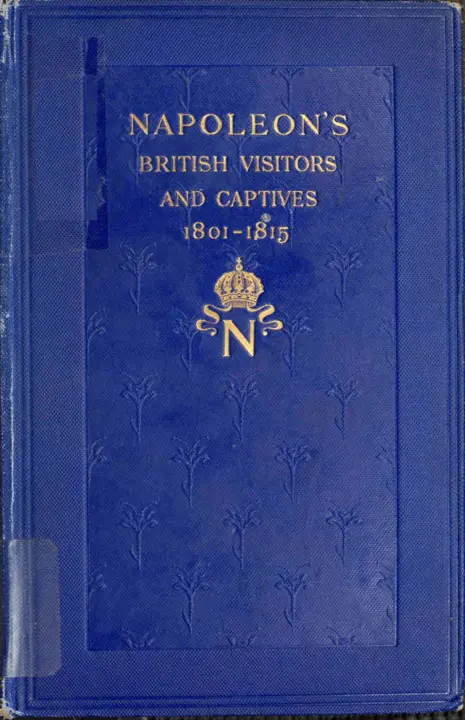
THE CLASSIC COLLECTION · 1904
"Napoleon's British Visitors and Captives, 1801-1815" by John Goldworth Alger is a historical account written in the early 20th century. The book explores the interactions and experiences of British visitors and captives in France during the tumultuous period of Napoleon's rise and reign. Alger delves into the social dynamics, political undertones, and personal stories that emerged as Englishmen navigated their relationships with French citizens amid shifting allegiances and changing circumstances. The opening of the work sets the stage for a comprehensive examination of the vast impact of the French Revolution, highlighting the notable dislocation of individuals across Europe, particularly among the French nobility and other political figures. Alger outlines how the Peace of Amiens in 1802 marked a significant uptick in British travel to France after a decade of hostilities, with numerous English visitors eager to witness the transformative atmosphere of post-revolutionary France. The introductory chapter establishes a backdrop of historical context, emphasizing the social and political exchanges that occurred not only between British visitors and French society but also amidst the hardships faced by those who found themselves unexpectedly detained under Napoleon's regime.
Introduction adapted from the source catalogue; source summaries may be automatically generated.
Free to read · English · 89,397 words · No account needed
MAKE TIME FOR A GOOD BOOK
On by default. Untick to stop anonymous reading totals. Each page counts after 10 seconds in view. How this works.
Anonymous counting is on unless you have switched it off.
[100] It was published by William Dugard, a Worcestershire man, but to judge by his name, of French extraction. He was master of Merchant Taylors’ School, London, printer to the Council of State, and a friend of Milton. See Dictionary of National Biography, which does not, however, mention his newspaper.
[101] This daughter apparently died in childhood.
[102] Souvenirs et Mémoires, Oct. 1899.
[103] See my Paris in 1789–1794.
[104] A. F. ii. 288.
[105] His age is registered as thirty, which, if correct, settles the
date of his birth.
[107] Révolution Française, February 1890.
[108] Fraser’s Mag. 1860: le Correspondant, 1897–1898.
[109] Another brother was captured at sea during the war and
incarcerated at Brest.
[110] Remacle.
[111] Gentleman’s Magazine.
[112] A. F. iv. 1503.
[113] F. 7, 5735; T. 1112; Jerningham Letters.
[114] Weston tells us that some of the pictures, much damaged in transit, had had to be repaired. Shepherd noticed many soldiers at the Louvre gazing triumphantly at the pictures conquered by them.
[115] Redhead Yorke, Letters from France.
[116] One of these was Manning. At first, indeed, imperfect knowledge of French deterred him, for Lamb wrote to him:--‘Your letter was just what a letter should be, crammed and very funny. Every part of it pleased me till you came to Paris, then your philosophical indolence or indifference stung me. You cannot stir from your rooms till you know the language. What the devil! Are men nothing but ear-trumpets? Are men all tongue and ear?’
But presently he says:--‘ ... the god-like face of the First Consul.... I envy you your access to this great man much more than your seances and conversaziones, which I have a shrewd suspicion must be something dull.’ (S. Wheeler, Letters of Lamb.)
Among the lectures by which he profited were those on Chinese by Joseph Heger, a German whom he may have previously met in London.
[117] Holcroft, Travels.
[118] Mémoires d’un Nonagénaire.
[119] De Bray, Revue de Paris, February 15 and March 1, 1901.
[120] Westmorland MSS. (Hist. MSS. Commission).
[121] Mgr. Justin Févra, Revue du Monde Catholique, June 15,
1900.
[122] Remacle, Bonaparte et les Bourbons, p. 99.
[123] Charles Orby Hunter, probably his father, had died at Paris in
1791.
[124] Reichardt, however, comparing France with Germany, speaks of the increase of drinking, and of young men deliberately assembling for a carouse; he also speaks of gormandising.
[125] Information kindly supplied by Canon Jessopp.
Your reading position is saved on this browser. Take it to another device with a library code. Reading pages adapt to text, rather than matching a printed edition.
BEHIND THE BOOK
This eBook is for the use of anyone anywhere in the United States and most other parts of the world at no cost and with almost no restrictions whatsoever. You may copy it, give it away or re-use it under the terms of the Project Gutenberg License included with this eBook or online at www.gutenberg.org. If you are not located in the United States, you will have to check the laws of the country where you are located before using this eBook. Read the source licence.
The original source file, including credits and licence, is retained by this library. Request an original-format copy at no charge. Please include the book title and Project Gutenberg identifier #70408.
KEEP YOUR CURIOSITY GOING
Cécile Tormay

Moritz Busch
John L. Ransom
Frances Wright
Cécile Tormay

Mabel Potter Daggett