THE CLASSIC COLLECTION✦An outlaw’s diary: the CommuneCLASSIC FREE BOOKS
An outlaw’s diary: the Commune
Cécile Tormay
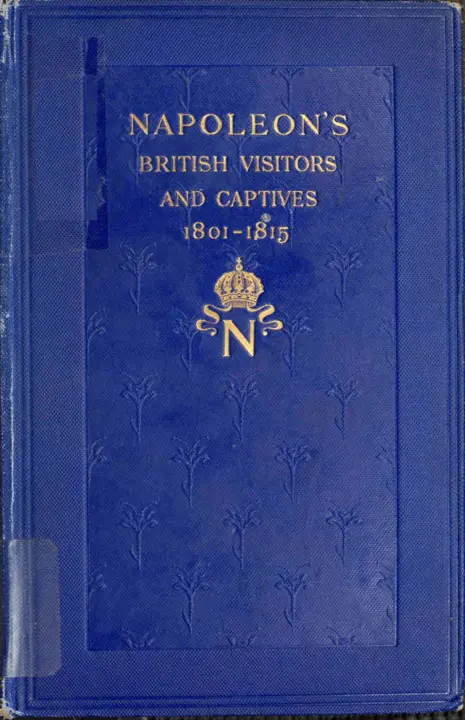
THE CLASSIC COLLECTION · 1904
"Napoleon's British Visitors and Captives, 1801-1815" by John Goldworth Alger is a historical account written in the early 20th century. The book explores the interactions and experiences of British visitors and captives in France during the tumultuous period of Napoleon's rise and reign. Alger delves into the social dynamics, political undertones, and personal stories that emerged as Englishmen navigated their relationships with French citizens amid shifting allegiances and changing circumstances. The opening of the work sets the stage for a comprehensive examination of the vast impact of the French Revolution, highlighting the notable dislocation of individuals across Europe, particularly among the French nobility and other political figures. Alger outlines how the Peace of Amiens in 1802 marked a significant uptick in British travel to France after a decade of hostilities, with numerous English visitors eager to witness the transformative atmosphere of post-revolutionary France. The introductory chapter establishes a backdrop of historical context, emphasizing the social and political exchanges that occurred not only between British visitors and French society but also amidst the hardships faced by those who found themselves unexpectedly detained under Napoleon's regime.
Introduction adapted from the source catalogue; source summaries may be automatically generated.
Free to read · English · 89,397 words · No account needed
MAKE TIME FOR A GOOD BOOK
On by default. Untick to stop anonymous reading totals. Each page counts after 10 seconds in view. How this works.
Anonymous counting is on unless you have switched it off.
[54] Life of Lord Minto. Two other daughters married the Duke of Richmond and Marquis Cornwallis.
[55] George Sand, Mémoires.
[56] F. 7, 6307, 6339, 6534, 6481. He seems to have tried to conceal this adventure, alleging that he had been courteously received by Napoleon, which may have been true, but was not the whole truth.
[57] Times, December 21, 1802.
[58] Cholmondeley and Guilford had also in 1794 voted for peace.
[59] Notes and Queries, February 6, 1892.
[60] Lady Sophia Hobart, daughter of the Earl of Buckinghamshire, had been educated at the Bernardine convent at Paris.
[61] Cloncurry, Recollections.
[62] See article on Spa in Nineteenth Century, October 1902.
[63] Cloncurry, Recollections.
[64] Monthly Review, December 1800.
[65] Notes and Queries, May 4, 1901.
[66] Courrier de Londres, July 1802.
[67] Minerva, January 1793.
[68] See my Englishmen in the French Revolution.
[69] Dropmore Papers, iii. 286, 472.
[70] Lord Sheffield and his daughter visited Bouillon in 1791.
[71] Fortnightly Review, July 1892.
[72] Naval Chronicle, 1816, p. 98.
[73] Drake does not give the source of the letters, but this may be inferred from Pingaud, Un Agent Secret sous la Révolution.
[74] I am indebted for this and other data to Miss Evelyn Drake of Grampound, a great-granddaughter.
[75] Paget Papers, 1896.
[76] See Cornhill Magazine, September 1903.
[77] A. F. iv. 1503.
[78] Notes and Queries, November 30, 1901.
[79] See my Englishman in the French Revolution, p. 130.
[80] Early Married Life of Lord Stanley of Alderley.
[81] Again in 1831, at the request of Lafayette, he addressed to ‘my fellow-citizens of all places and times’ a pamphlet on a Second or Upper Chamber.
[82] Bonaparte, with similar courtesy, had in 1800 sent the Royal Society Marchand’s Voyage autour du Monde, and in 1802 he presented copies to George III. and all the European sovereigns.
[83] Atlantic Monthly, February 1893.
[84] A Mrs. Pigott, living at Geneva 1807–1815, may have been his widow.
[85] An E. Dyson died at Palgrave in 1812, aged eighty-seven.
[86] Monthly Review, 1826.
[87] Revue Hebdomadaire, October 19, 1895.
[88] Paris Temps, December 13 and 25, 1878.
[89] His ‘Countess of Dysart’ was sold in June 1901 for 14,050 guineas, the highest price ever given at an auction in England for a picture.
[90] Despatches, Record Office.
[91] Revue Historique (Paris), Jan. 1903.
[92] The visitor of 1802 may, however, have been not Théroigne’s lover, but her lover’s son.
[93] A. F. iv. 1494.
[94] Joseph Montefiore, arrested in 1803 on returning from a visit to London, is described as having been born there and as residing at Marseilles.
[95] Many of Richard’s letters to Mezières, in indifferent spelling, are in the French Archives. T. 132.
[96] She was the daughter of Sebastian Mercier, and after Holcroft’s death married James Kenney, the dramatist. She died in 1853. Her brother accompanied Holcroft back to England, but the printing-office started by them did not succeed.
[97] The son, who married Elizabeth Latouche, died in 1806, leaving a son who became a lunatic in 1826 and died unmarried in 1847.
[98] F. 7, 3755 and 3759.
[99] Monthly Review, Nov. 1823, and Gentleman’s Magazine,
Feb. 1824.
Your reading position is saved on this browser. Take it to another device with a library code. Reading pages adapt to text, rather than matching a printed edition.
BEHIND THE BOOK
This eBook is for the use of anyone anywhere in the United States and most other parts of the world at no cost and with almost no restrictions whatsoever. You may copy it, give it away or re-use it under the terms of the Project Gutenberg License included with this eBook or online at www.gutenberg.org. If you are not located in the United States, you will have to check the laws of the country where you are located before using this eBook. Read the source licence.
The original source file, including credits and licence, is retained by this library. Request an original-format copy at no charge. Please include the book title and Project Gutenberg identifier #70408.
KEEP YOUR CURIOSITY GOING
Cécile Tormay

Moritz Busch
John L. Ransom
Frances Wright
Cécile Tormay

Mabel Potter Daggett