
The Writing of News A Handbook with Chapters on Newspaper Correspondence and Copy Reading
Charles G. (Charles Griffith) Ross
THE CLASSIC COLLECTION · 1886
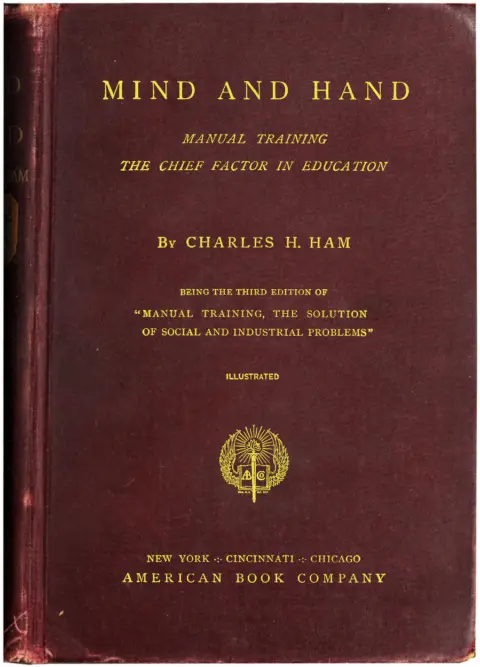
"Mind and Hand: Manual Training the Chief Factor in Education" by Charles H. Ham is an educational treatise written in the late 19th century. The book advocates for an educational reform that emphasizes the integration of manual training with intellectual development, positioning these skills as fundamental to a well-rounded education. Ham argues that the combination of mind and hands-on experience creates a more effective learning environment, fostering not only intellectual growth but also moral and practical skills in students. The beginning of the text discusses Ham's vision of the "Ideal School," a transformative educational institution that prioritizes practical training and labor alongside traditional learning. Describing the school as a place that dignifies labor and combines knowledge with hands-on work, he draws inspiration from historical educational theorists. He emphasizes the significance of tools as critical instruments in education, lamenting their absence in conventional schools, and challenges the status quo of education that often neglects practical skills. In his view, true education goes beyond theory to actively engage students in the physical world, blending learning with creativity and practical applications.
Introduction adapted from the source catalogue; source summaries may be automatically generated.
Free to read · English · 138,003 words · No account needed
MAKE TIME FOR A GOOD BOOK
On by default. Untick to stop anonymous reading totals. Each page counts after 10 seconds in view. How this works.
Anonymous counting is on unless you have switched it off.
Smiles, Samuel, declares that the automata of the Middle Ages led to the useful automatic tools of the eighteenth century, 35; his peculiar views about Maudslay’s great invention, 36; his history of the Dutch and German mechanics who contributed to the solution of the problem of the application of mineral coal to smelting purposes, 64; his graphic picture of the versatility of the smith, 71; his pen-picture of the steamship Warrior “breasting the billows of the North Sea,” 85; shows the true springs of English greatness in his “Lives of the Engineers,” 172; shows the origin of useful arts in England in his great work on the Huguenots, 185.
Smith, the, gives direction to the course of Empire, 62; a man of great consequence in England in the early time, 71; name of, descends to more families than that of any other profession, 71; versatility of, 71, 72; conducts the engineering at the siege of Berwick, 72; ancient, kin to all the ages through his works, 74.
Social evils, are the product of defective education, 325.
Social problems, solution of, to be sought through a radical change in educational methods, 248; the railway and factory are new factors in, 321; of America cannot be settled as those of Europe are, by emigration, 326.
Solicis, Prof. G., the chief supporter of manual training in France,
368.
South Carolina, educational system of, confined to a class, as opposed to universal education in New England, 235.
Spain, ruined by the expulsion of the Moors, 283; destitution in the chief cities of, 283; danger that the royal family of, would go hungry to bed, 283; is bankrupt, 296.
Speculation, rages on the exchanges of all large American cities, 322; affects every class in the community, 322; stimulates bad passions, and creates a distaste for labor, 322.
Speculative philosophy, only resource of the ancients, 153; dominated the world from the fall of Rome to the time of Bacon, 153.
Speech, must be incarnate in things or it is dead, 141; man would lose the power of, if his words should cease to be realized in things, 149; dependent upon objects for its existence, 150; has its origin not less in external objects than in the mind, 150; would be lost if the senses should cease to be impressed by things, 150; freedom of, and of thought, catch-penny phrases, 192.
Spelling, automatism in teaching, in the schools of the United States, as shown by the Walton report, 198, 199.
Spencer, Herbert, on the defects of the schools of England, 325; the contrast between his views and the dictum of Dr. Dwight of Yale University, 374; pointed out, the analogy between early methods of education and barbarism, 377.
Your reading position is saved on this browser. Take it to another device with a library code. Reading pages adapt to text, rather than matching a printed edition.
BEHIND THE BOOK
This eBook is for the use of anyone anywhere in the United States and most other parts of the world at no cost and with almost no restrictions whatsoever. You may copy it, give it away or re-use it under the terms of the Project Gutenberg License included with this eBook or online at www.gutenberg.org. If you are not located in the United States, you will have to check the laws of the country where you are located before using this eBook. Read the source licence.
The original source file, including credits and licence, is retained by this library. Request an original-format copy at no charge. Please include the book title and Project Gutenberg identifier #67039.
KEEP YOUR CURIOSITY GOING
Charles G. (Charles Griffith) Ross
Hannah Webster Foster

Emily Lawless
Edwin Hamlin Carr

Charles De Lano Hine
Andrew Ure