
The Writing of News A Handbook with Chapters on Newspaper Correspondence and Copy Reading
Charles G. (Charles Griffith) Ross
THE CLASSIC COLLECTION · 1886
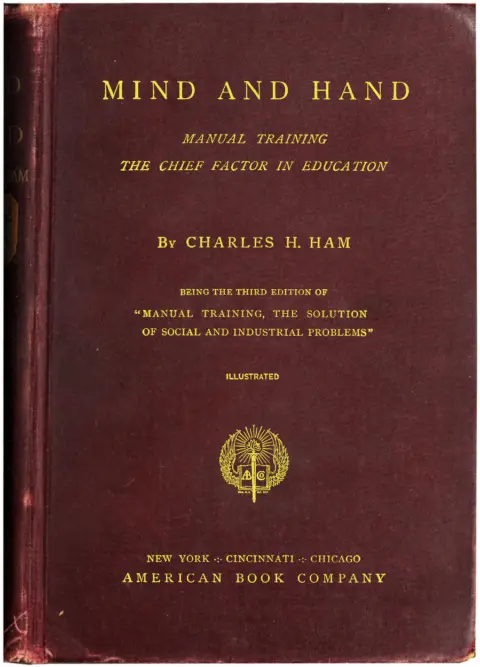
"Mind and Hand: Manual Training the Chief Factor in Education" by Charles H. Ham is an educational treatise written in the late 19th century. The book advocates for an educational reform that emphasizes the integration of manual training with intellectual development, positioning these skills as fundamental to a well-rounded education. Ham argues that the combination of mind and hands-on experience creates a more effective learning environment, fostering not only intellectual growth but also moral and practical skills in students. The beginning of the text discusses Ham's vision of the "Ideal School," a transformative educational institution that prioritizes practical training and labor alongside traditional learning. Describing the school as a place that dignifies labor and combines knowledge with hands-on work, he draws inspiration from historical educational theorists. He emphasizes the significance of tools as critical instruments in education, lamenting their absence in conventional schools, and challenges the status quo of education that often neglects practical skills. In his view, true education goes beyond theory to actively engage students in the physical world, blending learning with creativity and practical applications.
Introduction adapted from the source catalogue; source summaries may be automatically generated.
Free to read · English · 138,003 words · No account needed
MAKE TIME FOR A GOOD BOOK
On by default. Untick to stop anonymous reading totals. Each page counts after 10 seconds in view. How this works.
Anonymous counting is on unless you have switched it off.
Seneca, sublime moral precepts of, contrasted with the horrors of the gladiatorial games, 138; his doctrine of humanity, 139; ignores slavery, the slave, the laborer, and the useful arts, 268; morals of, glittering generalities, politics of, practical, 269; put money in his purse, 269; charged with complicity in the Piso conspiracy, and banished for the crime of adultery, 269.
Serfs of the Middle Ages the mercenary troops of the modern State,
290.
Service--the greatest thing in the moral world, 378.
Seville, silk industry of, 292; looms of, silenced in the seventeenth
century, 283.
Sewing-machine, the, its accuracy, 87; it illustrates the interdependence of the practical arts, 87; it multiplies garments beyond the power of figures to express, 87.
Sheffield, Lord, his estimate of the value of Henry Cort’s improvements in iron and the steam-engine of Watt, 115; his declaration of the purpose of the establishment of the American colonies, 202.
Sheffield, town of, its insignificance in 1715, 116; its manufacturing
importance now, 116.
Skill being prolific of good should be brought to bear upon
educational systems, 132.
Slavery existed in the United States when Horace Mann declared it to be the cause of the degradation of labor and the laborer, 189; aided by England in its struggle for survival, 189; influence of, not yet extinct, 189; has kept its brand of shame upon the useful arts for thousands of years, 190; how the Egyptian was reduced to, 250; and labor were synonymous terms in Rome, 265; a state of, is a state of war, 265; confounded with freedom in the United States, 311; negroes escaping from, called fugitives from justice, 311; justified in Faneuil Hall, the cradle of liberty, 311; tried only by the test of self-interest, 312; in the North it faded away, in the South it flourished, 312; climate conditions, not education, saved this continent from the scourge of, 312, 313; question of continuance of, in the United States, settled by violence, as savages settle controversies, 313.
Slaves, in Rome, laws in relation to, 265; a million killed in the course of the servile rebellion in Sicily, 265; exposed to wild beasts in the arena for the popular amusement, 265; all industrial pursuits in Rome carried on by, 266; labor of, in Rome, cheaper than that of cattle, 266; construct all the great public works in Rome, 269; strike for liberty in Rome, and are slaughtered, 271; clank of the chains of, in the streets of Boston, 311.
Smeaton helps to solve the steam-power problem, 15; the best workman
of his time, 85.
Your reading position is saved on this browser. Take it to another device with a library code. Reading pages adapt to text, rather than matching a printed edition.
BEHIND THE BOOK
This eBook is for the use of anyone anywhere in the United States and most other parts of the world at no cost and with almost no restrictions whatsoever. You may copy it, give it away or re-use it under the terms of the Project Gutenberg License included with this eBook or online at www.gutenberg.org. If you are not located in the United States, you will have to check the laws of the country where you are located before using this eBook. Read the source licence.
The original source file, including credits and licence, is retained by this library. Request an original-format copy at no charge. Please include the book title and Project Gutenberg identifier #67039.
KEEP YOUR CURIOSITY GOING
Charles G. (Charles Griffith) Ross
Hannah Webster Foster

Emily Lawless
Edwin Hamlin Carr

Charles De Lano Hine
Andrew Ure