
The Writing of News A Handbook with Chapters on Newspaper Correspondence and Copy Reading
Charles G. (Charles Griffith) Ross
THE CLASSIC COLLECTION · 1886
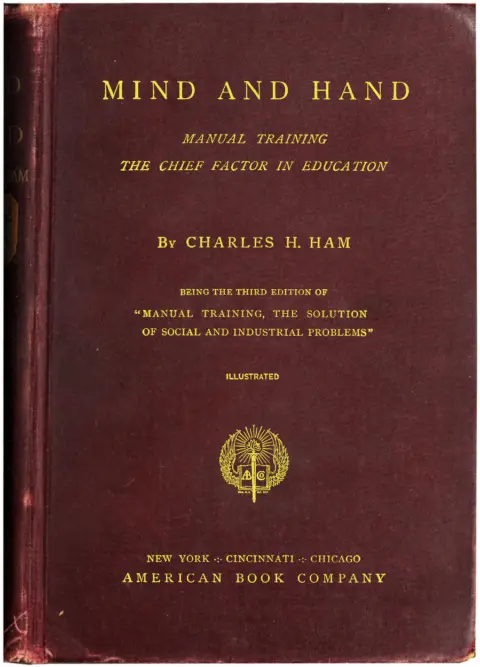
"Mind and Hand: Manual Training the Chief Factor in Education" by Charles H. Ham is an educational treatise written in the late 19th century. The book advocates for an educational reform that emphasizes the integration of manual training with intellectual development, positioning these skills as fundamental to a well-rounded education. Ham argues that the combination of mind and hands-on experience creates a more effective learning environment, fostering not only intellectual growth but also moral and practical skills in students. The beginning of the text discusses Ham's vision of the "Ideal School," a transformative educational institution that prioritizes practical training and labor alongside traditional learning. Describing the school as a place that dignifies labor and combines knowledge with hands-on work, he draws inspiration from historical educational theorists. He emphasizes the significance of tools as critical instruments in education, lamenting their absence in conventional schools, and challenges the status quo of education that often neglects practical skills. In his view, true education goes beyond theory to actively engage students in the physical world, blending learning with creativity and practical applications.
Introduction adapted from the source catalogue; source summaries may be automatically generated.
Free to read · English · 138,003 words · No account needed
MAKE TIME FOR A GOOD BOOK
On by default. Untick to stop anonymous reading totals. Each page counts after 10 seconds in view. How this works.
Anonymous counting is on unless you have switched it off.
Ignorance, illustration of, in the opposition of a Roman Emperor to the use of improved machinery, 178; reverences the past, never doubts, is suspicious, an enemy of all progress, 179; in the schools of Norfolk County, Mass., 197.
Illinois Penitentiary, statistics of show that four out of five of the inmates of have no handicraft, 182.
Imagination, Buckle’s tribute to the, 38; Disraeli on Sir Robert Peel’s want of, 38; Disraeli’s career an illustration of the value of, 39; the discovery of America appealed powerfully to the, 287; blazes the path to glorious achievements, 287.
Imperial Technical School, Moscow, manual training adopted as part of curriculum of the, in 1868, 331; sketch of the history of manual training in, by Director Della Vos, 331-333.
India, how the castes of, arose, 249.
Injustice, civilization languishes in an atmosphere of, 278.
Inquisition, the, its persecution of Galileo, 177, 178.
Instructors, lack of competent, in the new education, 352, 353.
Intelligence, the basis of morality, 113.
Inventions, a growth, 14; each step of constitutes a link in the chain of progress, 187; contain the germs of imperishable truth, 243.
Inventive genius, to the, mankind owes more than to the philosophers, littérateurs, professors, and statesmen of all time, 84.
Inventor, the, produces a machine that will make a thousand things in the time required by the hand-worker to make one, 86; helps on the cause of progress, 160; rules the world, 161; his works are never repealed, 187; is always in the advance, 242.
Iowa, Agricultural College of, makes domestic economy a part of its curriculum, 360; faculty and course of study in the department of domestic economy of, 360, 361.
Iron, Locke’s famous apothegm on the value of, 45; the most potent instrument of power, 61; use of by Queen Elizabeth to defeat the Spanish Armada, 61; the equivalent of civilization, 62; is king, and the smelter and smith are his chief ministers, 62; to make a ton of, required hundreds of cords of wood before the introduction of “pit” coal for smelting purposes, 63; the foundation of every useful art, 81.
Italy, government of, during the Middle Ages, consisted of a menace
and a sneer, 284.
Jacobson, Col. Augustus, on the demand for a more comprehensive system of education, 180; on the proper equipment of the boy upon leaving school, 209.
Jerusalem, when conquered, its smiths and other craftsmen were carried away as captives by the Babylonians, 70.
Jews, learning of, exerted an ameliorating influence upon the darkness of the Middle Ages, 285.
Judges, training of, is exclusively subjective, 230; rendered selfish by subjective processes of thought, 231; venerate the past, 242.
Justice assumes the place of selfishness in the mind of the hero, 233; cause of the failure of, 242.
Keith, Edson, Trustee of Chicago Manual Training School Association,
340.
Your reading position is saved on this browser. Take it to another device with a library code. Reading pages adapt to text, rather than matching a printed edition.
BEHIND THE BOOK
This eBook is for the use of anyone anywhere in the United States and most other parts of the world at no cost and with almost no restrictions whatsoever. You may copy it, give it away or re-use it under the terms of the Project Gutenberg License included with this eBook or online at www.gutenberg.org. If you are not located in the United States, you will have to check the laws of the country where you are located before using this eBook. Read the source licence.
The original source file, including credits and licence, is retained by this library. Request an original-format copy at no charge. Please include the book title and Project Gutenberg identifier #67039.
KEEP YOUR CURIOSITY GOING
Charles G. (Charles Griffith) Ross
Hannah Webster Foster

Emily Lawless
Edwin Hamlin Carr

Charles De Lano Hine
Andrew Ure