
The Writing of News A Handbook with Chapters on Newspaper Correspondence and Copy Reading
Charles G. (Charles Griffith) Ross
THE CLASSIC COLLECTION · 1886
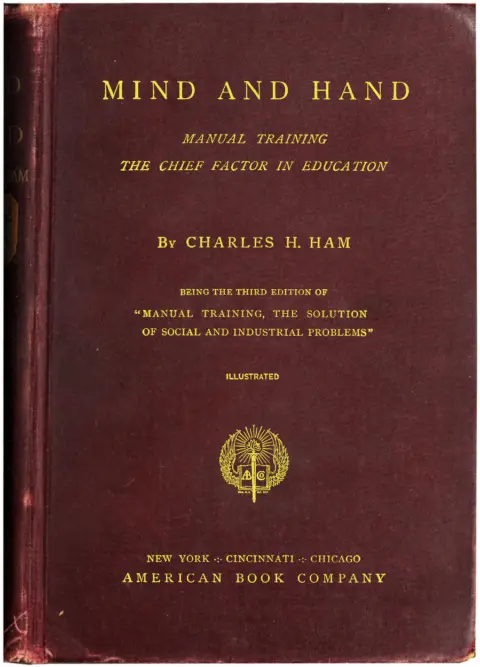
"Mind and Hand: Manual Training the Chief Factor in Education" by Charles H. Ham is an educational treatise written in the late 19th century. The book advocates for an educational reform that emphasizes the integration of manual training with intellectual development, positioning these skills as fundamental to a well-rounded education. Ham argues that the combination of mind and hands-on experience creates a more effective learning environment, fostering not only intellectual growth but also moral and practical skills in students. The beginning of the text discusses Ham's vision of the "Ideal School," a transformative educational institution that prioritizes practical training and labor alongside traditional learning. Describing the school as a place that dignifies labor and combines knowledge with hands-on work, he draws inspiration from historical educational theorists. He emphasizes the significance of tools as critical instruments in education, lamenting their absence in conventional schools, and challenges the status quo of education that often neglects practical skills. In his view, true education goes beyond theory to actively engage students in the physical world, blending learning with creativity and practical applications.
Introduction adapted from the source catalogue; source summaries may be automatically generated.
Free to read · English · 138,003 words · No account needed
MAKE TIME FOR A GOOD BOOK
On by default. Untick to stop anonymous reading totals. Each page counts after 10 seconds in view. How this works.
Anonymous counting is on unless you have switched it off.
How is the idea of the rising of the sun modified?
“Flashed all their sabres bare,
Flashed as they turned in air,
Sab’ring the gunners there,
Charging an army, while
All the world wondered.”
Change to good prose.
4. State the meaning of each prefix and suffix in the following words: Emigrate; Immigrate; Illegally; Admissible; Thoughtlessness; Affixing.
a. Why is the final e of “service” retained in “serviceable?”
b. Write the present participle of “befit;” of “benefit.” What difference in spelling? Why?
c. Define Ancient; Venerable; Obsolete.
6. Write an essay on Chicago, mentioning the rapid growth of the city; its land and water communications; its commerce and manufactures; its public buildings; its institutions of learning and charity, and any other items which may occur to you.
Having passed the ordeal of the foregoing battery of questions the student of the Ideal School finds his mental exercises alternated with manual exercises throughout the entire course in something like the following order, namely:
=Junior Year.=--(1.) Mathematics--Arithmetic; Algebra. (2.) Science.--Physiology; Physical Geography. (3.) Language.--English Language and Literature; or Latin Reader. (4.) Drawing.--Freehand Model and Object; Projection; Machine; Perspective. (5.) Shopwork.--Carpentry, Joinery, Wood-Turning, Pattern-Making, Proper Care and Use of Tools.
=Middle Year.=--(1.) Mathematics.--Geometry. (2.) Science.--Physics. (3.) Language.--General History and Literature; or Cæsar. (4.) Drawing.--Orthographic Projection and Shadows; Line and Brush Shading; Isometric Projection and Shadows; Details of Machinery; Machine from Measurement. (5.) Shopwork.--Molding, Casting; Forging, Welding, Tempering; Soldering, Brazing.
=Senior Year.=--(1.) Mathematics.--Plane Trigonometry; Mechanics; Book-keeping. (2.) Science.--Chemistry; or Descriptive Geometry and Higher Algebra. (3.) Language, etc.--English Literature, Civil Government, Political Economy; or Cicero, or French. (4.) Drawing.--Machine from Measurement; Building from Measurement; Architectural Perspective. (5.) Machine Shopwork.--Such as Chipping, Filing, Fitting, Turning, Drilling, Planing, etc. Study of Machinery, including the Management and Care of Steam Engines and Boilers.
Latin and French may be taken instead of English Language, Literature, and History. Instruction will be given each year in the properties of the materials--wood, iron, brass, etc.--used in that year.
Throughout the course, one hour per day, or more, will be given to drawing, and not less than two hours per day to laboratory work. The remainder of the school day will be devoted to study and recitation. Before graduating, each pupil will be required to construct a machine from drawings and patterns made by himself. A diploma will be given on graduation.
The new education is a blending of manual and mental training. It recognizes the fact that science discovers and art utilizes, and that these two forces move the modern world.
Your reading position is saved on this browser. Take it to another device with a library code. Reading pages adapt to text, rather than matching a printed edition.
BEHIND THE BOOK
This eBook is for the use of anyone anywhere in the United States and most other parts of the world at no cost and with almost no restrictions whatsoever. You may copy it, give it away or re-use it under the terms of the Project Gutenberg License included with this eBook or online at www.gutenberg.org. If you are not located in the United States, you will have to check the laws of the country where you are located before using this eBook. Read the source licence.
The original source file, including credits and licence, is retained by this library. Request an original-format copy at no charge. Please include the book title and Project Gutenberg identifier #67039.
KEEP YOUR CURIOSITY GOING
Charles G. (Charles Griffith) Ross
Hannah Webster Foster

Emily Lawless
Edwin Hamlin Carr

Charles De Lano Hine
Andrew Ure