
The Writing of News A Handbook with Chapters on Newspaper Correspondence and Copy Reading
Charles G. (Charles Griffith) Ross
THE CLASSIC COLLECTION · 1886
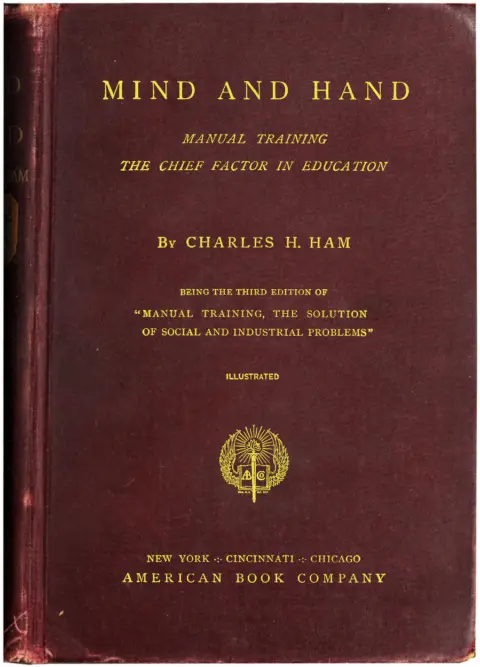
"Mind and Hand: Manual Training the Chief Factor in Education" by Charles H. Ham is an educational treatise written in the late 19th century. The book advocates for an educational reform that emphasizes the integration of manual training with intellectual development, positioning these skills as fundamental to a well-rounded education. Ham argues that the combination of mind and hands-on experience creates a more effective learning environment, fostering not only intellectual growth but also moral and practical skills in students. The beginning of the text discusses Ham's vision of the "Ideal School," a transformative educational institution that prioritizes practical training and labor alongside traditional learning. Describing the school as a place that dignifies labor and combines knowledge with hands-on work, he draws inspiration from historical educational theorists. He emphasizes the significance of tools as critical instruments in education, lamenting their absence in conventional schools, and challenges the status quo of education that often neglects practical skills. In his view, true education goes beyond theory to actively engage students in the physical world, blending learning with creativity and practical applications.
Introduction adapted from the source catalogue; source summaries may be automatically generated.
Free to read · English · 138,003 words · No account needed
MAKE TIME FOR A GOOD BOOK
On by default. Untick to stop anonymous reading totals. Each page counts after 10 seconds in view. How this works.
Anonymous counting is on unless you have switched it off.
Expression, power of, quite as important as that of absorption, 208; susceptible of being made clear only in things, 208.
Eye, not a more important organ than the hand, because it is situated
nearer the brain, 154.
Fairbank, N. K., Trustee of the Chicago Manual Training School
Association, 346.
Faneuil Hall, slavery justified in, 311.
Feudalism emasculated human energy, 281; the ruin of, set thousands of
serfs free, 290.
Field, Marshall, Treasurer of the Chicago Manual Training School
Association, 346.
File, the, older than history, dating back to the Greek mythological period, 91; of the Swiss watch-makers, 91; dexterity of the hand-working cutter of, 91; invention of file-cutting machine in 1859, 91.
Finland, all the schools of, give instruction in hand-cunning, 368.
Fire, legend in regard to its discovery, 62.
Foley, Thomas, on the excellence of the laboratory methods of
instruction, 217, 218.
Force, new elements of, to be discovered and applied to the needs of
man, 180.
Forging, laboratory of, 58; pen-picture of a class of students in, 61; story of the origin of the Turkish Empire related by the instructor in, 61; the management of the forge fires in, 62; lessons in, on the black-board and at the forges, in detail, 66; the instructor in, at the forge, 69; questions by the students in, 69; the school-room converted into a smithy which resounds with the clang of sledges, 69, 70; healthful effects of the exercise--the anvil chorus, 70; the tests of merit in, applied, 75; the instructor in, gives a lecture on the steam-hammer, 75; extent of the course in, 77.
Founding, laboratory of, 45; history of the art of, 46; first applied to bronze, 46; lesson of the day, casting a pulley, 48; the process in detail, 51; pen-picture of the students pouring the steaming metal into moulds, 52.
France, permanently weakened by the increase of her national debt, 296; debt, statement of--what the war with Germany cost her, 296; cannot double her debt again and make her people pay interest on it, 297; a law of, makes manual training obligatory, 368; supports a school for training teachers of manual training, 368; Prof. G. Solicis the chief supporter of manual training in, 368.
Franklin, the famous selfish maxims of, 311.
Froebel, the school be struggled in vain to establish, 2; first applies Rousseau’s ideas to school life, 126; his definition of education, 126; condemns the old system of education, 126; a character of, 127; his discovery of the superior fitness of woman for the office of teacher, 127, 128; foresees the manual training school, 245; it was reserved for him to rescue woman from the scorn of the ages, 367.
Fuller, William A., Secretary of the Chicago Manual Training School
Association, 346.
Fulton, Robert, an American inventor, 84.
Galileo, persecution of, for his great discovery, 177, 178; persecutors of, believed and trembled, 287.
Your reading position is saved on this browser. Take it to another device with a library code. Reading pages adapt to text, rather than matching a printed edition.
BEHIND THE BOOK
This eBook is for the use of anyone anywhere in the United States and most other parts of the world at no cost and with almost no restrictions whatsoever. You may copy it, give it away or re-use it under the terms of the Project Gutenberg License included with this eBook or online at www.gutenberg.org. If you are not located in the United States, you will have to check the laws of the country where you are located before using this eBook. Read the source licence.
The original source file, including credits and licence, is retained by this library. Request an original-format copy at no charge. Please include the book title and Project Gutenberg identifier #67039.
KEEP YOUR CURIOSITY GOING
Charles G. (Charles Griffith) Ross
Hannah Webster Foster

Emily Lawless
Edwin Hamlin Carr

Charles De Lano Hine
Andrew Ure