
The Writing of News A Handbook with Chapters on Newspaper Correspondence and Copy Reading
Charles G. (Charles Griffith) Ross
THE CLASSIC COLLECTION · 1886
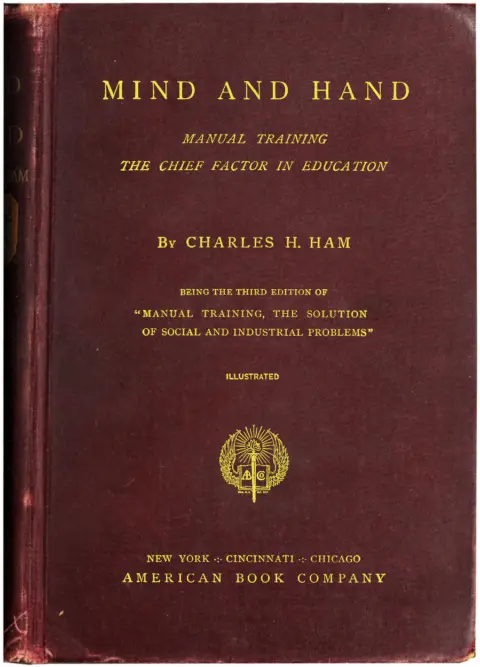
"Mind and Hand: Manual Training the Chief Factor in Education" by Charles H. Ham is an educational treatise written in the late 19th century. The book advocates for an educational reform that emphasizes the integration of manual training with intellectual development, positioning these skills as fundamental to a well-rounded education. Ham argues that the combination of mind and hands-on experience creates a more effective learning environment, fostering not only intellectual growth but also moral and practical skills in students. The beginning of the text discusses Ham's vision of the "Ideal School," a transformative educational institution that prioritizes practical training and labor alongside traditional learning. Describing the school as a place that dignifies labor and combines knowledge with hands-on work, he draws inspiration from historical educational theorists. He emphasizes the significance of tools as critical instruments in education, lamenting their absence in conventional schools, and challenges the status quo of education that often neglects practical skills. In his view, true education goes beyond theory to actively engage students in the physical world, blending learning with creativity and practical applications.
Introduction adapted from the source catalogue; source summaries may be automatically generated.
Free to read · English · 138,003 words · No account needed
MAKE TIME FOR A GOOD BOOK
On by default. Untick to stop anonymous reading totals. Each page counts after 10 seconds in view. How this works.
Anonymous counting is on unless you have switched it off.
Edward III. of England uses the smiths at the siege of Berwick, 72.
Egypt, how the castes of, arose, 249; progress of the civilization of, 249; civilization of, the product of education, 250; selfishness the basis of the system of education of, 250; wealth, commerce, and military and naval power of, 250; learning of, 251; luxury of, 251; conquered by Persia, 251, 252; no provision in, for the training of woman, 366.
Electricity must be “harnessed” at the forge and in the shop to enable it to do its work, 170.
Elizabeth, Queen, use of iron by, to defeat the Spanish Armada, 61.
Emerson, his declaration that Napoleon was typical of the modern man, 134; his observation that during the Crusades “the banker with his seven per cent. drove the earl out of his castle,” 286.
Emigrant, the, withdraws his support from the fatherland, 290.
Emigration, social questions cannot much longer be settled by, 299.
Empire, art of mechanism greatest of modern times, 61.
England, history of the early iron manufacture of, 63; decline of the iron industry of, during the seventeenth century, 65; the people of, import their pots and kettles, 65; workshops of, originate great inventions during the period 1740-1840, 115; apprentices of, become learned men, 115; material condition of, 250 years ago, 158, 159; civilization and transformation of--how accomplished, 159; studded with workshops, filled with automatic machines through the apprentice system, 181; debt of, to the French and Flemish immigrants, 185; constitution of, grew out of the feudal system, 190; safer to shoot a man than a hare in, 190; school system of, indescribably poor, 224; a scientific system of education in, would have averted wars and kept down the national debt of, 237; criminal laws of, 241; draws from her people a larger per capita revenue than any nation of Europe, 297; has nearly reached the limit of the power of her people to pay taxes, 297; land system of--its terrible effect upon the English, Scotch, and Irish, 317.
English history, the great names in--the names without which there would have been no English history, 175.
Enterprise, in the Middle Ages, the slave of superstition and
ignorance, 277.
Epictetus, lofty patriotism of, 139.
Equality, social and educational, essential to an ideal civilization,
375.
Europe, face of, and civilization of, changed during the Crusades, 286; growth of the middle class of, 286; the artisan became a factor in the social problem of, 286; art treasures of, destined to follow in the track of her fleeing population, 294; may restore to productive employments three millions of men, 302; may place at the disposal of her educators seven hundred million dollars per annum, instead of seventy million dollars, as at present, 302; may extinguish her national debts in fifty-four years, 303; progress in, previous to the discovery of America, 307, 308.
Ewing, Mrs. Emma P., Dean of the Domestic Economy Department of the Iowa Agricultural College, 361; on the importance of the study of domestic economy, 361, 362.
Your reading position is saved on this browser. Take it to another device with a library code. Reading pages adapt to text, rather than matching a printed edition.
BEHIND THE BOOK
This eBook is for the use of anyone anywhere in the United States and most other parts of the world at no cost and with almost no restrictions whatsoever. You may copy it, give it away or re-use it under the terms of the Project Gutenberg License included with this eBook or online at www.gutenberg.org. If you are not located in the United States, you will have to check the laws of the country where you are located before using this eBook. Read the source licence.
The original source file, including credits and licence, is retained by this library. Request an original-format copy at no charge. Please include the book title and Project Gutenberg identifier #67039.
KEEP YOUR CURIOSITY GOING
Charles G. (Charles Griffith) Ross
Hannah Webster Foster

Emily Lawless
Edwin Hamlin Carr

Charles De Lano Hine
Andrew Ure