
The Writing of News A Handbook with Chapters on Newspaper Correspondence and Copy Reading
Charles G. (Charles Griffith) Ross
THE CLASSIC COLLECTION · 1907
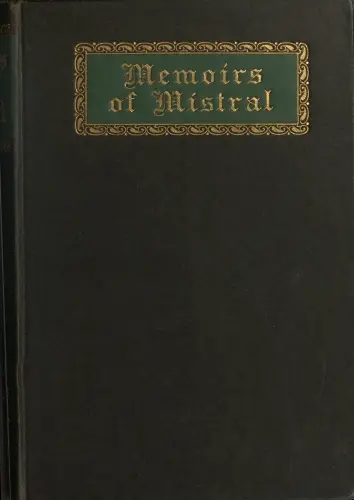
"Memoirs of Mistral" by Frédéric Mistral is a memoir written in the late 19th century. The work provides a vivid account of the author's early life in the province of Provence, capturing the essence of rural life and his formative experiences. The narrative is likely to focus on Mistral's childhood memories, including his family, education, and the natural landscapes that shaped his identity as a poet. The opening portion of the memoir introduces Frédéric Mistral’s childhood in the village of Maillane, nestled at the foot of the Alpilles mountains. He shares details of his family's way of life as yeoman farmers, emphasizing the harmony between their traditions and the landscape. Key figures in his early life, such as his parents, are vividly described; particularly his father, a hardworking patriarch with deep roots in Provençal traditions. Mistral paints a nostalgic picture of his innocent adventures, interactions with local characters, and fond memories tied to nature and familial bonds, establishing a strong sense of place and identity that resonates throughout the memoir.
Introduction adapted from the source catalogue; source summaries may be automatically generated.
Free to read · English · 69,531 words · No account needed
MAKE TIME FOR A GOOD BOOK
On by default. Untick to stop anonymous reading totals. Each page counts after 10 seconds in view. How this works.
Anonymous counting is on unless you have switched it off.
“‘That is true,’ said Jesus. ‘I will try again.’ And with that he returned to the smithy.
“‘God give you good-day, master above all other masters. Have you no need of an apprentice?’
“‘Come in, come in,’ replied Eloi. ‘I have been thinking that we could give you work also. But listen to this once and for all: When you address me, you must say, “Master, above all other masters,” see you--this is not to boast, but men like me, who can forge a shoe in two heatings, there are not two in Limousin!’
“‘Oh,’ replied the apprentice, ‘in our country, we do it with one
heating!’
“‘Only one heating! Go to, boy, be silent then--why the thing is not
possible.’
“‘Very well, you shall see, master above all other masters!’
“Jesus took a piece of iron, threw it into the forge, blew, made up the fire, and when the iron was red--red, and incandescent--he took it out with his hand.
“‘Oh--poor simpleton!’ the head apprentice cried to him, ‘thou wilt scorch thy fingers!’
“‘Have no fear!’ answered Jesus. ‘Thanks to God, in our country we have no need of pincers.’ And the little workman seizes with his hand the iron heated to white heat, carries it to the anvil, and with his hammer, pif, paf, in the twinkle of an eye, stretches it, flattens it, rounds it and stamps it so well that one would have said it was cast.
“‘Oh, I, too,’ said Master Eloi, ‘I could do that if I wanted to.’
“He then takes a piece of iron, throws it in the forge, blows, makes up the fire, and when the iron is red hot, goes to take it as his apprentice had done and carry it to the anvil--but he burns his fingers badly! In vain he tried to hurry, to harden himself to endure the burn, he was forced to let go his hold and run for the pincers. In the meantime the shoe for the horse grew cold--and only a few sparks burnt out. Ah! poor Master Eloi, he might well hammer, and put himself in a sweat--to do it with one heating was impossible.
“‘But listen,’ said the apprentice, ‘I seem to hear the gallop of a
horse.’
“Master Eloi at once stalked to the door and sees a cavalier, a splendid cavalier, drawing up at the smithy. Now this was Saint-Martin.
“‘I come a long way,’ he said, ‘my horse has lost a shoe, and I am in a great hurry to find a blacksmith.’
“Master Eloi bridled up.
Your reading position is saved on this browser. Take it to another device with a library code. Reading pages adapt to text, rather than matching a printed edition.
BEHIND THE BOOK
This eBook is for the use of anyone anywhere in the United States and most other parts of the world at no cost and with almost no restrictions whatsoever. You may copy it, give it away or re-use it under the terms of the Project Gutenberg License included with this eBook or online at www.gutenberg.org. If you are not located in the United States, you will have to check the laws of the country where you are located before using this eBook. Read the source licence.
The original source file, including credits and licence, is retained by this library. Request an original-format copy at no charge. Please include the book title and Project Gutenberg identifier #56040.
KEEP YOUR CURIOSITY GOING
Charles G. (Charles Griffith) Ross
Hannah Webster Foster

Emily Lawless
Edwin Hamlin Carr

Charles De Lano Hine
Andrew Ure