
The Writing of News A Handbook with Chapters on Newspaper Correspondence and Copy Reading
Charles G. (Charles Griffith) Ross
THE CLASSIC COLLECTION · 1907
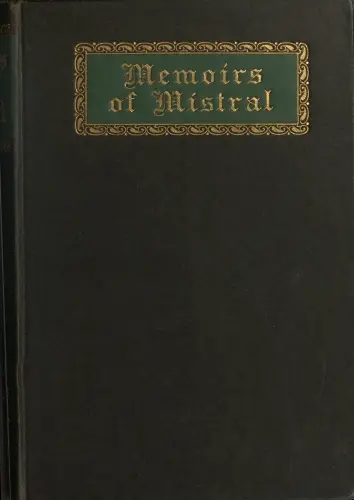
"Memoirs of Mistral" by Frédéric Mistral is a memoir written in the late 19th century. The work provides a vivid account of the author's early life in the province of Provence, capturing the essence of rural life and his formative experiences. The narrative is likely to focus on Mistral's childhood memories, including his family, education, and the natural landscapes that shaped his identity as a poet. The opening portion of the memoir introduces Frédéric Mistral’s childhood in the village of Maillane, nestled at the foot of the Alpilles mountains. He shares details of his family's way of life as yeoman farmers, emphasizing the harmony between their traditions and the landscape. Key figures in his early life, such as his parents, are vividly described; particularly his father, a hardworking patriarch with deep roots in Provençal traditions. Mistral paints a nostalgic picture of his innocent adventures, interactions with local characters, and fond memories tied to nature and familial bonds, establishing a strong sense of place and identity that resonates throughout the memoir.
Introduction adapted from the source catalogue; source summaries may be automatically generated.
Free to read · English · 69,531 words · No account needed
MAKE TIME FOR A GOOD BOOK
On by default. Untick to stop anonymous reading totals. Each page counts after 10 seconds in view. How this works.
Anonymous counting is on unless you have switched it off.
The company confessed that all they had heard was that their saint had
been a blacksmith.
“Yes, but I am going to tell you how he became a saint.” And while soaking a crisp tortillarde in his glass of Tavel wine, the worthy Roussière proceeded:
“Our Lord God the Father, one day in Paradise, wore a troubled air. The child Jesus inquired of him:
“‘What is the matter, my Father?’
“‘I have,’ replied God, ‘a case that greatly plagues me. Hold, look down
there!’
“‘Where?’ asked Jesus.
“‘Down there, in the Limousin, to the right of my finger: thou seest, in that village, near the city, a smithy, a large fine smithy?’
“‘I see--I see.’
“‘Well, my son, there is a man that I should like to have saved: they call him Master Eloi. He is a reliable, good fellow, a faithful observer of my Commandments, charitable to the poor, kind-hearted to every one, of exemplary conduct, hammering away from morning to night without evil speaking or blasphemy. Yes, he seems to me worthy to become a great saint.’
“‘And what prevents it?’ asked Jesus.
“‘His pride, my son. Because he is a good worker, a worker of the first order, Eloi thinks that no one on earth is above him, and presumption is perdition.’
“‘My Lord Father,’ said Jesus, ‘if you will permit me to descend to the earth I will try and convert him.’
“‘Go, my dear son.’
“And the good Jesus descended. Dressed like an apprentice, his tool-bag on his back, the divine workman alighted right in the street where Eloi dwelt. Over the blacksmith’s door was the usual signboard, and on it this inscription:
“‘Eloi the blacksmith, master above all other masters, forges a shoe in
two heatings.’
“The little apprentice stepped on to the threshold and taking off his
hat:
“‘God give you good-day, master, and to the company,’ said he; ‘have you need of any help?’
“‘Not for the moment,’ answered Eloi.
“‘Farewell then, master: it will be for another time.’
“And the good Jesus continued his road. In the street he saw a group of men talking, and Jesus said in passing:
“‘I should not have thought that in such a smithy, where there must be, one would think, so much doing, they would refuse me work.’
“‘Wait a bit, my lad,’ said one of the neighbours. ‘What salutation did you make to Master Eloi!’
“‘I said, as is usual, “God give you good-day, master, and to the
company!’
“‘Ah, but that is not what you should have said. You should have addressed him as, “Master above all other masters.” There, look at the board!’
Your reading position is saved on this browser. Take it to another device with a library code. Reading pages adapt to text, rather than matching a printed edition.
BEHIND THE BOOK
This eBook is for the use of anyone anywhere in the United States and most other parts of the world at no cost and with almost no restrictions whatsoever. You may copy it, give it away or re-use it under the terms of the Project Gutenberg License included with this eBook or online at www.gutenberg.org. If you are not located in the United States, you will have to check the laws of the country where you are located before using this eBook. Read the source licence.
The original source file, including credits and licence, is retained by this library. Request an original-format copy at no charge. Please include the book title and Project Gutenberg identifier #56040.
KEEP YOUR CURIOSITY GOING
Charles G. (Charles Griffith) Ross
Hannah Webster Foster

Emily Lawless
Edwin Hamlin Carr

Charles De Lano Hine
Andrew Ure