THE CLASSIC COLLECTION✦An outlaw’s diary: the CommuneCLASSIC FREE BOOKS
An outlaw’s diary: the Commune
Cécile Tormay
THE CLASSIC COLLECTION · 1920
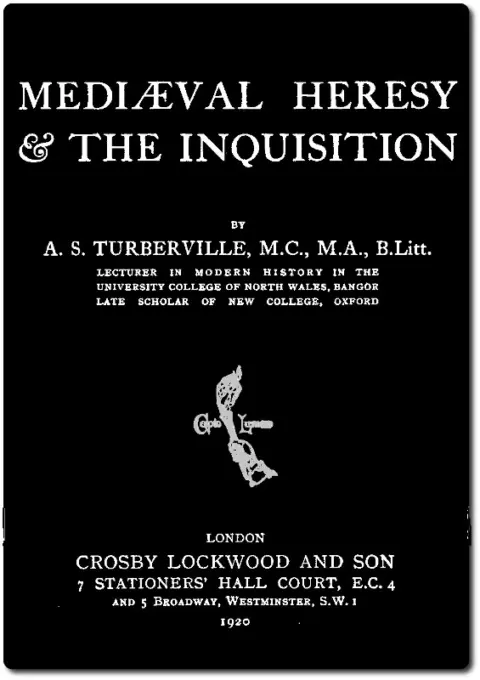
"Mediæval Heresy & the Inquisition" by Arthur Stanley Turberville is a historical account written in the early 20th century. The work explores the complex relationship between various heretical movements that emerged in the Middle Ages and the Church's response to them through the Inquisition. With a focus primarily on the origins of heresy and the nature of ecclesiastical power, it seeks to provide insight into the doctrinal conflicts and social conditions that fueled these movements. The opening of the book sets the stage by describing the historical context of the Middle Ages, establishing a nuanced perspective on what is often referred to as the "Ages of Faith." Turberville asserts that this title does not reflect the whole truth, as various heresies arose from psychological, social, and intellectual tensions within society. He delves into the concept of the "Civitas Dei," emphasizing the intertwined relationship of church and state, and addresses the roots of heresy stemming from clerical abuses and public dissatisfaction. By laying this groundwork, the author suggests that the Inquisition's emergence was a societal response to the perceived threats posed by heretical teachings, highlighting the complexities of faith and authority during this turbulent period.
Introduction adapted from the source catalogue; source summaries may be automatically generated.
Free to read · English · 89,610 words · No account needed
MAKE TIME FOR A GOOD BOOK
On by default. Untick to stop anonymous reading totals. Each page counts after 10 seconds in view. How this works.
Anonymous counting is on unless you have switched it off.
[408] Lea, vol. i, pp. 423-4, with reference to the infrequent mention of torture in inquisitorial registers. ‘Apparently it was felt that to record its use would in some way invalidate the force of the testimony.’ Cf. Tanon, p. 377. ‘Cette particularité (silence) n’est pas spéciale aux registres de l’Inquisition. La plupart des registres criminels des juridictions laïques, pour les époques auxquelles la “question” était d’une application constante, la présentent pareillement. La question était un incident de procédure qui donnait lieu d’abord à un interlocutoire, puis à un procès-verbal spécial, dont la transcription dans les registres n’était nullement nécessaire. Le greffier qui rédigeait la sentence, lorsqu’il relatait les aveux de l’accusé, était beaucoup moins préoccupé de constater les moyens de contrainte à l’aide desquels ils avaient été obtenus que la réitération de ces mêmes aveux, réputés alors volontiers, hors de la chambre de torture.’
[409] Eymeric, Directorium, p. 640; Peña’s comment, 110, p. 643.
[410] Ibid., comment 39, p. 520. ‘Cum reus fuit leviter et molliter tortus, repeti potest in tormentis, ita ut sufficienter torqueatur, ... et haec non tam dicitur repetitio torturae quam continuatio.’
[411] Frédéricq, Corpus, vol. i, No. 318.
[412] Eymeric, Peña’s comment, p. 521.
[413] Ibid., p. 519.
[414] Ibid., pp. 480, 592, 614.
[415] See Tanon, p. 433. Out of 200 cases before the Carcassonne tribunal there was only one acquittal.
[416] Ludovico à Paramo, p. 269.
[417] They were also, of course, a warning. ‘The punishment of one is the fear of many,’ remarks Simancas sententiously, Zilettus, vol. xi, pt. ii, p. 179. But the main object is repentance and conversion. Ibid., p. 181.
[418] Bernard Gui, Practica, p. 38.
[419] Ibid., pp. 94-8.
[420] See Douais, Documents, vol. ii, p. 181.
[421] Bernard Gui, Practica, p. 95; Liber Sententiarum in Limborch, Historia Inquisitionis, pp. 218, 347. For an instance of this sort of sentence, see Douais, Documents, vol. ii, pp. 116-17. ‘Injunctum fuit Ullixi in penitentia per inquisitores pro perjurio, quia non resumpsit cruces sicut juraverat, quod dominica post instantem dominicam in lxxͣ veniat Carcassonam visitaturus omnes ecclesias Burgi Carcassonensis nudis pedibus in camesis et braceis, cum virgis in manu, eundo de una ecclesia ad aliam; et idem faciet in prima dominica mensium singulorum quousque transeat ultra mare. Et hoc fuit ei injunctum in virtute praestiti juramenti.’
[422] Lea, vol. i, p. 464; De Cauzons, vol. ii, p. 303.
[423] Mansi, vol. xxiii, p. 271, § iv. Bernard Gui’s sentences are full of the infliction of this penance. Cf. Liber Sententiarum, pp. 40-5, 100-17, 185-91, 218-28.
Your reading position is saved on this browser. Take it to another device with a library code. Reading pages adapt to text, rather than matching a printed edition.
BEHIND THE BOOK
This eBook is for the use of anyone anywhere in the United States and most other parts of the world at no cost and with almost no restrictions whatsoever. You may copy it, give it away or re-use it under the terms of the Project Gutenberg License included with this eBook or online at www.gutenberg.org. If you are not located in the United States, you will have to check the laws of the country where you are located before using this eBook. Read the source licence.
The original source file, including credits and licence, is retained by this library. Request an original-format copy at no charge. Please include the book title and Project Gutenberg identifier #46149.
KEEP YOUR CURIOSITY GOING
Cécile Tormay

Moritz Busch
John L. Ransom
Frances Wright
Cécile Tormay

Mabel Potter Daggett