THE CLASSIC COLLECTION✦An outlaw’s diary: the CommuneCLASSIC FREE BOOKS
An outlaw’s diary: the Commune
Cécile Tormay
THE CLASSIC COLLECTION · 1920
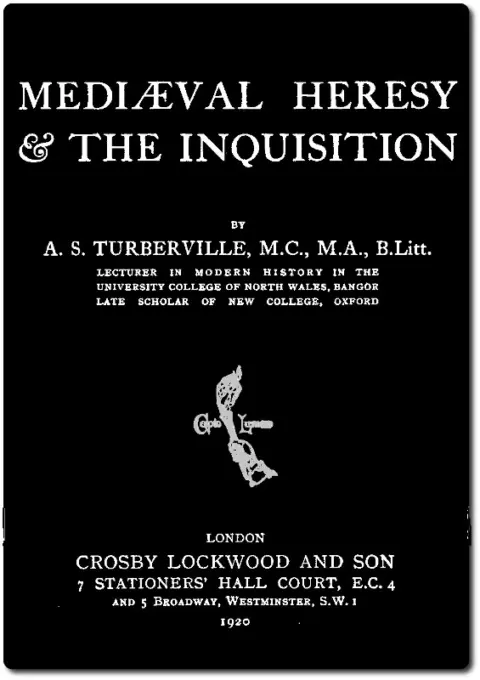
"Mediæval Heresy & the Inquisition" by Arthur Stanley Turberville is a historical account written in the early 20th century. The work explores the complex relationship between various heretical movements that emerged in the Middle Ages and the Church's response to them through the Inquisition. With a focus primarily on the origins of heresy and the nature of ecclesiastical power, it seeks to provide insight into the doctrinal conflicts and social conditions that fueled these movements. The opening of the book sets the stage by describing the historical context of the Middle Ages, establishing a nuanced perspective on what is often referred to as the "Ages of Faith." Turberville asserts that this title does not reflect the whole truth, as various heresies arose from psychological, social, and intellectual tensions within society. He delves into the concept of the "Civitas Dei," emphasizing the intertwined relationship of church and state, and addresses the roots of heresy stemming from clerical abuses and public dissatisfaction. By laying this groundwork, the author suggests that the Inquisition's emergence was a societal response to the perceived threats posed by heretical teachings, highlighting the complexities of faith and authority during this turbulent period.
Introduction adapted from the source catalogue; source summaries may be automatically generated.
Free to read · English · 89,610 words · No account needed
MAKE TIME FOR A GOOD BOOK
On by default. Untick to stop anonymous reading totals. Each page counts after 10 seconds in view. How this works.
Anonymous counting is on unless you have switched it off.
[393] On the question of the confessional, see De Cauzons, vol. ii, pp. 214-7; Douais, L’Inquisition, p. 279, in treatise ascribed to Raymond of Peñaforte; Lea, vol. i, p. 437 and note. For decree of Council of Tarragona, see Mansi, vol. xxiii, pp. 555-6. See also E. Martène and U. Durand, Thesaurus novus Anecdotorum (Paris, 1717), vol. v, p. 1802. Doctrina de Modo Procedendi contra Haereticos, the section Qualiter sacerdos debet inquirere in confessione de facto haeresis. ‘Item, injungitur sacerdotibus quod in poenitentiis diligenter inquirant de haereticis & Insabbatis, credentibus, & fautoribus eorumdem, & si quid invenerint, fideliter conscribant, & mox cum illo vel cum illis qui hoc confessi fuerint, episcopo, vel ejus vicario, quid super hoc invenerint manifestent. Si vero confessus noluerit consentire, ut quod dictum est reveletur episcopo vel ejus vicario, Ipse nihilominus sacerdos requirat consilium non specificando personam a peritis & Deum timentibus, qualiter sit ulterius procedendum.’
[394] Directorium, p. 480.
[395] See Tanon, p. 401.
[396] Mansi, vol. xxiii, p. 838.
[397] De Cauzons, vol. ii, p. 188.
[398] See Ludovico à Paramo, p. 550; Simancas in Zilettus, vol. xi, pt.
ii, pp. 138-40.
[399] See Douais, Documents, vol. ii, p. 136. ‘Arnaldus Pagesii, de Mossoleux, comparuit apud Carcassonam coram domino episcopo Carcassone; et requisitus si vult se deffendere de hiis qui in inquisitione inventa sunt contra eum, respondit quod nullus pro vero potest aliquid dicere de ipso. Requisitus si velit ea de scriptis recipere, dixit quod non; et aliter non vult se deffendere. Item, requisitus si habet inimicos, dixit quod sic, Ber. Gausbert et Martinum Montanerii, sed nullam legitimam causam inimicitiarum assignavit; et alios inimicos noluit nominare.’ Cf. ibid., p. 178. See also Lea, vol. i, pp. 578-9, appendix.
[400] Tanon, p. 402.
[401] Ibid., p. 362.
[402] Mansi, vol. xxiii, p. 573, § 23. ‘Teneatur praeterea Potestas, seu rector, omnes haereticos quos captos habuerit, cogere, citra membri diminutionem & mortis periculum, tanquam vere latrones & homicidas animarum, & fures sacramentorum Dei & fidei Christianae, errores suos expresse fateri, & accusare alios haereticos quos sciunt, & bona eorum, & credentes & receptatores, & defensores eorum, sicut coguntur fures & latrones bonorum temporalium accusare suos complices, & fateri maleficia quae fecerunt.’ Cf. David of Augsburg, quoted by Douais, L’Inquisition, pp. 171-2 note.
[403] By the time of the Spanish Inquisition of Ferdinand and Isabella torture had come to be accepted as a most praiseworthy and Christian institution. Cf. Simancas in Zilettus, vol. xi, pt. ii, p. 204.
[404] Potthast, Regesta Pontificum Romanorum (Berlin, 1874 et
seq.), No. 18057.
[405] Ibid., No. 18390.
[406] Tanon, p. 379.
[407] See supra, p. 161.
Your reading position is saved on this browser. Take it to another device with a library code. Reading pages adapt to text, rather than matching a printed edition.
BEHIND THE BOOK
This eBook is for the use of anyone anywhere in the United States and most other parts of the world at no cost and with almost no restrictions whatsoever. You may copy it, give it away or re-use it under the terms of the Project Gutenberg License included with this eBook or online at www.gutenberg.org. If you are not located in the United States, you will have to check the laws of the country where you are located before using this eBook. Read the source licence.
The original source file, including credits and licence, is retained by this library. Request an original-format copy at no charge. Please include the book title and Project Gutenberg identifier #46149.
KEEP YOUR CURIOSITY GOING
Cécile Tormay

Moritz Busch
John L. Ransom
Frances Wright
Cécile Tormay

Mabel Potter Daggett