THE CLASSIC COLLECTION✦An outlaw’s diary: the CommuneCLASSIC FREE BOOKS
An outlaw’s diary: the Commune
Cécile Tormay
THE CLASSIC COLLECTION · 1920
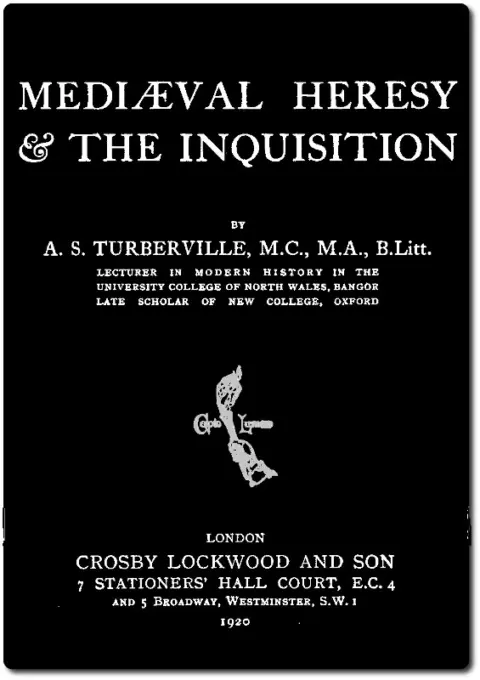
"Mediæval Heresy & the Inquisition" by Arthur Stanley Turberville is a historical account written in the early 20th century. The work explores the complex relationship between various heretical movements that emerged in the Middle Ages and the Church's response to them through the Inquisition. With a focus primarily on the origins of heresy and the nature of ecclesiastical power, it seeks to provide insight into the doctrinal conflicts and social conditions that fueled these movements. The opening of the book sets the stage by describing the historical context of the Middle Ages, establishing a nuanced perspective on what is often referred to as the "Ages of Faith." Turberville asserts that this title does not reflect the whole truth, as various heresies arose from psychological, social, and intellectual tensions within society. He delves into the concept of the "Civitas Dei," emphasizing the intertwined relationship of church and state, and addresses the roots of heresy stemming from clerical abuses and public dissatisfaction. By laying this groundwork, the author suggests that the Inquisition's emergence was a societal response to the perceived threats posed by heretical teachings, highlighting the complexities of faith and authority during this turbulent period.
Introduction adapted from the source catalogue; source summaries may be automatically generated.
Free to read · English · 89,610 words · No account needed
MAKE TIME FOR A GOOD BOOK
On by default. Untick to stop anonymous reading totals. Each page counts after 10 seconds in view. How this works.
Anonymous counting is on unless you have switched it off.
The principal works of Wycliffe are published by the Wyclif Society. See especially De Dominio Divino (ed. R. L. Poole, 1890); Tract. de Civili dominio liber primus (ed. R. L. Poole, 1885); De Eucharistia (1892); De Potestate Pape (ed. J. Loserth, 1907). See also Fasciculi Zizaniorum Magistri Johannis Wyclif (Rolls series, ed. W. W. Shirley, 1858). See also the Chronicon Angliae (ed. Maunde Thompson, 1874); Chronicon of Henry Knighton (ed. Lumby, 1895), vol. ii; D. Wilkins, Concilia M. Britanniae et Hiberniae (1737), vol. iii.
The Letters of Hus are edited by H. B. Workman and R. M. Pope (1904). Invaluable is F. Palacky’s Documenta Mag. Joannis Hus (Prague, 1869).
For the works of Gerson and D’Ailly see J. Gerson, Opera (Antwerp, 1706). Works of D’Ailly are included in this volume.
See also Theodoric de Niem, De Schismate (Leipzig, 1890).
The works of Marsiglio of Padua and of William of Ockham are in Melchior Goldast, Monarchia S. Romani Imperii (Hanover, Frankfort, 1611-14), vol. ii. They are summarized in S. Riezler, Die literarischen Widersacher der Päpste zur Zeit Ludwig des Baiers (1874).
See also the following relating to Bohemia or the Council of Constance:
Aeneas Sylvius, Historia Bohemica (1453).
Etienne Baluze, Vitae Paparum Avenionensium (Paris, 1693).
H. v. der Hardt, Magnum oecumenicum Constantiense Concilium
(Frankfort, 1697-1742).
E. Martène and V. Durand, Veterum Scriptorum et monumentorum amplissima collectio (Paris, 1724-33), vol. vii, pp. 425-1078.
The following also are useful:
N. Valois, La France et le Grand Schisme d’occident (Paris,
1896-1902).
J. B. Schwab, J. Gerson (Würzburg, 1858).
B. Labanca, Marsiglio da Padova (Padua, 1882).
H. B. Workman, The Dawn of the Reformation: the Age of Wyclif (1901); The Dawn of the Reformation: the Age of Hus (1902).
J. Lewis, History of the Life and Sufferings of John Wicliffe
(1720).
J. Loserth, Wyclif and Hus (tr. W. J. Evans, 1884).
G. M. Trevelyan, England in the Age of Wycliffe (1904).
G. V. Lechler, Wyclif and his English Precursors (tr. P. Lorimer,
1878).
R. L. Poole, Wyclif and Movements for Reform (1889); Illustrations of the History of Mediæval Thought (1884).
H. Rashdall, Article on Wycliffe in Dictionary of National
Biography (1900), vol. lxiii.
A. H. Wratislaw, Native Literature of Bohemia in the Fourteenth
Century (1878).
Count Lützow, The Life and Times of Master John Hus (1909).
H. Rashdall, Universities of Europe in the Middle Ages (1895),
vol. ii.
Also of course M. Creighton, History of the Papacy (1903-9),
Introd. and Books I and II.
Your reading position is saved on this browser. Take it to another device with a library code. Reading pages adapt to text, rather than matching a printed edition.
BEHIND THE BOOK
This eBook is for the use of anyone anywhere in the United States and most other parts of the world at no cost and with almost no restrictions whatsoever. You may copy it, give it away or re-use it under the terms of the Project Gutenberg License included with this eBook or online at www.gutenberg.org. If you are not located in the United States, you will have to check the laws of the country where you are located before using this eBook. Read the source licence.
The original source file, including credits and licence, is retained by this library. Request an original-format copy at no charge. Please include the book title and Project Gutenberg identifier #46149.
KEEP YOUR CURIOSITY GOING
Cécile Tormay

Moritz Busch
John L. Ransom
Frances Wright
Cécile Tormay

Mabel Potter Daggett