THE CLASSIC COLLECTION✦An outlaw’s diary: the CommuneCLASSIC FREE BOOKS
An outlaw’s diary: the Commune
Cécile Tormay
THE CLASSIC COLLECTION · 1920
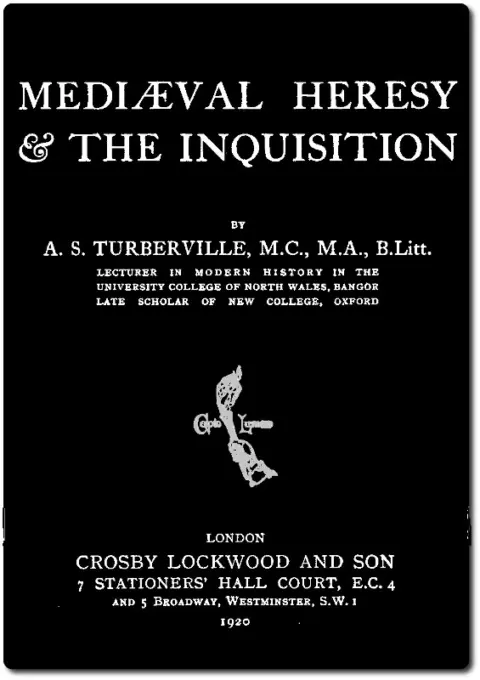
"Mediæval Heresy & the Inquisition" by Arthur Stanley Turberville is a historical account written in the early 20th century. The work explores the complex relationship between various heretical movements that emerged in the Middle Ages and the Church's response to them through the Inquisition. With a focus primarily on the origins of heresy and the nature of ecclesiastical power, it seeks to provide insight into the doctrinal conflicts and social conditions that fueled these movements. The opening of the book sets the stage by describing the historical context of the Middle Ages, establishing a nuanced perspective on what is often referred to as the "Ages of Faith." Turberville asserts that this title does not reflect the whole truth, as various heresies arose from psychological, social, and intellectual tensions within society. He delves into the concept of the "Civitas Dei," emphasizing the intertwined relationship of church and state, and addresses the roots of heresy stemming from clerical abuses and public dissatisfaction. By laying this groundwork, the author suggests that the Inquisition's emergence was a societal response to the perceived threats posed by heretical teachings, highlighting the complexities of faith and authority during this turbulent period.
Introduction adapted from the source catalogue; source summaries may be automatically generated.
Free to read · English · 89,610 words · No account needed
MAKE TIME FOR A GOOD BOOK
On by default. Untick to stop anonymous reading totals. Each page counts after 10 seconds in view. How this works.
Anonymous counting is on unless you have switched it off.
[424] Mansi, vol. xxiii, p. 693. ‘Cum peccatores sint ad poenitentiam invitandi juxta Dominicam vocem, gaudere oportet si poenitentiam impositam libenter suscipiunt et supportant. Quocirca statuimus, & in virtute sancti Spiritus inhibemus, ne poenitentibus, quibus cruces pro crimine haeresis imponuntur, irrisio ulla fiat, nec a locis propriis seu communibus commerciis excludantur, ne retardetur conversio peccatorum, & ne conversi propter scandalum abjecta poenitentia relabantur. Et si moniti desistere noluerint, per censuram ecclesiasticam compellantur.’ Cf. Bernard Gui, Practica, pp. 101-2.
[425] Eymeric, Directorium, pp. 702-4; Molinier, op. cit., pp. 23,
390.
[426] Practica, pp. 165, 169.
[427] Douais, Documents, vol. ii, pp. 213, 237.
[428] ‘Filios haereticorum, etiam natos ante crimen commissum, sub poenis, & prohibitionibus canonicis comprehendi.’ J. à Royas in Zilettus, vol. xi, pt. ii, p. 231.
[429] See Lea, vol. i, pp. 471-81.
[430] While in France the Inquisition took no official record of confiscation—it was automatically carried out by the State—in Italy the tribunal gave a formal declaratory sentence of confiscation. Zanchino, Tractatus de Haereticis, chs. xxiii, xxv, xxvi.
[431] See Lea, vol. i, pp. 520-1.
[432] Mansi, vol. xxiii, pp. 574-5.
[433] See Lea, vol. iii, p. 525. On whole question of confiscation, see also Tanon, op. cit., pp. 523-38.
[434] Lea, vol. i, p. 529. Lea was the first historian to go into the financial aspect of the Inquisition at all thoroughly. He devotes a whole chapter, book i, ch. xiii, to the subject of confiscation. ‘It was this,’ in his view, ‘which supplied the fuel which kept up the fires of zeal, and when it was lacking, the business of defending the faith languished lamentably.’
[435] Cf. Langlois, op. cit., p. 74.
[436] See De Cauzons, op. cit., vol. i, pp. 48-53. P. 53. ‘Ce n’est pas ambition ni cupidité: c’est instinct de préservation.’ But see Vacandard, op. cit., pp. 202-3. ‘But would the ecclesiastical and lay princes, who, in varying proportion, shared with the Holy Office in these confiscations, and who in some countries appropriated them all, have accorded to the Inquisition that continual good-will and help, which was the condition of its prosperity without what Lea calls “the stimulant of pillage”? We may well doubt it.’
[437] Directorium, pp. 709-22.
[438] See Douais, Documents, vol. ii, pp. 6, 7, 15, 18, 20, 23, 26, 29, 30, 34; Tanon, op. cit., p. 482; Vacandard, op. cit., p. 193. Eymeric imposed this penance on the violently suspect, Directorium, pp. 530-1.
[439] See Lea, vol. i, p. 487.
[440] See supra, p. 161; Molinier, op. cit., p. 449.
[441] See Lea, vol. i, p. 492.
[442] See provisions of the decrees of the Council of Toulouse (1229), in Mansi, vol. xxiii, p. 196; and of the Council of Albi (1244), ibid., p. 840.
[443] See Tanon, op. cit., p. 544.
Your reading position is saved on this browser. Take it to another device with a library code. Reading pages adapt to text, rather than matching a printed edition.
BEHIND THE BOOK
This eBook is for the use of anyone anywhere in the United States and most other parts of the world at no cost and with almost no restrictions whatsoever. You may copy it, give it away or re-use it under the terms of the Project Gutenberg License included with this eBook or online at www.gutenberg.org. If you are not located in the United States, you will have to check the laws of the country where you are located before using this eBook. Read the source licence.
The original source file, including credits and licence, is retained by this library. Request an original-format copy at no charge. Please include the book title and Project Gutenberg identifier #46149.
KEEP YOUR CURIOSITY GOING
Cécile Tormay

Moritz Busch
John L. Ransom
Frances Wright
Cécile Tormay

Mabel Potter Daggett