THE CLASSIC COLLECTION✦An outlaw’s diary: the CommuneCLASSIC FREE BOOKS
An outlaw’s diary: the Commune
Cécile Tormay
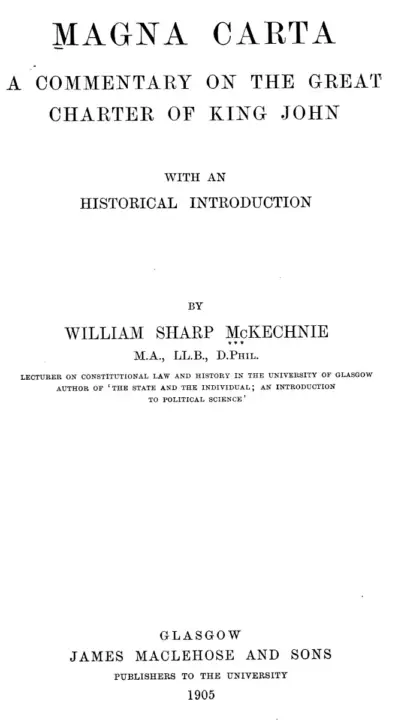
THE CLASSIC COLLECTION · 1905
"Magna Carta: A Commentary on the Great Charter of King John" by William Sharp McKechnie is a historical account written in the early 20th century. This work delves into the significance and implications of the Magna Carta, focusing on its historical context and its role in the development of constitutional freedoms in England. The book aims to provide a fresh commentary on this pivotal document, critiquing earlier interpretations and emphasizing its relevance to the struggles for liberty. The opening of the commentary highlights that no significant modern analysis of Magna Carta has been published until now, despite the profound impact of the Great Charter on English constitutional history. McKechnie discusses the motivations behind his work, emphasizing the necessity of examining the various grievances that led to its creation and outlining the events that unfolded in the lead-up to its signing. He argues that the Magna Carta is deserving of detailed study due to its complexities and the wealth of knowledge in contemporary scholarship, setting the stage for a thorough exploration of its chapters and clauses in the remaining text.
Introduction adapted from the source catalogue; source summaries may be automatically generated.
Free to read · English · 212,300 words · No account needed
MAKE TIME FOR A GOOD BOOK
On by default. Untick to stop anonymous reading totals. Each page counts after 10 seconds in view. How this works.
Anonymous counting is on unless you have switched it off.
Wendover (Roger of), 30, 35, 38, 43, 53, 123, 204, 205, 355 n., 550 n.,
561 n.
Wer, 335, 336, 340.
Wessex, supremacy of, 7, 17;
royal House of, 16, 113.
Westminster, 12, 111, 177, 310, 314, 316, 326, 333.
Whitby, Synod of, 7.
Widow’s rights, 243, 253-261, 273-4, 380, 384, 527.
Wills, 376-82.
William I., 7, 8-10, 12, 16, 21, 71, 83, 106, 115, 116, 191, 234, 507,
514;
difficulties and policy of, 8-10, 65;
local government under, 16, 18-19;
relations to Rome, 21-2;
his innovations, 105-6;
his title to English Crown, 9, 115.
William II., 10-11, 21, 71, 116, 239, 242, 249;
his relations to the church, 21, 238-9, 249.
William the Lion, King of Scots, 252, 538-41.
Witenagemot, 9, 18, 114, 219, 294.
Wites, 335, 336, 337 n.
Witnesses, 102.
Writ de odio et atia, 108, 161, 417-25.
Writ praecipe, 108-9, 405-13.
Writ of habeas corpus, 156, 421-2.
Writ ne exeat regno, 476-7.
Writs (royal), 14, 406, 417, 460.
Writ process, 14, 108, 406-9.
Transcriber’s Note
The entry for ‘3 Edward I. c. 41’ refers to ‘520 n.’ which appears in
‘527 n.’
The entry for ‘5 Henry IV. c. 14’ in the index of Statutes refers to ‘425 n.’ That note refers to ‘1 Henry IV. c. 14’, which is most likely correct. One summary of that Statute says that it “abolished appeals of treason in parliament, and sent the accuser to established courts of law.” (Lolme, The Constitution of England, 1839, p. 137.)
Coincidentally, a reference in the index entry for ‘Constables’ refers to ‘456 n.’ No note on that page mentions that topic. However, the ‘Court of the Constable and Marshal’ is mentioned in the same ‘425 n.’, which is not indexed to that topic. We suggest that the reference to 425 n. was intended.
Lapses in the punctuation of index and footnote entries have been regularized with no further mention.
Other errors deemed most likely to be the printer’s have been corrected, and are noted here. The references are to the page and line in the original. Those with a third number refer to the line within a footnote beginning on that page.
65.37 copyhold and leasehold[.] Restored. 83.118.4 go with the King an[d] serve him Restored. 149.23 whether conscious or uncon[s]cious Inserted. 219.328.1 a prisoner in Corfe Castle[.[ Added. 307.31 to those of Charles II[.] Added. 323.37 twelve local gentlem[e/a]n Replaced. 367.20 for each county by p[r]icking at random Removed. 386.3 he can have postpon[e]ment Inserted. 422.762.1 En[t]stehung der S[ch]wurgerichte Inserted. 425.14 I[n/t] was unfair that he should be Replaced. 435.793.1 En[t]stehung der Schwurgerichte Inserted. 440.809.1 See Placitorum Abbrev[i]atio Inserted. 483.33 these high[ ]places of royal prerogative Inserted. 488.914.3 to speak of "agisting a wood,[”] Added. 490.35 exercised functions anal[a/o]gous to those Replaced. 537.11 to be otherwise acc[c]ording Removed. 540.1052.4 virtually her fellow-[p]risoners Restored. 547.41 the said five-and[-]twenty barons Restored. 577.37 manu nostra saisita[ saisita] fuerint Removed. 588.33 sumagio aliquod chim[u/i]nagium capiatur Replaced. 588.38 detur chiminagium for[i/e]stariis nostris Replaced. 601.18 influence o[n/f] church on Charter Replaced.
Your reading position is saved on this browser. Take it to another device with a library code. Reading pages adapt to text, rather than matching a printed edition.
BEHIND THE BOOK
This eBook is for the use of anyone anywhere in the United States and most other parts of the world at no cost and with almost no restrictions whatsoever. You may copy it, give it away or re-use it under the terms of the Project Gutenberg License included with this eBook or online at www.gutenberg.org. If you are not located in the United States, you will have to check the laws of the country where you are located before using this eBook. Read the source licence.
The original source file, including credits and licence, is retained by this library. Request an original-format copy at no charge. Please include the book title and Project Gutenberg identifier #65363.
KEEP YOUR CURIOSITY GOING
Cécile Tormay

Moritz Busch
John L. Ransom
Frances Wright
Cécile Tormay

Mabel Potter Daggett