THE CLASSIC COLLECTION✦An outlaw’s diary: the CommuneCLASSIC FREE BOOKS
An outlaw’s diary: the Commune
Cécile Tormay
THE CLASSIC COLLECTION · 1905
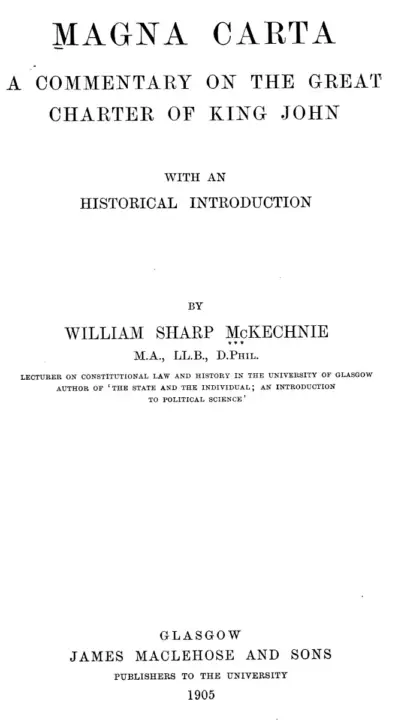
"Magna Carta: A Commentary on the Great Charter of King John" by William Sharp McKechnie is a historical account written in the early 20th century. This work delves into the significance and implications of the Magna Carta, focusing on its historical context and its role in the development of constitutional freedoms in England. The book aims to provide a fresh commentary on this pivotal document, critiquing earlier interpretations and emphasizing its relevance to the struggles for liberty. The opening of the commentary highlights that no significant modern analysis of Magna Carta has been published until now, despite the profound impact of the Great Charter on English constitutional history. McKechnie discusses the motivations behind his work, emphasizing the necessity of examining the various grievances that led to its creation and outlining the events that unfolded in the lead-up to its signing. He argues that the Magna Carta is deserving of detailed study due to its complexities and the wealth of knowledge in contemporary scholarship, setting the stage for a thorough exploration of its chapters and clauses in the remaining text.
Introduction adapted from the source catalogue; source summaries may be automatically generated.
Free to read · English · 212,300 words · No account needed
MAKE TIME FOR A GOOD BOOK
On by default. Untick to stop anonymous reading totals. Each page counts after 10 seconds in view. How this works.
Anonymous counting is on unless you have switched it off.
Footnote 1094:
The text is founded on that of the Statutes of the Realm, I. 1; but has been also collated with the admirable text prepared by M. Bémont, Chartes, 1–6, whose emendations have been freely used not only for this Charter, but for all those which follow in this Appendix. M. Bémont gives an exhaustive account of the copies of the lost original of Henry’s charter.
Anno incarnationis dominice M.CI. Henricus, filius Willelmi regis, post obitum fratris sui Willelmi Dei gratia rex Anglorum, omnibus fidelibus salutem.
1. Sciatis me Dei misericordia et communi consilio baronum totius regni Anglie, ejusdem regem coronatum esse. Et, quia regnum oppressum erat injustis exactionibus, ego, Dei respectu et amore quem erga vos habeo, sanctam Dei ecclesiam inprimis liberam facio, ita quod nec vendam, nec ad firmam ponam, nec mortuo archiepiscopo, sive episcopo, sive abbate, aliquid accipiam de dominico ecclesie vel de hominibus ejus, donec successor in eam ingrediatur. Et omnes malas consuetudines, quibus regnum Anglie injuste opprimebatur, inde aufero; quas malas consuetudines ex parte hic pono:
2. Si quis baronum, comitum meorum, sive aliorum qui de me tenent, mortuus fuerit, heres suus non redimet terram suam sicut faciebat tempore fratris mei, sed justa et legitima relevatione relevabit eam. Similiter et homines baronum meorum justa et legitima relevatione relevabunt terras suas de dominis suis.
3. Et si quis baronum vel aliorum hominum meorum filiam suam nuptum tradere voluerit, sive sororem, sive neptim, sive cognatam, mecum inde loquatur; sed neque ego aliquid de suo pro hac licentia accipiam, neque defendam ei quin eam det, excepto si eam vellet jungere inimico meo. Et si, mortuo barone sive alio homine meo, filia heres remanserit, illam dabo consilio baronum meorum cum terra sua. Et si, mortuo viro, uxor ejus remanserit et sine liberis fuerit, dotem suam et maritationem habebit; et eam non dabo marito, nisi secundum velle suum.
4. Si vero uxor cum liberis remanserit, dotem quidem et maritationem habebit dum corpus suum legitime servaverit, et eam non dabo, nisi secundum velle suum; et terre et liberorum custos erit sive uxor, sive alius propinquarius qui justius esse debeat. Et precipio quod barones mei similiter se contineant erga filios vel filias et uxores hominum suorum.
5. Monetagium commune, quod capiebatur per civitates et comitatus, quod non fuit tempore regis Edwardi, hoc ne amodo sit omnino defendo. Si quis captus fuerit, sive monetarius, sive alius, cum falsa moneta, justicia recta inde fiat.
6. Omnia placita et omnia debita que fratri meo debebantur condono, exceptis rectis firmis meis, et exceptis illis que pacta erant pro aliorum hereditatibus, vel pro eis rebus que justius aliis contingebant. Et si quis pro hereditate sua aliquid pepigerat, illud condono, et omnes relevationes que pro rectis hereditatibus pacte fuerant.
Your reading position is saved on this browser. Take it to another device with a library code. Reading pages adapt to text, rather than matching a printed edition.
BEHIND THE BOOK
This eBook is for the use of anyone anywhere in the United States and most other parts of the world at no cost and with almost no restrictions whatsoever. You may copy it, give it away or re-use it under the terms of the Project Gutenberg License included with this eBook or online at www.gutenberg.org. If you are not located in the United States, you will have to check the laws of the country where you are located before using this eBook. Read the source licence.
The original source file, including credits and licence, is retained by this library. Request an original-format copy at no charge. Please include the book title and Project Gutenberg identifier #65363.
KEEP YOUR CURIOSITY GOING
Cécile Tormay

Moritz Busch
John L. Ransom
Frances Wright
Cécile Tormay

Mabel Potter Daggett